Choosing a wireless handheld scanner involves weighing battery life, durability, connectivity, and compatibility. The following selections are among the top options for Americans seeking reliable cordless scanning in retail, warehouses, libraries, or mobile workflows. This guide compares five models from reputable brands, highlighting what each brings to everyday scanning tasks.
| Product | Brand | Connectivity | Battery | Key Strength |
|---|---|---|---|---|
| Tera D5100 | Tera | Wireless/Wired | 2200mAh | Ergonomic grip and rugged design |
| Tera HW0009 Pro | Tera | 2.4G/USB Wireless | 2500mAh | Screen setting capabilities |
| Tera 2-in-1 Scannner | Tera | 2.4G + USB | Battery unspecified | 2-in-1 wireless and USB |
| NT-1228BC | NETUM | Bluetooth/Wireless/USB | Rechargeable battery | Broad compatibility |
| Rabitpos | Rabitpos | Wireless/USB | 2000mAh | Long battery life for heavy use |
Tera D5100 Wireless Handheld Scanner

The Tera D5100 combines cordless operation with a battery indicator and a robust 2200mAh capacity, supporting longer continuous use and extended standby time. ergonomic design emphasizes comfort during prolonged scanning sessions, including a curved, extended handle and a smooth trigger for reliable grip. It ships with essential accessories — scanner, USB cable, dongle, and user manual — and includes an anti-shock silicone cover to mitigate scratches from drops up to 6.56 feet. IP54 protection adds dust resistance, making this model well-suited for busy retail and light industrial settings. These features collectively support a steady workflow for inventory checks, shelf replenishment, and receipts processing without constant recharging. Its combination of wireless flexibility and a durable build is especially beneficial for users who move around a store floor or warehouse aisles.
Pros highlight easy plug-and-play setup, strong battery life, and a protective shell that helps reduce maintenance concerns. Potential considerations include ensuring compatibility with your existing POS or inventory software and verifying connector options for your computer or tablet. The D5100’s rugged design makes it a strong pick for environments where accidental impacts are common, while the sizable battery minimizes downtime between charges.
Tera HW0009 Pro: Screen-Setting Barcode Scanner

The HW0009 Pro features a dedicated screen setting that enables language selection, volume control, and display preferences, plus the ability to view stored and total barcodes. Its scanning performance covers ordinary 1D/2D formats and challenging codes like PDF417 found on driver licenses, with reliable decoding in various conditions, including underwater or on reflective materials. A charging cradle and a large 2500mAh battery afford all-day operation with convenient recharging when not in use. This model is designed for users who require flexible configuration and robust scanning in dynamic environments such as retail checkouts, fieldwork, or event management. The combination of a programmable interface and high-capacity power source supports persistent scanning across shifts with minimal downtime.
Considerations include ensuring the cradle is compatible with your workstation and confirming the device’s software supports required barcode symbologies for your application. The HW0009 Pro is well-suited for users who value customization and high-density scanning capability in addition to wireless freedom.
Tera 2-in-1 Wireless Scanner

This versatile model offers a 2.4GHz wireless option alongside USB wired connectivity, combining flexibility with straightforward operation. A battery level indicator helps users monitor power status to reduce unexpected shutdowns during peak workflows. The extended and widened curved handle, combined with a smooth trigger, aims for comfortable prolonged scanning. Anti-shock silicone protection helps guard the device during frequent handling, and IP54 protection provides dust resistance. The 2-in-1 design is ideal for work scenarios requiring quick toggling between wireless handheld use and wired connections, such as stocktaking, library checks, or mobile point-of-sale tasks. The balance between portability and durability makes it a practical choice for mixed-use environments.
Potential considerations include evaluating how well the device interfaces with your POS or inventory software and whether you need additional accessories such as extra batteries or a dedicated cradle. The model is a solid option for users seeking versatility without sacrificing reliability in daily barcode reading tasks.
NT-1228BC NETUM Bluetooth Barcode Scanner
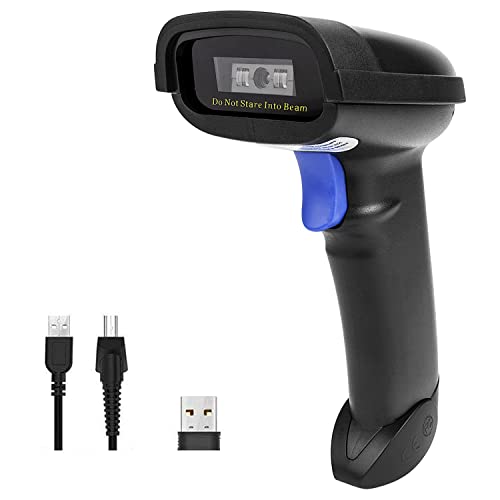
This NETUM model emphasizes broad compatibility and flexible connectivity, including Bluetooth, 2.4G wireless, and wired USB options. It supports HID, SPP, and BLE modes, and works across Windows, Mac, Android, iOS, Linux, and more, making it suitable for mixed-device ecosystems. It uses a high-resolution 2500-pixel CCD sensor for fast 1D and stacked barcode reading, including scans from screens or glass surfaces. In addition, it offers storage mode to capture up to 100,000 barcodes when out of range, which is useful for inventory counts or fieldwork where connectivity is intermittent. The NT-1228BC is designed for versatility in offices, retail stores, and small warehouses where multi-device compatibility matters.
Users should consider the setup complexity and whether their preferred software supports the scanner’s operating modes. For teams that require seamless cross-platform usage, this NETUM option provides robust support and a broad feature set in a compact package.
Rabitpos Wireless 1D/2D QR Scanner

The Rabitpos model combines 1D and 2D code reading with a sizable 2000mAh battery designed for long shifts in mobile payment scenarios, convenience stores, and warehouse work. It supports wireless operation and USB, offering versatility for various workflows. The device emphasizes stability and rapid scanning across common barcode formats, ensuring dependable performance in real-time transactions or inventory checks. Its portability makes it suitable for point-of-sale desks, stockrooms, and mobile carts, enabling quick scans without tethering to a computer or workstation.
When evaluating this option, consider your need for continuous scanning versus occasional barcode reads, as well as the compatibility with your payment processing or inventory software. The Rabitpos scanner presents a balanced mix of battery life, compatibility, and ease of use for daily scanning tasks in retail and logistics environments.
Buying Guide: Key Purchase Considerations
Battery life and charging options are critical for roles with long shifts or high scanning volumes. Look for large-capacity batteries and convenient charging docks or USB charging as part of your workflow. Consider the expected duty cycle and whether you need all-day operation without frequent recharging.
Connectivity flexibility matters in dynamic environments. 2.4G wireless, Bluetooth, and USB wired options enable you to adapt to different devices and workspaces. For team environments with multiple devices, storage modes and cross-platform compatibility can save setup time and reduce compatibility issues.
Ergonomics and durability affect user comfort and tool longevity. An extended curved handle, a smooth trigger, and protective shells or IP ratings help withstand daily use and occasional drops. If your workspace includes dust, moisture, or occasional splashes, an IP-rated device can offer added resilience.
Barcode coverage should align with your needs. Most business scanners read common 1D codes, with many models handling 2D formats like QR, Data Matrix, and PDF417. If you frequently read driver licenses or dense codes, ensure the device supports high-density scans and 2D formats with reliable decoding on challenging surfaces.
Software and ecosystem compatibility influence how smoothly the device integrates with existing POS, inventory, or ERP systems. Check for HID compatibility for plug-and-play use, as well as any vendor-provided software for managing settings, storage, and barcode formats. Storage capacity, recovery options, and data transfer modes (instant vs. offline) are practical details for busy operations.
Price versus value is a practical lens for business purchasing. While the upfront cost matters, ongoing maintenance, battery life, and durability determine total cost of ownership over time. A slightly higher upfront cost may yield significant savings through reduced downtime and greater reliability.