Finding the right wireless guitar system or patch cables can dramatically improve practice sessions, gigs, and studio setups. This article highlights five top options designed for American players seeking reliable wireless transmission or sturdy patch cables that minimize noise and maximize signal clarity. Each pick is evaluated on range, latency, battery life, and build quality to help you choose a solution that fits your gear and playing style.
Summary of chosen products
| Product | Brand | Key Benefit | Transmission Type |
|---|---|---|---|
| INGPARTNER 2.4GHz Wireless Guitar System | INGPARTNER | Uncompressed, long-range wireless with quick plug-and-play | Wireless |
| Getaria GWS-8 Wireless Guitar System | Getaria | Rotatable 1/4″ plug for various instrument positions | Wireless |
| LEKATO Wireless Guitar System 5.8 | LEKATO | Higher anti-interference frequency with solid range | Wireless |
| FW2D Wireless Guitar System | flatsons | Low latency, silent plug, noise-free switching | Wireless |
| Ruxely Patch Cables 6-Inch 3-Pack | RUXELY | Durable, braided cables with robust plugs | Wired Patch Cables |
The following sections dive into each product, offering a concise overview of features and how they suit different playing situations—from home practice to live performance and studio setups. The selection balances true wireless systems with high-quality patch cables to cover both wireless transmission and reliable instrument connections.
INGPARTNER 2.4GHz Wireless Guitar System

The INGPARTNER system aims for straightforward operation with plug-and-play pairing. Transmitter and receiver connect automatically once powered on, reducing setup time between songs or practice sessions. Visual indicators help monitor charging status and guitar type, with distinct lights for charging, acoustic guitar, and electric guitar. The package emphasizes a 2.4GHz wireless link, delivering over 30 meters (approximately 100 feet) of range with low noise and low latency, improving freedom on stage or in rehearsal rooms. Built-in rechargeable batteries and a dual USB charging setup streamline recharging mid-session.
Performance notes indicate a fast, uncomplicated experience suitable for players who want minimal configuration. The absence of wires can simplify stage layouts and reduce trip hazards. However, users should note the importance of using a 5V charger to avoid battery damage, as improper charging can negatively affect longevity. Latency below 4ms supports real-time playing without noticeable delay, which is beneficial for guitarists sensitive to timing.
Getaria GWS-8 Wireless Guitar System

Getaria’s GWS-8 system focuses on broad compatibility and a user-friendly pairing process, suitable for guitars, basses, and other electronic instruments. A notable feature is the 280° rotatable 1/4″ plug, which accommodates inputs in different positions, helpful for players with varied guitar body designs or pedalboard layouts. The system supports multiple devices (up to six) working in parallel with a one-to-one pairing approach, reducing interference and cross-talk during multi-instrument setups in rehearsals or small gigs. Fast, simple plug-and-play pairing means players can start playing within seconds.
Performance considerations include reliable transmission with minimal interference in typical performance environments. The rotatable plug design helps preserve cable management and reduces physical strain on the connector. While the article does not specify exact latency figures, the emphasis on stability and ease of use makes this a strong choice for players prioritizing plug-and-play reliability in live or studio settings.
LEKATO Wireless Guitar System 5.8
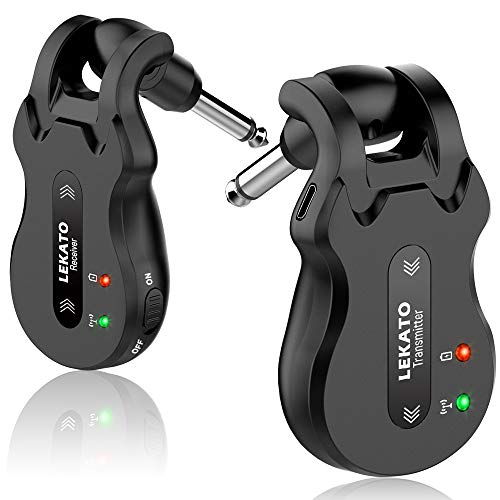
LEKATO’s system operates on the 5.8 GHz band, marketed as offering stronger anti-interference capabilities than some 2.4 GHz options. It emphasizes clear signal transmission with 24-bit/48 kHz audio quality and a latency of less than 6 ms, which helps preserve the natural feel of playing and reduces timing mismatches. A built-in rechargeable battery supports up to several hours of use, depending on usage, and a dual USB cable helps keep gear charged between sessions, which is particularly convenient for performers who travel with limited power outlets.
For players with crowded wireless environments or busy stage setups, the higher-frequency choice can reduce interference from other wireless devices. The system’s compatibility with electric guitars, basses, and related instruments makes it a versatile option, though some users may trade off a shorter battery life in exchange for improved signal stability in certain environments. Overall, LEKATO provides a robust option for those seeking more stable wireless operation and reliable performance on stage or in the studio.
FW2D Wireless Guitar System

FW2D emphasizes dynamic interference blocking with intelligent frequency modulation to maintain a stable connection even in crowded signal environments. It offers a practical wireless range up to about 98 feet, which suits most stage and rehearsal settings. The kit highlights a low latency of around 5 milliseconds to preserve real-time performance, while a patented silent plug design minimizes pops and buzzes when plugging or unplugging, enabling quiet instrument changes during performances. The system is designed for acoustic-electric guitars, basses, ukuleles, and other instruments, providing flexibility for diverse players.
These features collectively target professional use, offering high-fidelity audio with reduced noise. The combination of interference management, silent switching, and broad compatibility makes FW2D a competitive option for performers and studios seeking dependable wireless operation with thoughtful design elements that reduce common on-stage audio issues.
Ruxely Patch Cables 6-Inch 3-Pack

Ruxely offers compact 6-inch patch cables designed for pedalboards and instrument connections. The patch cables feature nylon braided construction with gold-plated TS plugs for corrosion resistance and reliable signal conduction. The design emphasizes durability with a double-braided jacket and an aluminum-alloy housing that helps withstand daily use in live rigs or studio environments. The 6-inch length is particularly useful for tight pedalboard layouts, allowing clean, space-efficient connections between pedals, amps, or mixers. The brand highlights resistance to twists and kinking, contributing to long-term reliability.
The Ruxely cables focus on a balance of affordability and durability, making them suitable for players upgrading an existing pedalboard or building a new setup without overspending. The emphasis on robust materials, shielding, and high-conductivity copper wires helps maintain signal integrity across multiple devices. While not wireless, dependable patch cables are a critical complement to any wireless system, ensuring that your instrument-to-amp or pedalboard chain remains clear and consistent.
Buying Guide: Key Purchase Considerations And Comparisons
When choosing wireless guitar systems or patch cables, consider the following factors to match your needs with the right product:
- Range and environment: For large stages or rehearsal spaces, prioritize systems advertising 100 feet or more of range and low latency. Indoor environments with metal structures may still experience interference, so a model with adaptive frequency management can help.
- Latency: Low latency (a few milliseconds) is essential for precise timing. Wireless options generally offer under 10 ms; those marketed around 4–6 ms are suitable for most players, especially in live settings.
- Interference handling: Look for 2.4 GHz systems with robust modulation and interference avoidance. Higher-frequency systems (such as 5.8 GHz) may offer less congestion but could have compatibility considerations with older gear.
- Battery life and charging: Rechargeable batteries with clear charging indicators and convenient dual-charge methods are valuable for gig hours or long practice sessions.
- Build quality and durability: For pedalboards, patch cables with braided jackets, gold-plated plugs, and rigid connectors resist wear from frequent plugging and unplugging.
- Compatibility: Ensure the wireless system supports your instrument type (electric guitar, bass, acoustic-electric) and that patch cables fit your plug spacing and pedalboard layout.
- Ease of use: Quick pairing, plug-and-play setup, and silent switching features reduce on-stage disruptions and help maintain performance flow.
Comparative takeaways:
- Best for plug-and-play: INGPARTNER offers straightforward pairing and clear indicator lights, ideal for users who want fast setup with minimal fiddling.
- Best for versatile input positions: Getaria’s rotatable plug design helps accommodate different guitar body shapes and input placements.
- Best for high-frequency stability: LEKATO’s 5.8 GHz system targets stronger anti-interference performance in busy environments.
- Best for live switching and quiet operation: FW2D includes silent plug technology and robust interference management for professional performances.
- Best budget patch cables: Ruxely patches provide durable, space-saving connections for pedalboards without overspending.
</ul}
For players who rely on a consistent signal chain, combining a dependable wireless system with high-quality patch cables creates a stable, flexible setup. Consider the type of venue, gear, and personal preferences when selecting your configuration. The products listed above offer varied approaches to wireless transmission and wired reliability, enabling you to tailor a rig that fits practice, rehearsal, and performance needs.