Discover reliable wireless emergency response systems designed to keep loved ones safe and caregivers in the loop. This guide highlights five top options, covering long-range coverage, audible alerts, and easy setup. Whether for home use, clinics, or nursing facilities, these systems help ensure help is never far away. Below you’ll find product highlights, what to consider when buying, and a quick comparison to aid your decision.
| Product | Brand | Key Benefit | Typical Range |
|---|---|---|---|
| CallToU Wireless Caregiver Pager System | CallToU | Two receivers for flexible monitoring | 500+ feet |
| Greetmed Wireless Caregiver Pager Dual Receiver | Greetmed | Long-range, 38 melodies, AB button support | ≥1000 feet |
| PILSAMAS WiFi Caregiver System | PILSAMAS | No monthly fees, cloud/app alerts | ~328 feet |
| SavvyMate Nurse Call System | SavvyMate | Clear visual/voice alerts, up to 1000 feet | Up to 1000 feet |
| SanJie Wireless Emergency Call Button System | SanJie | LED display, 38 ring tones | 500 feet |
CallToU Wireless Caregiver Pager System
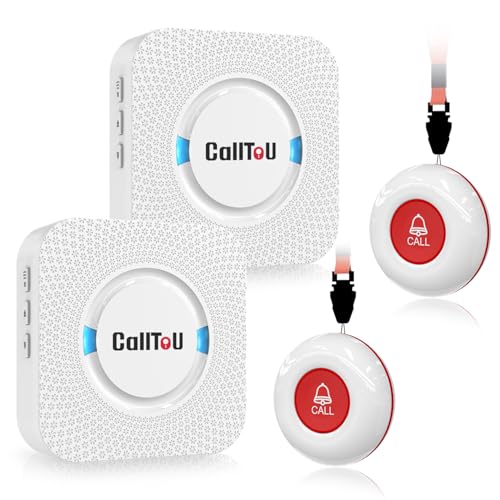
The CallToU system includes two receivers and two call buttons, enabling caregivers and residents to move freely while ensuring help is readily available. The open-area range exceeds 500 feet, making it suitable for multiple rooms or spaces such as bedrooms, kitchens, and living areas. The pendant-style call button can be worn around the neck or mounted with a bracket or sticker. The receiver supports 55 ringing tones and five volume levels (0 dB to 110 dB) for customizable alerts, and it plugs directly into an electrical outlet for quick setup.
Greetmed Wireless Caregiver Pager Dual Receiver

Greetmed offers a robust monitoring solution with two receivers and two transmitters, supporting AB button functionality that assigns 38 melodies to each transmitter. This allows distinct alerts for different caregivers or zones. With up to 1000 feet of wireless range in open areas and 165 feet indoors, this system is designed for multi-room homes or facilities. It runs on standard AC power, while transmitters use long-life batteries to minimize maintenance. The audible alerts reach at least 70 dB, helping ensure alerts are heard even in busy environments.
PILSAMAS WiFi Caregiver System

This PILSAMAS system uses a hub that connects to 2.4G Wi-Fi, enabling app-based alerts globally. It supports 18 tones across four volume levels and lets you name buttons, share alerts with family, and view alert history. The setup claims lifetime free updates with no subscription, with optional SMS/call/email plans. It includes two IP65 waterproof lanyard buttons and a wall-mounted pull cord, providing flexible use for bathrooms, bedsides, and mobility, with a 328-foot range through walls.
SavvyMate Nurse Call System

SavvyMate emphasizes clarity with a display-based alert system that shows the exact call button number, paired with voice announcements for rapid identification. Coverage reaches up to 1000 feet in open spaces, including multi-floor layouts, making it suitable for large residences or facilities. It supports repeat alerts and offers customizable tones with 15 volume levels, enabling tailored notification for busy environments and diverse hearing needs.
SanJie Wireless Emergency Call Button System

SanJie offers a straightforward setup with a 500-foot range and a LED display for quick area identification. It supports 38 ringtones and five volume levels, enabling customization to suit different environments. The system is designed for homes, hospitals, and clinics, with easy button placement on walls or mobility aids. This option emphasizes reliable alerts and user-friendly identification of who needs help.
Buying Guide
Key considerations when choosing a wireless emergency response system include range, scalability, and alert clarity. Long-range systems (1000 feet or more) are better for multi-room homes or facilities, while smaller spaces may benefit from compact kits. AB button support and customizable melodies help differentiate alerts for multiple caregivers or zones. Consider whether you prefer battery-powered transmitters or plug-in receivers, as well as whether a hub with app integration or cloud-based alerts better fits your needs. Waterproof buttons can improve reliability in bathrooms, and visible LED displays or audio announcements aid recognition in loud environments. Finally, evaluate whether a system offers no monthly fees or has optional plans that fit your budget and usage pattern.
- Assess who will use the system and required accessibility features (visual and audible cues).
- Check compatibility with existing devices or home networks (Wi-Fi, power outlets).
- Consider installation complexity and whether expansion is needed in the future.
- Review maintenance needs, battery life, and replacement parts.
- Compare warranty terms and customer support options.