For winemakers and home brewers, accurately measuring sugar content and alcohol potential is essential. This guide highlights five reliable refractometers and alcohol testers that cover wine, spirits, and general fermentation needs. Each product offers clear readings, ATC support, and practical usage in field or lab settings. Read on to compare features and choose the right instrument for your process.
| Product | Brand | Range / Scale | ATC |
|---|---|---|---|
| Wine Refractometer, ATC 0-40% Brix & 0-25% Alcohol | V·RESOURCING | Brix 0-40%, Alcohol 0-25% Vol | Yes |
| Agriculture Solutions Alcohol Refractometer | Agriculture Solutions | 0-80% V/V | Yes |
| Handheld Alcohol Refractometer 0-80% | V·RESOURCING | 0-80% V/V | Yes |
| Buhobha ATC Dual Scale Refractometer | Buhobha | SG 1.000-1.130, Brix 0-32% | Yes |
| Refractometer For Grape Wine Brewing | aichose | Brix 0-40%, Alcohol 0-25% | No |
The following sections present five selected products. Each entry includes a concise overview, key features, and practical notes for use in home winemaking, beer brewing, and general alcohol testing.
V‑RESOURCING Wine Refractometer

The V-RESOURCING Winemaking Refractometer provides dual-scale readings for Brix and wine alcohol. It tests original grape juice to determine sugar content and estimates the resulting alcohol by volume after fermentation. The device includes automatic temperature compensation (ATC) within 10°C to 30°C, maintaining accuracy across typical work conditions. Users simply place 2–3 drops on the prism and read Brix and alcohol directly through the eyepiece, eliminating separate measurements or conversions.
Key features:
– Dual-scale: Brix 0-40% and Alcohol 0-25% Vol
– Automatic temperature compensation (ATC)
– Straightforward operation with no test jars or extra calculations
– Suitable for fieldwork and laboratory settings
– Compact handheld design for portability
Agriculture Solutions Alcohol Refractometer

Designed for measuring Spirit Alcohol Volume Percent, this refractometer is well-suited for brandy, whisky, vodka, and related spirits. It is a portable optical instrument intended for bartenders, alcohol retailers, and food producers. The scale runs from 0 to 80% V/V, with 1% V/V increments, enabling quick, direct readings of alcohol content in the tested sample. It is not recommended for samples with high sugar content or complex ingredients such as wines that contain multiple components.
V‑RESOURCING Handheld Alcohol Refractometer

This handheld tool measures the density of alcohol in solutions such as whiskey, brandy, vodka, and tequila. It covers 0–80% V/V and uses a blue-white sharp dividing line to promote accurate readings. Usage is straightforward: place 2–3 drops on the prism and read the alcohol density through the eyepiece. The device is designed for quick checks in bars, laboratories, or fieldworks, making it versatile for both professionals and hobbyists.
Buhobha ATC Dual-Scale Refractometer

The Buhobha refractometer combines dual scales with automatic temperature compensation (ATC) for precise wine and beer measurements. The device features 1.000–1.130 SG and 0–32% Brix, enabling concurrent readings for specific gravity and sugar content. ATC (10°C–30°C) minimizes manual calibration, supporting consistent results in diverse environments. Calibrations are straightforward with distilled water, and readings are designed to meet lab-grade expectations for brewing and agricultural testing. It targets home brewers, farmers, and researchers seeking reliable multi-parameter results.
Refractometer For Grape Wine Brewing

This refractometer specializes in testing the sugar content of grapes to predict the wine’s potential alcohol degree. The 0–40% Brix range is broad enough for grape juice and other liquids, enabling quick screening for ideal grapes suitable for winemaking. It serves as a practical tool for vintners to streamline grape selection and fermentation planning, with a straightforward two-step usage process similar to other handheld refractometers.
Tiaoyeer Brix Refractometer with ATC
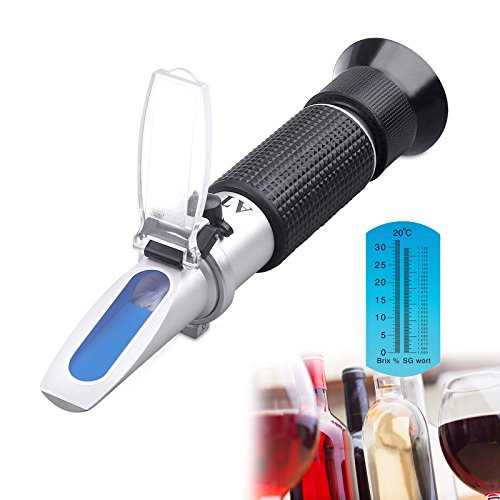
The Tiaoyeer Brix refractometer provides ATC to compensate automatically for temperature variation (10°C–30°C). It features dual scales: Brix 0–32% and Specific Gravity 1.000–1.130, delivering reliable results for sugar and wort measurements in beer and wine production. The device emphasizes ease of use with a small sample, requiring only a few drops, and facilitates fast, accurate readings when testing various fruit juices, wines, or melons. It is suitable for hobbyists and small-scale producers seeking efficient sugar analysis.
Buying Guide: Key Purchase Considerations And Comparisons
Choosing the right wine refractometer or alcohol tester depends on your production goals, sample types, and environment. Consider the following factors to align your choice with expected use and accuracy needs.
- Measurement range and scales: If you need both sugar content and alcohol potential for wine, prioritize dual-scale devices that offer Brix and alcohol percentage. For spirit-focused testing, a higher alcohol range (0–80% V/V) is advantageous.
- ATC (Automatic Temperature Compensation): ATC improves accuracy when temperatures vary. This is essential for field work or outdoor winemaking where ambient temperatures fluctuate.
- Sample type and sugar content: Wines often contain sugars and other components that can affect readings. Devices explicitly designed for wine or grape juice are typically better suited than generic alcohol testers.
- Ease of use and calibration: Look for devices that require minimal setup and offer straightforward calibration using distilled water. A clear eyepiece, readable scales, and a compact form factor enhance daily use.
- Durability and portability: Handheld refractometers are ideal for on-site testing, while lab-grade instruments may prioritize precision over portability. Consider your workspace and travel needs.
- Price and availability: While not a price guide, evaluate values based on features like dual scales, ATC, and the range of measurements offered. Compatibility with existing lab gear can also influence long-term cost efficiency.
- Maintenance: Proper cleaning after testing sugar-rich liquids reduces contamination. Some refractometers include calibration instructions or simple cleaning steps that help sustain accuracy over time.
In summary, for home winemaking and small-batch brewing, instruments combining Brix and alcohol readings with ATC tend to provide the most versatile and reliable results. For spirits-only applications, high alcohol-range testers can speed up checks, while dual-scale devices shine in grape juice testing and early fermentation monitoring. Always verify that readings align with your workflow, whether you’re screening grape varieties, tracking sugar depletion during fermentation, or estimating final alcohol content.