The right wind speed and temperature meter helps professionals and enthusiasts measure air flow, wind speed, wind temperature, and related conditions with reliability. This guide highlights five capable devices that cover common needs—from HVAC testing and drone flying to outdoor sports and meteorology. Each product section includes key features, making it easier to compare performance, usability, and compatibility for your specific tasks.
| Product | Brand | Key Use | Notable Features |
|---|---|---|---|
| BTMETER BT-100 Handheld | BTMETER | HVAC, drone flight prep, field work | Wind speed and wind temp, CFM calculation, tripod mount |
| HoldPeak 866B | H HOLDPEAK | Real-time wind monitoring, photography, sailing | Backlit display, Max/Min/Average, tripod hole |
| Clatoon Anemometer | Clatoon | Outdoor activities, HVAC testing | Six measurement units, wind temperature, wind chill |
| TopTes TS-301 | TOPTES | Sailing, drone flying, HVAC checks | 2.26″ backlit LCD, six units, wind humidity and temperature |
| BTMETER BT-100APP | BTMETER | Wireless readings, field applications | Wireless Bluetooth, wind speed, wind temp, wind chill, battery status |
Whether you’re calibrating HVAC systems, planning a drone mission, or simply tracking outdoor wind conditions, these meters offer multiple units and temperature ranges. The list prioritizes devices with strong measurement accuracy, practical features like tripod mounting, and clear displays for quick readings in varying lighting conditions.
BTMETER BT-100 Handheld Anemometer

The BT-100 measures wind speed and wind temperature with a bright backlit LCD, supporting units in m/s, km/h, ft/min, knots, and mph. It also reports wind chill and provides a temperature range of -10 to 60°C (14°F–113°F). With dual temperature sensors and eight vanes, this instrument is sensitive enough for HVAC duct work and low airflow detection. It’s designed for CFM calculations, and a threaded tripod mount enables hands-free operation during drone flights or long-duration measurements.
Key measurements include wind speed accuracy around +/- 2% and a resolution of 0.1 m/s, with temperature resolution at 0.2°C. This model supports convenient use in field work, lab setups, and drone operations, where a stable, portable meter is essential.
HoldPeak 866B Digital Anemometer

The HoldPeak 866B delivers a precise wind speed reading with dual temperature sensors, supported by eight vanes and a smooth fan shaft. It covers a wind speed range of 0.67–67.1 mph with +/- 2% accuracy and reports wind temperature in °C or °F. The device offers Max/Min/Average modes, a battery indicator, backlight, and a tripod hole for steady measurements in challenging angles—ideal for drone testing, sailing, or filming when stability matters.
Additional features include unit switching (m/s, km/h, ft/min, knots, mph) and wind temperature conversion, plus a backlit display for easy readings in low light and outdoor setups.
Clatoon Anemometer Handheld
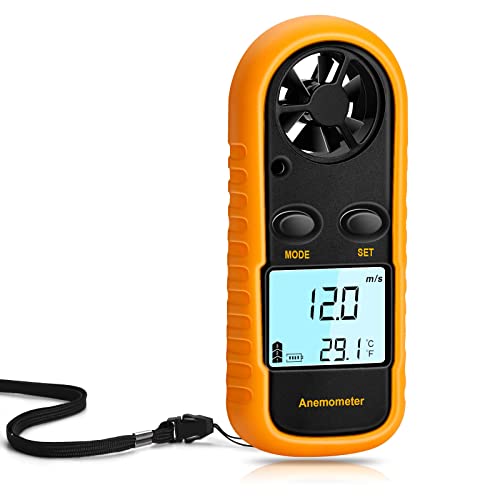
Clatoon’s handheld anemometer measures wind speed, wind temperature, and wind chill with five measurement units (including mph, m/s, and knots). It also provides wind temperature ranges from -40°C to 45°C (-40°F to 113°F) and reports wind chill values. Designed for kite flying, drones, sailing, and HVAC-related testing, this meter targets versatile field use with relatively compact construction. A six-blade rotor helps improve overall accuracy for routine wind assessments and air flow checks.
TopTes TS-301 Digital Anemometer
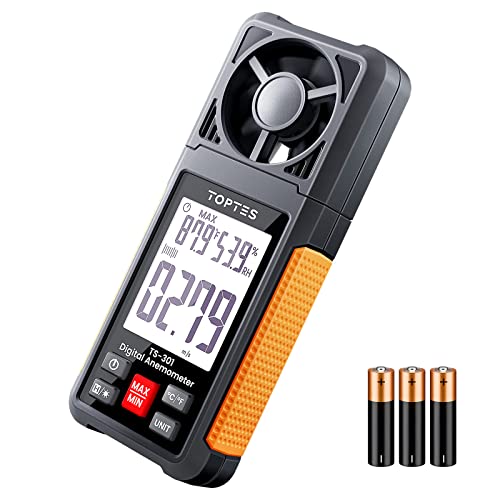
TopTes TS-301 features a large 2.26-inch backlit LCD screen for straightforward readings. It measures wind speed in six units (ft/min, ft/s, mph, knots, km/h, m/s), and includes wind humidity and wind temperature readings. The humidity range is 0.0% to 99.9% RH, while temperature spans -4.0°F to 140.0°F. The device is well-suited for outdoor sports, drone operation, sailing, and HVAC-related tasks where clear data presentation matters, especially in variable lighting conditions.
BTMETER BT-100APP Anemometer

The BT-100APP adds wireless Bluetooth connectivity to a compact, multifunction device. It reports wind speed in five units (m/s, km/h, ft/min, knots, mph) and wind temperature in °C/°F, along with wind chill. The meter emphasizes accuracy in the 0.67–67.1 mph range and temperatures from -10 to 45°C (14°F–113°F). Features include battery saving options, data logging, and a backlit display—supporting data sharing with mobile devices during fieldwork and drone operations.
Buying Guide: Key Considerations For Wind Speed And Temperature Meters
When choosing a wind speed and temperature meter, consider the following factors to match your use case and environmental conditions:
- Measurement range and accuracy: Ensure the unit covers your typical wind speeds and temperatures, with acceptable accuracy (often ±2% to ±5%).
- Units and temperature scales: Look for devices offering multiple wind speed units (m/s, ft/min, mph, knots, km/h) and temperature scales (Celsius/Fahrenheit).
- Temperature and humidity sensing: Some models include humidity and dew point, which is valuable for HVAC work and outdoor planning.
- Display quality: Backlit LCDs improve readability in sunlight or low-light conditions; consider the size of the display for quick field checks.
- Sensor sensitivity and rotor design: More blades and dual sensors can improve low-flow detection and measurement stability, particularly in ductwork or drone flight scenarios.
- Power and portability: Battery life, auto-off features, and lightweight form factors influence field usability. Data logging and auto power-saving modes are helpful for extended sessions.
- Mounting options: Tripod compatibility enables fixed, hands-free measurements in windy environments or when mounting on vehicles or drones.
- Connectivity: Bluetooth or data logging features facilitate integration with mobile devices and documentation workflows.
- Durability and form factor: For outdoor and on-site use, a rugged, weather-resistant design reduces vulnerability to dust and moisture.
Choosing between a simple wind speed meter and a multifunction device that reports wind chill, humidity, or air flow in CFM depends on your needs. For HVAC technicians, a model with CFM calculations and duct airflow considerations is advantageous. For drone operators and sports enthusiasts, a compact unit with a tripod mount and quick readings may be more suitable. Wireless options can streamline data collection during field missions, while larger displays help in bright outdoor environments.