Choosing the right wireless in-ear monitor (IEM) system can dramatically improve stage communication, personal monitoring, and overall sound quality. This guide highlights five top options, each offering low latency, robust wireless transmission, and user-friendly pairing. Use this overview to compare features like channel scanning, auto-pairing, battery life, and stereo/mono options to fit live performances, studios, and rehearsals.
Summary of Selected Products
| Product | Brand | Key Benefit | Best For |
|---|---|---|---|
| Xvive U45 Wireless IEM System | Xvive | 5.8 GHz true diversity with easy Channel Scan | Live performances, bands |
| LEKATO MS-02 | LEKATO | Upgraded ultra-low latency & One TX to Many | Small/medium stages, multi-performer |
| MELONARE PM-2 | MELONARE | Long battery life with charging case and OTG input | Mobile setups, studios |
| INGPARTNER A88T | INGPARTNER | Low latency with stable 2.4 GHz band and interference resistance | Studio, band practice |
| SWIFF AUDIO | SWIFF AUDIO | 5.8 GHz with 10-channel capacity & LED status | Large setups, classrooms, venues |
Xvive U45 Wireless In-Ear Monitor System

The Xvive U45 is a 5.8 GHz true diversity wireless IEM system designed for stage and studio use. It delivers a broad frequency range with a 24-bit/48kHz audio path and a high signal-to-noise ratio, ensuring clear audio even at higher volumes. The system provides solid RF performance over roughly 100 feet (30.5 meters) and includes a Channel Scan Mode that helps locate the best available channel. This makes it suitable for performers who need reliable, interference-resistant monitoring in dynamic environments. The U45 supports a setup where multiple performers can receive a stable, synchronized feed by matching transmitter and receiver channels after scanning.
LEKATO MS-02 Wireless IEM System

LEKATO’s MS-02 represents an upgraded 2.4 GHz IEM solution with ultra-low latency and a One TX to Many RX design. The system claims sub-4.5 ms latency, a 24-bit/48 kHz high sampling rate, and a robust 6-hour battery life per charge with a battery level LED. It supports up to four receivers on a single transmitter, making it practical for small to mid-sized performances or practice sessions with multiple performers. The pairing process is straightforward, often described as quick to establish, with status indicators for easy monitoring on stage.
MELONARE PM-2 Portable Wireless IEM System

The MELONARE PM-2 stands out for its long battery life and practical charging case, offering up to 30 hours of total runtime when combining transmitter/receiver operation and two extra charges from the case. It also adds OTG input support for direct connection to mobile devices, which is useful for on-the-go monitoring and quick setups. The system transmits at 24-bit/48kHz within a wide 20 Hz–20 kHz frequency response, delivering detailed, immersive audio with a substantial signal-to-noise ratio for clean monitoring in live settings. This model is well-suited for touring, studios, or multi-venue gigs where mobility matters.
INGPARTNER A88T Wireless In-Ear Monitor System

INGPARTNER’s A88T system emphasizes interference resistance and low latency, using the 2.4 GHz band to minimize signal dropouts while delivering 48 kHz/16-bit high-resolution audio. Its low-latency performance supports real-time feedback for vocalists and instrumentalists on stage or in the studio. The A88T is designed for studios and bands, providing stable performance with straightforward auto-pairing to simplify setup for performers who need reliable wireless monitoring without complex configuration.
SWIFF AUDIO Wireless IEM System
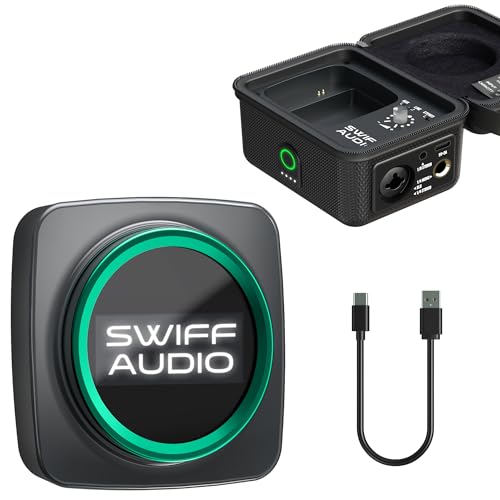
SWIFF AUDIO offers a 5.8 GHz wireless IEM system capable of connecting up to 10 receivers on one transmitter, making it a strong option for larger setups or classrooms, as well as multi-performer venues. It features a built-in cue mic, multiple channel options, and an LED display that stays illuminated to indicate connection status. With a wide 20 Hz–20 kHz audio range, a high SNR, and low latency under 5 ms, the SWIFF system aims to deliver clear, accurate monitoring across channels and performers.
Buying Guide: Key Purchase Considerations
- Latency: Lower latency reduces the delay between performance and monitoring. Look for systems with sub-5 ms latency to maintain in-sync audio, especially for live performance and vocalists.
- Channel Management: Channel Scan or Auto-Pairing features simplify setup and reduce on-stage fiddling. Multi-receiver support is essential for band practice or multi-performer gigs.
- Frequency Band: 2.4 GHz and 5.8 GHz are common. 5.8 GHz generally offers less congestion; 2.4 GHz can be more affordable but may face more interference in crowded environments.
- Battery Life and Charging: Consider how long you need to perform before recharging. Some kits include a charging case that extends total runtime significantly.
- Audio Quality: Look for 24-bit/48 kHz or better with a wide frequency response (roughly 20 Hz–20 kHz) and a high signal-to-noise ratio for clean monitoring.
- One TX to Many RX: If you perform with multiple musicians, a system that supports multiple receivers from a single transmitter is advantageous for synchronized monitoring.
- Durability and Comfort: In-ear monitors should be lightweight and comfortable for long sets. Consider ear tip options and build quality for touring or studio use.
- OTG and Mobile Compatibility: OTG support can connect to smartphones or tablets for on-the-go monitoring or quick cueing during setup.
The five selected models cover a range of scenarios—from solo performances requiring robust channel management to larger ensembles needing multiple simultaneous feeds. Each option emphasizes low latency, reliable wireless performance, and straightforward pairing to minimize on-stage setup time while preserving audio fidelity.