Smart homes demand strong, reliable wireless coverage across every room. The following five WiFi range extenders are among the top choices for expanding a 5GHz/2.4GHz network, boosting signal strength, and supporting multiple devices simultaneously. Each product is evaluated on speed, range, ease of setup, and security features to help you pick the right solution for a mid to large home.
Summary of chosen products:
| Product | Brand | Typical Coverage | Devices Supported | Key Benefit |
|---|---|---|---|---|
| AC1900 WiFi Range Extender RE550 | TP-Link | Up to 2100 sq. ft. | Up to 32 | High total bandwidth with external antennas |
| AX3000 WiFi 6 Range Extender RE715X | TP-Link | Up to 2400 sq. ft. | Up to 64 | WiFi 6 performance, Beamforming |
| RE515X AX1500 WiFi Extender | TP-Link | Up to 1800 sq. ft. | Up to 64 | Compact AX600-level speeds, EasyMesh |
| EX6120 | NETGEAR | Up to 1500 sq. ft. | Up to 32 | Trusted dual-band performance |
| EX5000 Mesh Range Extender | NETGEAR | Up to 1000 sq. ft. | Up to 15 | Compact, quick setup, solid coverage |
TP-Link AC1900 WiFi Range Extender RE550

The RE550 is a dual-band extender designed to boost home networks with a total bandwidth up to 1900 Mbps, including 1300 Mbps on the 5 GHz band and 600 Mbps on the 2.4 GHz band. Three external antennas help minimize dead spots and maximize coverage up to about 2100 square feet, making it suitable for multi-room homes. An Ethernet port allows wired connections for devices like gaming consoles or smart TVs, improving stability for latency-sensitive applications. TP-Link emphasizes cybersecurity, with Secure-by-Design commitments to protect connected devices.
TP-Link AX3000 WiFi 6 Range Extender RE715X

The RE715X brings WiFi 6 performance with dual-band operation and a powerful 3 Gbps total bandwidth, delivering up to 2400 Mbps on the 5 GHz band and 574 Mbps on the 2.4 GHz band. It’s designed for higher device counts, supporting up to 64 devices, which is ideal for busy households with many smart devices, laptops, and streaming players. Antenna design and Beamforming technology help improve range and signal reliability across larger living areas, and it includes TP-Link’s security commitments.
TP-Link RE515X AX1500 WiFi 6 Range Extender

The RE515X provides AX1500 performance, offering up to 1201 Mbps on the 5 GHz band and 300 Mbps on the 2.4 GHz band. It’s built to cover up to 1800 square feet and supports up to 64 devices, making it a robust choice for mid to large homes with several smart devices. Two high-gain antennas with Beamforming boost signal strength and reliability, while the device remains easy to configure via a mobile app. Security considerations align with TP-Link’s Secure-by-Design approach.
NETGEAR EX6120 WiFi Range Extender
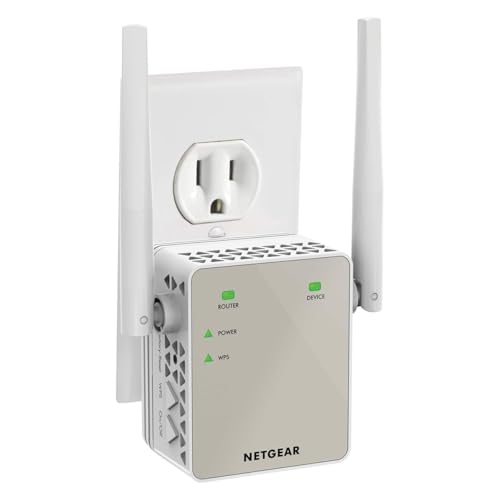
The EX6120 adds WiFi coverage up to 1500 square feet and supports up to 32 devices with AC1200 speeds. It uses dual-band technology to provide reliable streaming and online activity across multiple rooms and floors. This extender is designed to be compatible with any router, gateway, or cable modem with WiFi, offering straightforward setup for a broad range of homes. Its compact form fits discreetly into wall outlets while delivering solid performance for everyday devices.
NETGEAR EX5000 Mesh Range Extender

The EX5000 covers up to 1000 square feet and connects up to 15 devices, providing up to 1200 Mbps wireless performance through dual-band technology. It’s designed for quick deployment and works with any existing router to extend coverage where signals are weak. This model is suited for smaller homes or apartments where a simple, reliable range extension is sufficient without creating a separate mesh network.
Buying Guide: Key Considerations for Choosing a WiFi Range Extender
- Coverage area and device load: Larger homes and more connected devices require extenders with higher total bandwidth and multiple antennas. Look for models that advertise coverage in square feet and support dozens of devices.
- WiFi standard: WiFi 6 (802.11ax) extenders offer better efficiency and higher real-world speeds with many devices. If upgrading, prefer AX-rated extenders; for budget-conscious setups, AC models still perform well.
- Band configuration: Dual-band extenders are common, but tri-band or quad-band options exist in some high-end models. Consider whether you need more 5 GHz capacity or a dedicated backhaul channel in mesh setups.
- Backhaul and mesh compatibility: Some extenders work within a OneMesh or similar ecosystem, enabling seamless roaming as part of a larger mesh network. This matters for consistent performance in multi-story homes.
- Ethernet port availability: A wired backhaul port can significantly improve stability for gaming consoles, smart TVs, or desktop PCs. Check the number and type of ports (Gigabit Ethernet is standard).
- Security and updates: Choose brands with a track record of regular firmware updates and security commitments. This helps mitigate vulnerabilities as networks grow.
- Setup experience: App-driven setup and straightforward management improve day-to-day usability. Look for guides, quick setup wizards, and compatibility with your existing router.
- Power and placement: Consider where outlets are located and how easy it is to position the extender for optimal signal spread. If placement is challenging, a mesh system might be a better fit.
How to Optimize Your WiFi Extender Setup
Place the extender halfway between the router and the farthest area needing coverage, avoiding large metal objects and microwaves. Use the 5 GHz band for devices close to the extender to maximize throughput, and switch to the 2.4 GHz band for farther rooms or walls. If your extender supports a dedicated backhaul channel, enable it to reduce interference and improve overall network performance.
When to Choose a Mesh Alternative
For homes with complex layouts or multiple floors, consider a mesh WiFi system instead of a single extender. Mesh systems provide seamless roaming, consistent speeds, and simpler management across a large footprint. Some extenders in this list are compatible with mesh ecosystems, offering a bridge between simple range extension and scalable coverage.