The demand for reliable visual fault locators (VFLs) has grown as fiber networks expand into tighter spaces and more complex topologies. This guide highlights top options that help technicians quickly identify breaks, bends, and poor connections using a visible red laser. Each pick supports common fiber interfaces, offers portability for on-site use, and is designed to work with single-mode and multimode cables. Read on to compare features, compatibility, and practical considerations to choose a VFL that suits field maintenance, CATV installs, and network troubleshooting.
| Product | Brand | Key Strength |
|---|---|---|
| Visual Fault Locator 30KM | BoltBlaze | High-intensity 650nm laser; long-range tracing |
| Sysotek Visual Fault Locator | Sysotek | Rechargeable; USB-C charging; broad compatibility |
| Moocci Visual Fault Locator Kit | Moocci | Multiple interfaces; long battery life |
| GESD Visual Fault Locator Kit | GESD | FC/LC adapter kit; universal 2.5mm connector |
| SinLoon Visual Fault Locator | SinLoon | 2.5mm universal connector; compact design |
BoltBlaze 30KM Visual Fault Locator

The BoltBlaze 30KM VFL is built for demanding field use with a high-intensity 650nm red laser. It helps locate fiber breaks, weak connections, bends, or cracks, with faults visibly refracting light at problem points. The device emphasizes constant output power and extended battery life, enabling reliable performance in remote locations. It uses a universal 2.5mm adapter to fit ST, SC, and FC interfaces, whether circular or square, offering compatibility across most fiber optic cables. Battery details indicate power is available for lengthy field tasks, though batteries are not included in some kits.
In practice, technicians rely on the bright red trace to quickly identify problem areas during installation and maintenance. The compact design reduces fatigue during long field sessions, and the 2.5mm adaptor compatibility ensures easy integration with existing panel adapters and patch cables. This model is particularly useful for trace alignment in fiber trunks and service drops where quick, non-destructive fault localization is essential.
Sysotek Visual Fault Locator Fiber Optic

The Sysotek VFL is designed for technicians who need a rechargeable, field-ready tool. It emits a vivid red light to trace fiber paths, pinpointing faults during installation and maintenance. The device supports single-mode and multimode fibers (9/125 µm) and includes a 2.5mm ferrule that fits SC, FC, and ST connectors. A noteworthy feature is USB-C charging, which supports fast recharging and convenient power management in the field. The VFL also offers both constant and pulsing light modes along with an integrated LED flashlight for low-light inspections.
The kit’s versatility makes it suitable for a broad range of tasks, including patch panel tracing, fiber routing, and end-face inspections. Its rechargeable design reduces ongoing cost and waste, while the broad connector compatibility minimizes the need for extra adapters. For technicians working across heterogeneous networks, this tool provides a reliable, all-in-one solution for quick fault localization and verification of cable integrity.
Moocci Visual Fault Locator Kit

Moocci’s VFL tester emphasizes ease of use in field tests, with multiple interfaces and a bright glow at break or fault points. It’s designed for efficient fiber tracing, routing, and continuity checks, making it a practical choice for technicians performing splicing work or locating breaks in both circular and square connector footprints. The device supports constant output and has long battery life, with a simple AA battery power source that’s easy to replace on-site. It’s compatible with ST, SC, FC, and LC adapters, aiding compatibility across diverse cables and patch panels.
The Moocci kit is well-suited for CATV, telecommunications engineering, and integrated wiring, where identifying fault areas quickly can save time and reduce downtime. The kit’s portability and straightforward operation help technicians perform rapid field verifications, ensuring that fiber runs are continuous before proceeding with terminations or connectors. This makes it a solid all-around option for mid-range field deployments and service checks.
GESD Visual Fault Locator Kit

GESD offers a VFL kit with an FC/LC adapter configuration, featuring a 2.5mm universal connector that supports various connector types, including ST, SC, MU, FC, and LC. This versatility helps technicians work across different fiber networks without swapping cables or adapters mid-task. The device emits a visible red light that travels through fiber, revealing faults such as fractures or poor connections by creating a glow around the affected area. The kit emphasizes compatibility and efficient power management, ensuring stable operation during extended fieldwork.
The included FC/LC adapters are valuable for patch panels and spaces with limited access, enabling easier alignment checks. The device’s universal connector design reduces the need for specialized ferrules when diagnosing mixed-fiber environments. For service technicians dealing with mixed deployments, this kit can streamline fault locating and verification across multiple fiber types.
SinLoon Visual Fault Locator
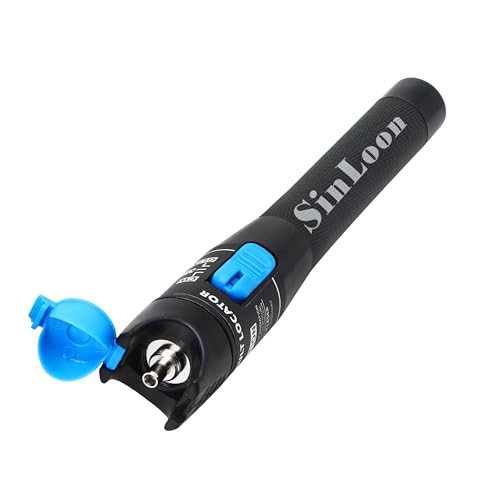
SinLoon’s VFL emphasizes a 2.5mm universal connector that accommodates ST, SC, FC, and LC interfaces in both circle and square formats. The device emits a 650nm red light with strong penetrating power to clearly reveal leakage light at fault areas. Its compact, lightweight design supports portable use in-field. The included pouch adds portability and protection, making this option well-suited for technicians who need a simple, reliable tool for quick fault localization and fiber tracing in varied environments.
With SinLoon’s emphasis on portability and compatibility, this VFL is often favored for quick checks on service drops, patch panel tasks, and field maintenance where a small, reliable instrument is valued. For technicians who prioritize ease of transport and immediate on-site results, SinLoon provides a practical blend of accessibility and effectiveness.
Buying Guide: Key Considerations For Visual Fault Locators
When shopping for a visual fault locator, consider the following factors to match your needs:
- Interface compatibility: Look for VFLs with 2.5mm ferrules that fit ST, SC, FC, and LC connectors, and verify whether adapters for LC or other early-stage connectors are included or purchasable separately.
- Light output and visibility: A bright 650nm red laser offers clear fault tracing over typical distances in network cabinets and field runs. Consider models with constant and pulsing modes for different tracing scenarios.
- Power source and longevity: Rechargeable batteries reduce ongoing costs, but check for battery life in field conditions. Some models use AA or 800mAh batteries; others are rechargeable via USB-C.
- Portability: Pen-type and compact designs minimize fatigue during long inspections. A pouch or protective case is an added benefit for on-site transport.
- Durability and build quality: Field tools should be rugged, dust-proof, and able to withstand vibration and occasional drops. Look for housings that resist moisture and general wear.
- Target applications: Determine whether you need a VFL for CATV, telecom, data-center patch panels, or general fiber routing. Some kits emphasize broader compatibility for mixed fiber networks.
- Battery replacement and availability: Consider whether the device uses standard batteries or integrated rechargeable packs, and whether replacements are easy to source.
- Warranty and support: A solid warranty helps reduce downtime in case of a fault or component failure, especially for field technicians who rely on timely repairs.
For buyers comparing options, map your priorities to these factors: compatibility breadth, battery life, and ease of maintenance. If you frequently work with both single-mode and multimode fibers, a VFL with flexible adapters and a rechargeable power source may offer the best long-term value. In environments with limited access, a compact, high-visibility unit with broad connector support can improve productivity and reduce the need for multiple tools.