For wildlife enthusiasts, hunters, and researchers, a reliable video camera that captures clear day and night footage is essential. This guide highlights five leading trail cameras designed for wildlife monitoring, offering fast triggers, long battery life, and robust night vision. Each model is evaluated on image and video quality, durability, power options, and ease of use to help you choose the best tool for field observation.
Summary of selected products:
- KJK Trail Camera 36MP 2.7K: Ultra-clear day and night footage with fast 0.1s trigger and wide 130° view; compact and rugged with a 2.0″ color screen.
- GardePro E5S Trail Camera: 64MP photos, 1296P video, no-wuss night vision, and long battery-friendly operation.
- MAXDONE Solar Trail Camera: 4K video, 64MP photos, solar charging with a large battery; independent of home Wi‑Fi.
- GardePro E6 WiFi Trail Camera: 48MP photos, 1296P video, Bluetooth/WiFi app control, live view, no monthly fees.
- WOSPORTS Trail Camera: 48MP 4K video, 0.2s trigger, 32 IR LEDs, LCD screen for instant viewing.
KJK Trail Camera 36MP 2.7K: Fast Trigger With 130° View

The KJK Trail Camera combines 36MP stills with smooth 2.7K video, delivering sharp daytime imagery and capable nighttime footage. It uses a 22-piece 850nm low-glow LED array and an advanced sensor to minimize noise while preserving color. A compact 2.0-inch TFT color screen lets you review shots on-site, framed by a rugged, waterproof housing suitable for forested or rural environments.
Its night-vision system employs adaptive illumination to reduce the risk of overexposure in challenging lighting, providing clear footage up to about 75 feet in total darkness. The camera excels in wildlife monitoring, backyard security, or farm surveillance, offering reliable performance in variable weather. Trigger speed is remarkably quick, ensuring animals are captured as they move through the detection zone. The 130° wide-angle lens helps cover larger scenes without repositioning.
GardePro E5S Trail Camera: High-Resolution Photos And Video

The E5S focuses on high-resolution captures with 64MP photos and 1296P HD video. Its non-cellular, non-WiFi design prioritizes long battery life and minimal intrusion into wildlife behavior—great for long-term studies where constant connectivity isn’t needed. An IP66-rated build protects against dust and rain, while a standard 1/4″-20 mount ensures flexible placement on trees, posts, or fences. This model suits observers who want detailed stills for documentation without the complexity of remote data retrieval.
MAXDONE Solar Trail Camera: Solar Powered 4K Wildlife Camera
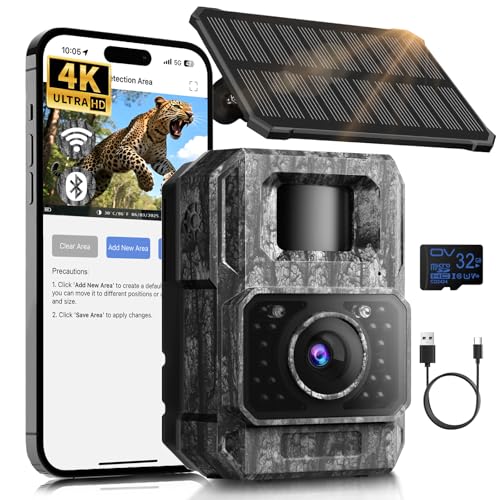
MAXDONE’s solar trail camera emphasizes independent power with a large 6000mAh rechargeable battery and a flexible solar charging setup. It records 4K video and 64MP photos, offering vivid footage that’s suitable for documenting wildlife behavior over extended periods. Important notes include that the camera creates its own short-range Wi-Fi hotspot for setup and file transfer, with a range of about 10–15 meters in open spaces. This model suits remote locations where frequent battery changes would be impractical.
GardePro E6 WiFi Trail Camera: App‑Controlled Real‑Time Viewing

The E6 introduces app-based live viewing via ultra-low-power WiFi and Bluetooth. Although it does not connect to home networks, it enables a direct link to a smartphone for real-time monitoring up to around 45 feet away. The camera captures 48MP photos and 1296P HD video with a wide 110° field of view, and its live view mode helps researchers or enthusiasts verify placement and scene composition without disturbing wildlife. The design emphasizes low power consumption for longer deployment intervals.
WOSPORTS Trail Camera: 4K Clarity With Quick Trigger

The WOSPORTS model features 48MP photo and 4K video capture with a rapid 0.2-second trigger, ensuring minimal missed moments. Its 32 infrared LEDs provide night vision for darker environments, with an IP66 rating indicating solid weather resistance. The built-in 2.0-inch LCD color screen allows immediate on-device playback, a practical feature for field researchers who need quick verification or don’t want to pull memory cards after every session. This camera is well-suited for wildlife monitoring, outdoor security, and recreational scouting.
Buying Guide: Key Factors In Choosing A Wildlife Video Camera
-
<li Image and video quality: Look for cameras offering at least 1080p HD or higher, with 4K options for detailed wildlife footage. For still shots, higher megapixel counts yield crisper images, but sensor quality and compression also matter.
<li Trigger speed and burst: A sub-0.2-second trigger helps capture fast animals. Burst modes (1–3 shots) increase odds of getting a complete sequence, but consider storage capacity and battery impact.
<li Night vision and flash: No-glow or low-glow infrared LEDs minimize disturbance to wildlife. Consider effective range, exposure control, and adaptive illumination to avoid overexposure or underexposure.
<li Power options: Non-cellular models run longer between visits, while solar or rechargeable batteries can enable extended deployments. Assess battery life, solar panel efficacy, and charging modes for your environment.
<li Connectivity: Cellular-enabled cameras offer remote access, but many users prefer non-cellular designs for reliability and longer lifespans. App-based WiFi/Bluetooth features can help with setup and live previews where available.
<li Durability and weather resistance: Weatherproof housings (IP ratings) protect against rain, dust, and temperature fluctuations. Mounting versatility and mounting threads facilitate flexible placement.
<li Storage and data handling: Ensure compatibility with SD cards of sufficient capacity and consider built-in review features to minimize field trips for data retrieval.
<li Field deployment considerations: Consider location, wildlife behavior, and terrain. Wide-angle lenses capture more area but may require higher-resolution sensors to preserve detail at close distances.
<li Budget and maintenance: Balance upfront costs with ongoing maintenance, battery replacements, and potential subscription fees for cloud storage or remote access.