Durable, standalone USB and drive duplicators save time for IT teams, technicians, and data-security professionals. The following selections cover small to large batch cloning, secure erasing, and cross-device copying. Each product listed below supports multiple formats and interfaces, enabling fast, independent operation without a PC. Read on to compare features, compatibility, and potential use cases for USB flash drives, USB external storage, SATA HDDs/SSDs, and more.
| Product | Brand | Key Capabilities | Interface |
|---|---|---|---|
| StarTech Standalone 1 to 2 USB Drive Duplicator | StarTech.com | 1:2 cloning, 3-pass erase, sector-by-sector copy | USB |
| SABRENT USB 3.0 to SATA Docking Station with Duplicator | SABRENT | 2.5″/3.5″ drive cloning, up to 10TB drives | SATA / USB |
| EZ Dupe 1 to 9 USB Duplicator | EZ DUPE | Up to 9 drives simultaneously, 2GB/min copies | USB |
| Vinpower USBSHARK-23T-BK | Vinpower Digital | 1:23 standalone copying, asynchronous and smart/raw modes | USB |
| StarTech SU2DUPERA11 | StarTech.com | 1:1 standalone duplicator/eraser, cross-interface support | USB / SATA |
StarTech Standalone 1 to 2 USB Drive Duplicator

Designed for technicians and IT professionals, this standalone duplicator supports cloning and erasing USB 3.0/2.0 flash drives and external USB storage. It operates without a computer, offering 1.5 GB/min system and file copy, sector-by-sector copying, and both quick erase and 3-pass overwrite options. It features firmware upgradeability and a LCD display for status updates. This model is TAA compliant, suitable for labs and service desks that require compliant data handling and secure erasure capabilities.
SABRENT USB 3.0 to SATA Dual Bay Docking Station with Duplicator
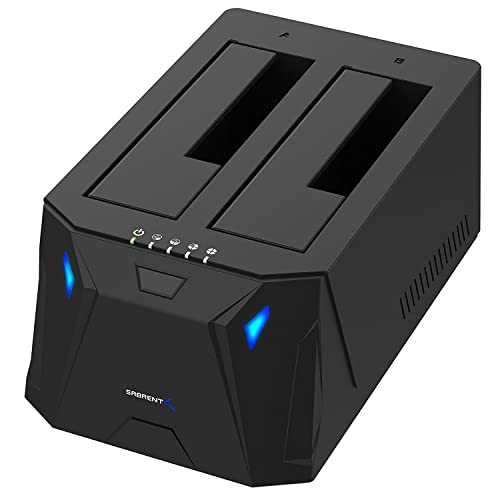
This external dock supports standard 2.5″ and 3.5″ SATA drives or SSDs and can clone efficiently. It handles drives up to 10TB and is plug-and-play with no drivers required. The docking station doubles as a USB-to-SATA adapter, enabling quick access to drives for data transfer, backup, and cloning tasks. Its dual-bay configuration is well-suited for batch duplication workflows and expansion projects in IT environments.
EZ Dupe 1 to 9 USB Duplicator
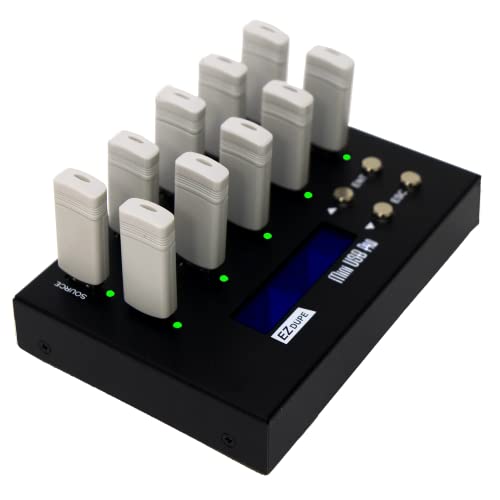
This compact standalone unit can duplicate up to nine USB flash drives simultaneously. It supports USB 1.0/2.0/3.0 media and achieves copy speeds up to 2 GB/min. The device is designed for fast, bulk duplication and erasure across multiple USB devices, making it a practical choice for software distribution, security boot drives, and routine backup kits in office environments or field operations.
Vinpower 1 to 23 Standalone USB Duplicator

The USBSHARK-23T-BK model from Vinpower Digital offers extensive standalone copying capabilities, allowing asynchronous duplication across multiple sources. It features smart copy and raw mode for comprehensive data replication, supporting robust IT workflows where speed and reliability are critical. Standalone operation reduces system load and enhances security by avoiding PC dependencies during cloning tasks.
StarTech SU2DUPERA11 Standalone Duplicator

This toolless sanitizer supports 2.5/3.5″ SATA HDDs/SSDs and USB flash drives, offering multiple copy and erase modes. It enables cross-interface copy and erase operations between USB and SATA drives, making it suitable for secure data sanitization, disk upgrading, or mass cloning across different drive types. The LCD display provides clear status feedback and control over duplication tasks, with DoD 5220.22-M compliant erase options.
StarTech Standalone Hard Drive Duplicator Docking Station
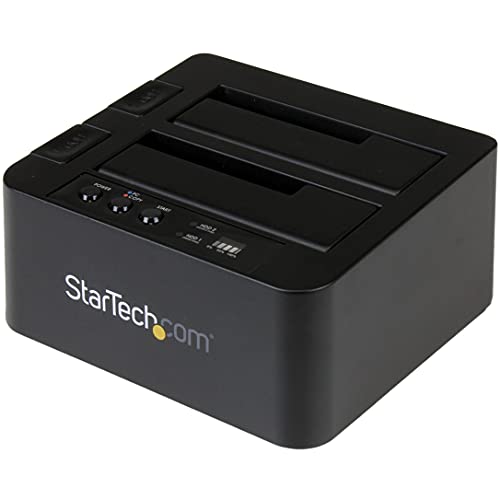
This dual-bay standalone duplicator doubles as a USB-to-SATA docking station, allowing direct access to drives for cloning and data transfer. It supports 2.5″/3.5″ SATA HDDs/SSDs and provides a fast sector-by-sector copy mode for exact duplicates. The device includes USB-C and USB-A cables along with a universal power adapter, and it remains OS independent with broad compatibility for different storage configurations and recovery tasks.
Buying Guide: Key Considerations And Comparisons
- Standalone operation vs. PC-dependent cloning: Standalone devices eliminate the need for a computer, reducing bottlenecks and increasing data handling security in sensitive environments.
- Drive compatibility: Check whether you need cloning support for USB flash drives, USB external storage, SATA HDDs/SSDs, or mixed interfaces. Some models also support M.2 or SATA adapters via expansion options.
- Copy modes and erasure: Evaluate whether you require sector-by-sector copies, system-and-file cloning, or full-disk duplication. For security, prefer devices offering DoD/NIST-compliant erase options (e.g., 3-pass overwrite or cryptographic erase).
- Speed and throughput: Look at reported copy speeds (GB/min or MB/s) and whether the device supports asynchronous copies, which can improve throughput when duplicating to multiple targets.
- Capacity and scalability: Consider the maximum drive sizes supported (e.g., 10 TB or higher) and whether the device supports multiple targets simultaneously or only 1:1 cloning.
- Power, cooling, and form factor: Larger, multi-drive units may require dedicated power supplies and adequate ventilation. Smaller units are ideal for on-site field work and quick builds.
- Firmware and warranties: Firmware upgradeability can extend functionality and security. A solid warranty and supported customer service help with long-term maintenance.
- Security and compliance: For sensitive data, prioritize devices with secure erase options and physical build quality that minimizes accidental data leakage during transport or use.
- Use-case fit: For software distribution or bootable media kits, high-port-count USB duplicators may be best. For disk imaging or data migration across SATA drives, a dock-style or 1:1 standalone may be ideal.