Choosing a 1000W-equivalent LED grow light is about balancing power, spectrum, and efficiency. The following five options provide full-spectrum lighting, energy savings, and reliable cooling to support seeds, vegetative growth, and flowering in indoor setups. Each product below includes a quick reference to its strengths and typical applications, helping you compare performance for a 2×2, 3×3, or 4×4 footprint.
Product Quick Reference
- Beelux 1000W LED Grow Light — Full spectrum with extra red diodes for higher yields; strong cooling and multiple convection sides.
- TATU 1000W LED Grow Light — High efficiency, wide spectrum, quiet operation with heat-dissipating design.
- KingLED KP1000 — 2×2 ft coverage, three growth modes, efficient white/colored spectrum for all stages.
- ECOHOM 1000W LED Grow Light — Large full-spectrum with precise white/blue/red balance; robust heat management.
- FECiDA 1200W Equivalent LED Grow Light — 130W real draw, daisy chain capable, dimmable for scalable setups.
Note: All products listed are marketed as 1000W-equivalent LEDs with real power varies. Evaluate PPFD, coverage, and heat dissipation alongside spectrum and dimming features to fit your grow tent or greenhouse needs.
Beelux 1000w LED Grow Light for Indoor Plants

The Beelux model targets energy efficiency by replacing traditional 1000W HPS/MH with a claimed 110W draw. It aims for a 4×4 ft growing area and emphasizes a higher yield through added red diodes. The design features a fireproof PC cover and aluminum back, with six sides contributing up to 60% convection-based heat dissipation and virtually silent operation. This solution is positioned for year-round tropicals and easy garden crops in cooler months.
Its spectrum strategy leans on more red channels to boost flowering and fruiting, aligning with vegetative and full-cycle indoor cultivation. The cooling system and rugged construction are marketed to reduce downtime and maintenance needs. For growers prioritizing low energy use while maintaining a robust light intensity, this option presents a solid balance between efficiency and yield potential.
TATU 1000w LED Grow Light for Indoor Plants

The TATU lamp emphasizes all-growth-stage performance with a well-rounded spectrum, including 660nm red and 430nm blue, plus white tones to support flowering and leaf development. It claims high light utilization, reducing energy loss and delivering an efficient 1000W-equivalent output. A fireproof PC cover and aluminum back support durability, while a heat-dissipation system minimizes heat buildup and noise—ensuring a stable environment for seedling to harvest in grow tents or cabinets.
Three notable strengths are the broad spectrum targeting flowering, energy efficiency, and a design that keeps heat in check without adding audible noise. This makes it suitable for growers seeking reliable performance across growth stages without disruptive equipment, especially in compact indoor habitats where heat and noise can impact daily operations.
KingLED KP1000 LED Grow Lights

KingLED’s KP1000 delivers a 2×2 ft coverage footprint with 100W actual draw, supported by a matrix of 640 LEDs across blue, red, white, and yellow channels. The spectrum is designed to resemble natural sunlight, with a mix that supports photosynthesis across growth stages. Features include three light modes: Veg, Bloom, and Veg & Bloom, enabling stage-specific intensity. It also claims a high PPFD at close distances, balancing output with energy efficiency.
Key considerations include its coverage claim for a 2×2 ft area, the flexibility of mode selection for different growth phases, and a focus on energy-conscious operation. This option may appeal to hobbyists or small setups where precise light scheduling and spectrum tailoring matter for steady, predictable yields.
ECOHOM 1000W LED Grow Light
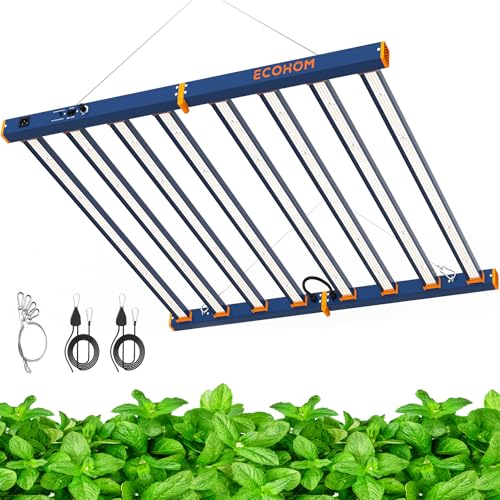
ECOHOM markets a high-efficiency full-spectrum LED with a claimed PPE around 2.8 µmol/J and a yield emphasis of up to 2.5g per watt, suggesting strong performance for quality-focused crops. The spectrum includes a mix of white, warm white, and red wavelengths designed to support all growth stages, with a big footprint intended for 6×6 ft grow tents or greenhouses. The design highlights an effective heat management system and a robust build for longer operation under continuous cycles.
Prospective buyers should weigh the larger footprint and power draw against the promised efficiency gains. The spectrum and high-yield claim make it a strong candidate for growers seeking robust canopy development and predictable flowering, especially in semi-commercial setups where space and energy costs are balanced against production goals.
FECiDA 1200W Equivalent LED Grow Light

The FECiDA unit is marketed as a 1200W-equivalent, with a real draw of about 130W and a full-spectrum output spanning 380–780 nm. It emphasizes dimming control up to 100% and the ability to daisy-chain up to eight lights, making it suitable for scalable grow spaces. A quiet cooling system supports longer runtimes with low noise, contributing to a steadier environment for seedling and vegetative growth in tents or rooms.
For growers planning expansion or multi-unit installations, the daisy-chain feature and dimming flexibility offer practical advantages. The balanced spectrum supports a broad range of plants from seed to bloom, while the energy profile helps control operating costs in larger indoor gardens.
Buying Guide: Key Purchase Considerations
- Coverage area vs. footprint: Match the light’s recommended coverage with your grow space (2×2 ft, 3×3 ft, 4×4 ft, etc.).
- Spectrum and growth stages: Look for full-spectrum LEDs that cover white, blue, red, and infrared bands or tailor the spectrum to flowering emphasis when needed.
- Efficacy and noise: Check PPE values (µmol/J) and cooling design. Lower noise and efficient heat dissipation improve consistency in long runs.
- Power draw vs. output: Compare real wattage to equivalent wattage ratings to estimate energy costs and heat load.
- Dimming and daisy chaining: If scaling, ensure dimming controls and chainability fit your setup.
- Durability and warranty: Consider heat sinks, aluminum construction, and the manufacturer’s warranty for long-term reliability.
- Compatibility with grow tents and ventilation: Ensure the unit’s heat profile and mounting fit your tent size and airflow strategy.
- Installation practicality: Look for adjustable mounts, easy suspension, and tool-free setup when possible.
- Price-to-performance balance: Weigh spectrum quality, cooling, and energy savings against upfront costs and expected yields.