Explore top WiFi temperature sensors designed for smart homes, cellars, greenhouses, and more. These devices connect directly to your WiFi, provide real-time readings, and send alerts when conditions move outside your set ranges. Below are five reliable options that balance accuracy, app support, and ease of use for American homes.
| Product | Brand | Key Features | Wi-Fi Type | Notes |
|---|---|---|---|---|
| WiFi Temperature Humidity Sensor: Indoor Thermometer Hygrometer (1-Pack) | Gaoducash | Remote monitoring, app alerts, history, Tuya/Smart Life scene integration | 2.4 GHz WiFi | Alexa voice compatible; data graphing |
| GoveeLife 2.0 WiFi Hygrometer Thermometer (3 Pack) | GoveeLife | App alerts, multi-sensor gateway, 2-year battery life | 2.4 GHz WiFi | Supports up to 10 sensors per gateway |
| Govee Smart Thermometer Hygrometer (2-Year Data Storage) | Govee | App notifications, data export, real-time monitoring | WiFi + Bluetooth (2.4 GHz) | Widget function available |
| X-Sense Indoor WiFi Thermometer Hygrometer (3 Sensors) | X-Sense | Base station with multiple sensors, remote monitoring | 2.4 GHz WiFi | Data export; base station alerts |
| eMylo WiFi Thermometer Hygrometer (4-Pack) | eMylo | Smart Life app alerts, voice command support, multiple scenes | 2.4 GHz WiFi | Alexa/Google compatibility |
Note: This article focuses on 2.4 GHz WiFi models. Some devices offer additional Bluetooth connections or require a gateway for full features. Always verify compatibility with your home network before purchasing.
Gaoducash WiFi Temperature Humidity Sensor

The Gaoducash indoor thermometer and hygrometer connects directly to a 2.4 GHz WiFi network without a hub. It supports remote monitoring and provides free app alerts, history records, and temperature-humidity graphs. The device can trigger scenes via Tuya Smart or Smart Life apps to automate cooling or dehumidification when thresholds are reached. Voice control via Alexa is available, enabling spoken temperature and humidity readings. Note that the Alexa app may display humidity data only.
GoveeLife 2.0 WiFi Hygrometer Thermometer (3 Pack)

The GoveeLife 2.0 trio provides WiFi monitoring with app-based alerts. It supports up to 10 sensors on a single gateway and features a Swiss-made sensor for high-precision readings. Readings refresh every 2 seconds, ideal for wine cellars and other sensitive environments. The system offers remote notifications by app and email, enabling proactive responses. It only supports 2.4 GHz networks and requires the gateway H5151/H5042 for operation.
Govee Smart Thermometer Hygrometer

This Govee model offers real-time monitoring via WiFi and Bluetooth with the Govee Home app. It provides app notifications, free data storage export for two years, and remote access to temperature and humidity readings. A Swiss-made sensor ensures precision to ±0.54°F/±0.3°C temperature and ±3% RH humidity, with updates every 2 seconds. It supports widget functionality for quick glance readings, and it’s suitable for rooms, basements, and small commercial spaces.
SENCKIT WiFi Thermometer Hygrometer
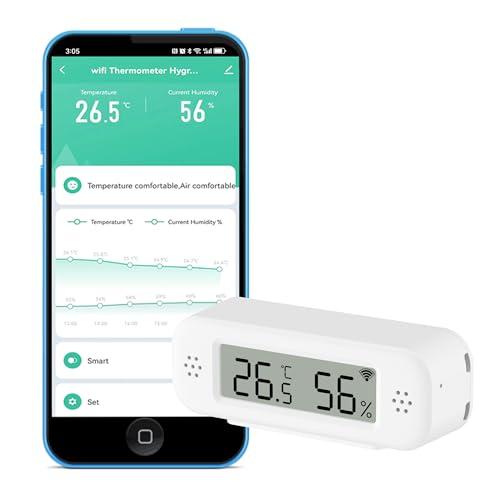
Note the SENCKIT device uses Tuya/Smart Life for setup and operates on 2.4 GHz WiFi. It supports smart scenes to trigger alerts, including high/low temperature and humidity events, and can turn connected devices (like fans or dehumidifiers) on or off based on preset limits. It is compatible with Alexa and Google Assistant, enabling voice queries for current temperature and humidity in a room. The system emphasizes scene automation and hands-free control in a smart home environment.
X-Sense WiFi Thermometer Indoor Hygrometer

The X-Sense system uses a base station to manage up to three sensors with 2.4 GHz WiFi connectivity. It provides remote monitoring and data storage export at no charge. The Swiss-made sensor delivers temperature accuracy to ±0.36°F (±0.2°C) and humidity accuracy to ±2% RH within 0–99% RH ranges. Users receive app notifications, and the base station can emit audible alarms for out-of-range conditions, offering multi-space coverage for homes, wine cellars, and basements.
X-Sense Indoor WiFi Thermometer Hygrometer (3 Sensors)

This variant expands monitoring across spaces with a four-space capable SBS50 base station and up to 10 sensors total. It connects via 2.4 GHz WiFi and provides real-time data access through the X-Sense app. High-precision sensors deliver ±0.36°F temperature accuracy and ±2% RH humidity accuracy. The system supports remote notifications, and you can manage sensors across multiple rooms or zones, including wine cellars or greenhouses.
eMylo WiFi Thermometer Hygrometer (4-Pack)

The eMylo four-pack provides real-time monitoring via 2.4 GHz WiFi with no gateway required. It delivers temperature accuracy of ±1°C (±1.8°F) and humidity accuracy of ±5% across a 0–100% RH range. Smart Life app alerts cover high/low temperature and humidity, with the option to trigger scenes such as turning an air conditioner or dehumidifier on or off. Voice command support includes Alexa and Google Assistant, enabling quick room checks verbally.
Buying Guide: Key Considerations For Choosing A WiFi Temperature Sensor
When evaluating WiFi temperature sensors for home use, several factors influence long-term satisfaction and effectiveness. Consider the following perspectives to ensure a well-matched purchase.
- Connectivity and compatibility: Most models operate on 2.4 GHz WiFi and support Tuya/Smart Life or dedicated apps. Confirm compatibility with your router and smartphone ecosystem (iOS/Android) and whether a gateway is required for advanced features.
- Sensor accuracy and range: Look for temperature accuracy within ±0.2–±0.6°C and humidity within ±2–±5% RH. If you store sensitive items (wine, cigars, produce), tighter tolerances and faster refresh rates (2 seconds) can be important.
- Alerts and automation: Choose devices offering push notifications, email alerts, and smart scenes. The ability to trigger HVAC, dehumidifiers, fans, or lights based on thresholds adds real value for climate control.
- Data storage and export: Some models include free data storage exports for historical analysis. If you need long-term trends, confirm export formats and storage duration.
- Display and readability: Electronic ink displays and large screens improve readability in bright rooms or dim basements. Consider battery life and whether the unit uses replaceable batteries or a rechargeable option.
- Multi-sensor scalability: For larger homes or spaces like basements, greenhouses, and wine rooms, check whether a gateway supports multiple sensors and how many sensors are supported per base station.
- Voice assistant integration: If convenient hands-free checks are important, ensure Alexa and/or Google Assistant compatibility and verify which data appears in voice queries.
- Privacy and data handling: Review how data is stored, whether local-only processing is possible, and how often data is synced to the cloud.
Choosing between a single-sensor model or a multi-sensor system depends on your space and monitoring needs. If you need room-by-room visibility, a base station with multiple sensors is often the better long-term investment. For quick, spot checks, a single-sensor device with robust app alerts may suffice. Compare not only price but also app reliability, update cadence, and the ecosystem’s openness for future integrations.