The following article highlights top talking alarm clocks and medication reminder devices designed for seniors, dementia care, and visually impaired users. Each product helps prompt timely medication, meals, or routines with clear spoken reminders, large displays, and adjustable alarms. Below you’ll find five carefully selected options, a quick reference table, and a practical buying guide to compare features like voice recording, alarm counts, power source, and accessibility.
| Product | Brand | Key Feature |
|---|---|---|
| MEDCENTER Talking Alarm Clock | MEDCENTER | |
| ORKA Talking Clock | ORKA | |
| MEDCENTER Your Minder | MEDCENTER | |
| Bovintex Medication Pill Reminder | Bovintex | |
| Clock With Day And Date (Roxicosly) | Roxicosly |
MEDCENTER Talking Alarm Clock

The MEDCENTER Talking Alarm Clock provides time and date alerts plus medication reminders via a repeating female voice. It can announce up to four daily dose times—Morning, Afternoon, Evening, and Night—and requires user acknowledgment after each alert. The device emphasizes a clear, voice-guided approach and a loud or extra loud setting for easier listening. Its simple controls are designed to avoid smartphone apps, focusing on straightforward medication compliance and routine reminders.
ORKA Talking Clock

ORKA’s Talking Clock is designed for seniors with dementia, hearing loss, or visual impairment. It features a large 5.69” display with 1.93” high digits and the ability to record up to eight alarm messages. It offers a 30-minute loop to prevent missed reminders and supports six languages. This AC-powered clock includes a mute option, a high-volume output of up to 90 decibels, and a USB port for additional accessibility. Users can hear time and day details spoken aloud in familiar phrases.
MEDCENTER Your Minder

Your Minder lets users pre-record and playback up to six reminders, making it suitable for medication schedules, meals, or other daily tasks. The device emphasizes a simple setup with loud and extra-loud options and a large backlit display for night viewing. It is designed to function without a smartphone or apps, focusing on reliable, independent reminders for seniors and care recipients.
Bovintex Medication Pill Reminder (Pink)
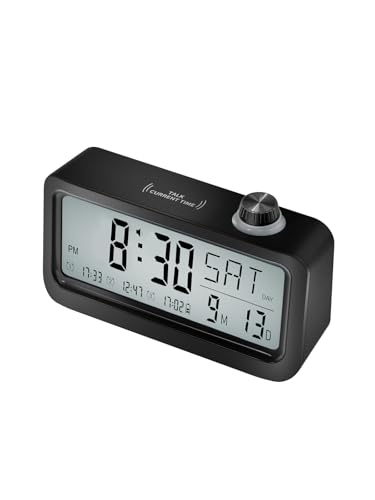
This Bovintex model offers three customizable voice reminders and touch-to-talk capability. It runs via USB, reducing battery concerns, and is designed for seniors who respond well to a familiar voice. The three volume levels support different hearing needs, making it a practical option for daily medication prompts and routine reminders in households with varying audio requirements.
Clock With Day And Date (Roxicosly)

Roxicosly’s Clock With Day And Date combines a 7-inch HD display with 20 normal alarms and 20 reminders. It presents day, date, and time with clear icons for different times of day, supporting dementia-friendly visuals. The device offers a sleep mode and adjustable brightness to reduce light disturbance, helping users manage medication and personal routines across a full week with personalized reminders.
Buying Guide
Key considerations when choosing a talking alarm clock or medication reminder device include:
- Voice and language options: Look for devices with clear spoken prompts and multiple languages if needed for caregivers or multilingual users.
- Alarm capacity: Determine how many daily reminders you need (4, 6, or more) and whether fixed times or flexible scheduling is important.
- Display readability: Bigger digits, high contrast, backlighting, and large screens help users with visual impairment.
- Power and portability: Decide between USB-powered, battery-backed, or AC-powered units based on reliability and convenience during outages.
- Recording capability: Some models allow personalized voices, which can improve recognition and adherence.
- Ease of use: Favor simple controls without smartphone integrations for better independence and fewer setup barriers.
- Additional features: Day/date displays, sleep modes, and volume control levels can enhance day-to-day usability and reduce confusion.
For caregivers, assess whether the device can support multiple users, offer remote alerts, or integrate with other assistive devices. Compare loudness levels, notification tones, and the clarity of spoken reminders to choose a model that minimizes missed doses and maximizes user comfort. Consider trying a few options to identify which voice, display, and interface best fit the user’s needs and daily routine.