Strobe lights paired with ultrasonic pest repellents provide a non-toxic, continuous approach to deter mice, rats, and other household pests. This article showcases top-rated products that combine motion-activated PIR sensors, multi-mode ultrasonic waves, and high-visibility LED strobes to disrupt pests’ senses. Each option is designed for indoor use, with some models suitable for attics and garages, while others are built for outdoor spaces. Read on to compare features, modes, and effectiveness considerations to help choose the right solution for your space.
| Product | Brand | Key Features |
|---|---|---|
| Mouse Repellent Ultrasonic Plug in, 360° Ultrasonic Rodent Repellent with PIR Sensor & LED Strobe Light for Indoor | XMUNIHA | 3 repelling modes, 9 LED strobe lights, PIR sensors, 360° coverage |
| Ultrasonic Mice Repellent, Rodent Repellent, 2026 Upgraded Ultrasonic Pest Repellent Plug in | PUBAMALL | 4 modes (Test, Fixed, Sweep, Double), 9 LED strobe lights, multi-target |
| Mice Repellent for House 2025 Upgraded Ultrasonic Squirrel Repeller | LAHUCK | LED strobe, 4-mode switch, day/night adaptation |
| Mouse Repellent Ultrasonic Plug in, 360° Ultrasonic Rodent Repellent with PIR Sensor & LED Strobe Light | XMUNIHA | Variable/fixed frequencies, bionic cat meow, 9 LED strobes |
| Mouse Repellent Ultrasonic Plug in, 360° Ultrasonic Rodent Repellent with PIR Sensor & LED Strobe Light | QMYJOHN | 8-speaker setup, 3900 sq ft coverage, 3 scene modes |
Note: Each product uses a combination of ultrasonic sound, visual strobes, and sensor-triggered responses to encourage pests to leave treated areas. When selecting a model, consider room size, target pests, power source, and whether outdoor compatibility is required for yards or barns.
1) XMUNIHA Mouse Repellent With PIR Sensor And LED Strobe

This upgraded 2026 model integrates ultrasonic waves with a 9-LED strobe and three repelling modes: Day, Night, and Auto PIR Sensor. The PIR sensor automates responses to rodent movement, intensifying the effect when activity is detected. The design targets rodents through hearing, vision, and nervous-system disruption, encouraging them to avoid treated spaces. Suitable for indoor use in homes and offices, it supports continuous protection by selecting the mode most appropriate for the environment.
2) Ultrasonic Mice Repellent With 9 LED Strobe Lights

This 2026-upgraded indoor repellent uses ultrasonic waves combined with 9 LED strobes to disrupt the rodents’ nervous systems and vision in dark spaces. Four operating modes—Test, Fixed, Sweep, and Double—allow customization to target mice, squirrels, and similar pests. It’s designed for attics, basements, and living areas where continuous deterrence is desired, helping to reduce pest activity over time without traps or chemicals.
3) LAHUCK Ultrasonic Squirrel And Rodent Repellent With LED Strobes

This 2025 upgraded device creates multiple disturbances: ultrasonic waves paired with strobe LEDs, plus four selectable modes, including a test function and a universal setting for various pests. The product emphasizes long-term deterrence by adjusting frequency and light patterns to prevent pests from adapting. It is positioned for homes and RVs where a robust, non-toxic deterrent is preferred.
4) QMYJOHN Indoor Ultrasonic Pest Repeller With LED Display
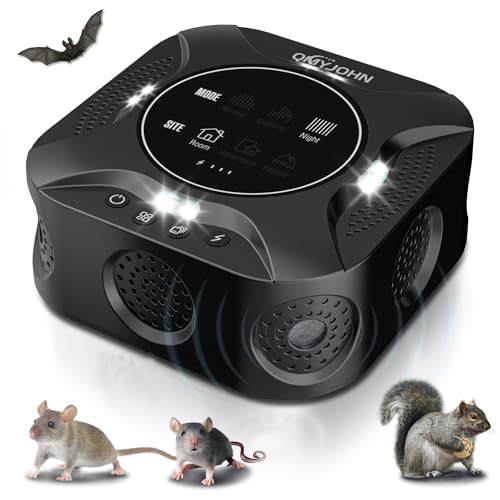
Designed for broad indoor coverage up to about 3900 square feet with 8 speakers, this device uses multiple modes and scene settings to tailor pest deterrence to room layout. The built-in LED display helps users monitor which mode is active and how lighting affects pest perception. It aims to deter mice, squirrels, roaches, and other common rodents by combining sonic frequencies with visual cues.
5) Compact 9-LED Strobe Rodent Deterrent (General Use)

Note: This section highlights a compact deterrent with strobes and motion-sensor options suitable for outdoor spaces like yards or gardens. It’s included to provide a broader perspective on strobe-enabled pest control, recognizing that some users prefer exterior deterrents to supplement interior devices in a layered approach.
Buying Guide: Key Purchase Considerations
- Target pests: Confirm whether the device addresses mice, rats, squirrels, or broader wildlife. Some models emphasize rodent deterring, while others can deter multiple pests with adjustable modes.
- Coverage area: Read square footage ratings and consider high ceilings or cluttered rooms. Indoor devices typically cover smaller spaces, while some models boast broader ranges up to several thousand square feet.
- Mode variety: Look for multiple ultrasonic frequencies, strobe light patterns, and PIR sensor integration. Modes such as Test, Fixed, Sweep, and Auto help adapt to different environments and pest behaviors.
- Sensor features: PIR sensors improve responsiveness by triggering deterrence when movement is detected. Double sensors or wider coverage can enhance effectiveness in larger rooms.
- Lighting and visibility: LED strobe brightness and color patterns impact how pests perceive the treated area. Ensure the lighting is appropriate for indoor spaces and won’t disturb occupants.
- Power source: Check whether the device is plug-in, battery-powered, or vehicle-compatible. For continuous protection, plug-in models with reliable power sources are common.
- Safety and maintenance: These devices are chemical-free and generally safe for humans and pets when used as directed. Regular placement adjustments can prevent pests from habituating to a single device.
- Outdoor suitability: If you need yard or garden deterrence, ensure the device is weatherproof and designed for outdoor use. Some models offer weather resistance and solar options.
When evaluating options, consider using a combination approach: interior plug-in units for rooms and attics, plus exterior deterrents for entry points. Reading user reviews about real-world effectiveness and maintenance needs can provide practical insights beyond feature lists.