Searching for a reliable way to upgrade legacy stereo setups to immersive surround sound? This guide reviews five well-regarded stereo-to-surround converters that convert digital audio signals into enhanced analog outputs. Each option supports common formats like PCM, Dolby, and DTS, and offers various input types such as optical, coaxial, and ARC compatibility. Read on to compare capabilities, adjustability, and compatibility with typical home-theater gear to find a solid match for your television, game consoles, and AV receivers.
| Product | Brand | Key Feature | Inputs |
|---|---|---|---|
| AUTOUTLET 192kHz DAC Optical to RCA | AUTOUTLET | 192 kHz high-resolution DAC with integrated amp | Optical Toslink |
| SOUTHSKY 5.1/2.1 DAC | SOUTHSKY | 5.1/2.1 channel output with memory function | SPDIF optical, Coaxial, 3.5mm aux |
| NAKVMN 5.1 Channel Converter | NAKVMN | 5.1 channel decoding from digital signals | Optical SPDIF, Coaxial, AUX |
| PROZOR 192KHz DAC | PROZOR | High-res 192 kHz DAC with dual RCA and 3.5mm output | Toslink/Coaxial |
| DOREWINAUD HDMI ARC Extractor | DOREWINAUD | ARC-compatible extractor with 5.1 output | HDMI ARC, Optical, Coaxial |
AUTOUTLET 192kHz Optical To RCA DAC Converter

AUTOUTLET’s 192kHz DAC converter converts optical Toslink digital audio to analog RCA output, enabling direct connection to stereo amplifiers or older AV receivers. It includes an integrated professional audio amplifier chip and a dual-channel operational amplifier to improve output level and clarity. The device is designed for PCM-compatible signals and emphasizes clean signal conversion with emphasis on reducing distortion. A notable setup note: configure your TV’s digital audio output to PCM and adjust volume on the connected output device rather than the TV remote. This unit is suitable for upgrading classic home theaters lacking modern HDMI audio returns.
Key considerations:
– Supports 192 kHz sampling on optical inputs.
– Requires a separate volume control on the downstream amplifier.
– Not intended for headphone-only connections; focuses on line-level RCA output.
– Good pick for end-to-end optical-to-analog conversions in stereo environments.
SOUTHSKY 5.1/2.1 DAC With 6 RCA Outputs
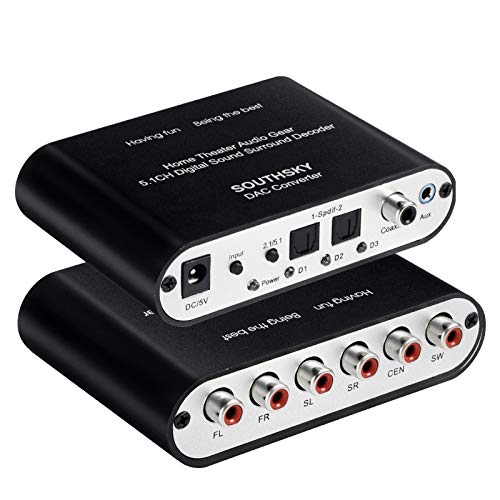
This converter is designed to translate digital optical or coaxial inputs into 5.1-channel analog outputs (via six RCA connectors) or 2.1-channel stereo, depending on the mode. It includes multiple input ports (two SPDIF optical inputs, one coaxial, and a 3.5mm aux) plus a straightforward one-key switch to toggle among modes. The device also features a memory function so input settings persist after reboot, which helps avoid repetitive reconfiguration in daily use. It’s suitable for upgrading older AV receivers or basic sound systems to a more immersive multi-channel experience without replacing the entire setup.
Key considerations:
– Flexible 5.1 or 2.1 output; supports LPCM and common surround formats.
– Simple switch for mode selection; recovery after restart enhances user experience.
– Six RCA outputs ensure compatibility with many legacy receivers.
– Overall emphasis on ease of use and reliable signal conversion for older gear.
NAKVMN 5.1 Channel Digital To Analog Converter

The NAKVMN model decodes DTS and AC-3 source signals into analog 5.1 channel audio, enabling home theaters to interpret digital surround content on older speaker setups. The product emphasizes decoding accuracy and compatible outputs to drive multi-speaker arrangements. It’s a practical bridge for users with legacy analog systems seeking to leverage modern digital sources like Blu-ray players or game consoles without upgrading the entire audio chain.
Key considerations:
– Focused on decoding DTS/AC-3 for 5.1 channel output.
– Works with common optical/coaxial inputs and AUX paths.
– Suitable for upgrading older receivers that lack built-in decoding for certain formats.
– Clear emphasis on preserving reliable surround interpretation in a compact device.
PROZOR 192KHz Digital to Analog Converter

The PROZOR DAC converts coaxial or Toslink/SPDIF digital signals to analog L/R RCA and 3.5mm outputs, supporting high-resolution up to 192 kHz/24-bit. The device is designed with an upgraded audio amplifier and dual operational amplifier for clearer, lower-distortion sound. It is suited for users who want improved stereo output from digital sources and may appreciate the added 3.5mm output for headphones or auxiliary speakers. A caveat is that optical output is not universally compatible with every setup, so verify compatibility with your receiver or amplifier before purchase.
Key considerations:
– High-resolution support up to 192 kHz/24-bit.
– Simultaneous RCA and 3.5mm outputs enhance versatility.
– Requires PCM-compatible sources and compatible downstream gear.
– Upgrade-focused DAC with improved amplification for cleaner sound.
DOREWINAUD HDMI ARC Audio Extractor

This HDMI ARC extractor supports 32, 44.1, 48, 96, and 192 kHz sampling rates with 24-bit S/PDIF input bitstreams. It outputs both optical and coaxial channels to deliver a rich 5.1-channel surround experience from ARC-enabled TVs. The device is positioned as a straightforward bridge between modern HDMI ARC sources and traditional surround sound systems, leveraging the TV’s ARC capability to pass audio to an external amplifier or soundbar. It’s well-suited for users with TVs that support ARC but whose audio chain lacks ARC support on the downstream gear.
Key considerations:
– ARC compatibility simplifies linking TVs to external sound systems.
– Supports Dolby and other common surround formats via down-mstream outputs.
– A practical solution for upgrading to multi-channel audio without new receivers.
– Emphasis on a plug-and-play workflow for quick setup.
Buying Guide: Key Purchase Considerations
- Input and output formats: Confirm which digital inputs (optical, coaxial, HDMI ARC, or USB) your source devices use and ensure the converter provides compatible outputs (RCA, 3.5mm, or optical/coaxial).
- Surround decoding vs. stereo enhancement: Some units focus on basic stereo conversion with a pseudo 5.1 output, while others decode Dolby Digital or DTS. Choose based on whether you need true surround decoding or simply an upgraded stereo signal.
- Sample rate and bit depth: Higher sampling rates (e.g., 192 kHz/24-bit) offer cleaner audio, but actual benefit depends on your source material and speakers. Ensure your downstream gear can handle the same rates.
- Volume control: Several devices require volume adjustments on the connected amplifiers or speakers rather than the converter itself. Verify how volume management works with your setup.
- Compatibility with older gear: If you have an older AV receiver or speakers, ensure the converter provides adequate RCA or 3.5mm outputs and that it supports LPCM and common Dolby/DTS formats.
- Power and size: Check for external power requirements and the physical footprint to ensure the unit fits in your entertainment center without obstructing vents or cables.
- Reliability and support: Look for devices with clear setup notes, stable signal recovery features, and accessible customer support if you encounter compatibility quirks with your TV or game console.
In comparing these options, consider your current gear: the presence of HDMI ARC, the number of speakers in your setup, and whether you primarily need a pure stereo upgrade or a true multi-channel experience. If you have a modern TV and a capable AVR, HDMI ARC extractors or optical-to-analog converters with robust Dolby/DTS support tend to deliver the most consistent results. For simpler setups with legacy receivers, optical-to-analog or coaxial-to-analog DACs with 5.1/2.1 output often present the most practical balance of cost and performance.