Discover top stereo line level mixers designed for sub-mixing keyboards, guitars, drums, and more. This guide highlights five capable units that balance noise, portability, and control, helping you route multiple inputs into a clean single output for small clubs, bars, or home studios. Explore features, connectivity, and practical considerations to choose the right mixer for your setup.
| Product | Input/Output Notes | |
|---|---|---|
| Moukey Audio Mixer MAMX3 | Moukey | 8 stereo/mono inputs; DC 5V; sub-mixing |
| LZSIG Mini Audio Mixer | LZSIG | 4-channel line mixer; 1/4″ & 1/8″ outputs; mono/stereo switch |
| Douk Audio MX5 | Douk Audio | 4-channel; LED level meters; DC5V |
| FlyroadUp RCA Splitter Mixer | FlyroadUp | 2 in / 4 out; independent channel volume |
| YGiTK Mini Audio Mixer | YGiTK | 4-channel; 6.35mm and 3.5mm; stereo/mono switch |
Moukey 8-Channel Stereo Line Mixer for Sub-Mixing

The Moukey MAMX3 offers eight input channels suitable for small venues or home studios. It supports stereo or mono operation, with a 5V DC power supply to simplify setup. The device is designed to mix multiple signals into a single track, making it appropriate for keyboards, guitars, drums, or sub-mixes. Users should note that TRS or TS cables are not included and external power with proper certification is recommended to minimize noise and interference.
LZSIG 4-Channel Mini Audio Mixer
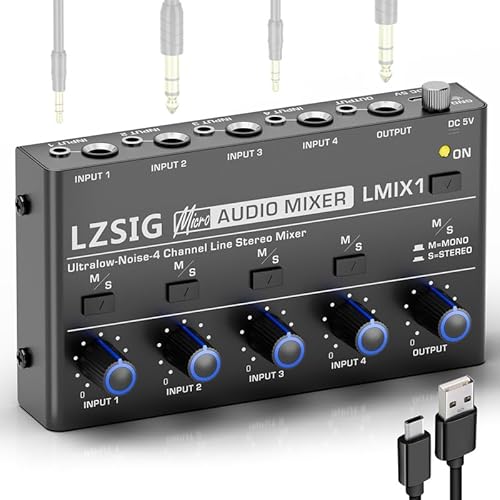
The LZSIG 4-channel mixer supports four inputs with a choice of mono or stereo output. It emphasizes ultra-low noise with a dedicated power management chip and ROHM low-noise op-amps. It accepts 3.5mm and 6.35mm TRS/TS cables for flexible connectivity and can switch between mono and stereo modes, making it versatile for different live or home setups without adapters.
Douk Audio MX5 4-Channel Mixer
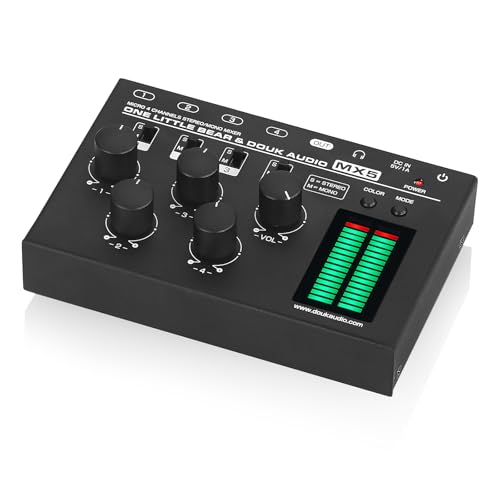
The MX5 provides four channels with independent mono/stereo switching and a main volume control. It includes a built-in LED level meter to visualize output levels and operates from a 5V DC supply. This makes it convenient for compact setups where quick visual feedback on levels is helpful, and it supports a range of devices via standard 6.35mm and 3.5mm connections.
FlyroadUp 2 In / 4 Out Stereo Mixer

The FlyroadUp unit functions as a stereo line level distributor with two inputs and four outputs, featuring a built-in amplifier for up to +15 dB gain. Each channel has its own volume control, facilitating flexible, real-time mixing without complex routing. It suits DJ setups, home studios, and podcasters who need straightforward multi-output distribution plus quick level adjustments.
YGiTK 4-Channel Mini Mixer

The YGiTK mixer provides four channels with independent volume controls and supports both 6.35mm and 3.5mm connections, making it a flexible option for guitars, keyboards, and wireless mics. Its stereo/mono switching adds versatility for different live or studio configurations while maintaining a compact footprint and low-noise performance, suitable for small venues or home use.
TENEALAY Two-Channel Passive Mixer

The TENEALAY two-way audio mixer is a compact passive option with stereo 2-in/1-out capability. Independent volume controls on each track help mix multiple sources for headphones or speakers. It’s powered passively (no external power required) and supports a range of devices, making it a convenient, low-profile solution for desktop setups and casual listening or basic mixing tasks.
Buying Guide: Key Considerations For Choosing A Stereo Line Level Mixer
- Input/Output Requirements: Assess how many sources you need to connect and what outputs you require (headphones, speakers, or recording devices). More channels give you flexibility, but also add size and complexity.
- Channel Configuration: Decide between mono vs. stereo operation, and whether you need independent channel control or simple bus mixing. Some models offer stereo/mono switching for versatility.
- Noise and Headroom: Look for low-noise designs, especially if you’ll be working with quiet microphones or delicate instruments. Ultra-low-noise op-amps and proper grounding features help reduce hum and interference.
- Power Requirements: Many compact mixers run on USB-C or DC 5V. Ensure your power source is compatible and consider the impact on noise if using shared power supplies.
- Connectivity: Check for 1/4″ (6.35mm) and 3.5mm inputs/outputs, as well as TRS/TS compatibility. Adapter needs can influence setup time and reliability.
- Size and Portability: If you’re touring or setting up in different spaces, a compact, lightweight design with straightforward controls is advantageous.
- Durability and Build: Metal enclosures and robust knobs help withstand transport and live-use environments, especially in small venues.
- Power Safety: Prefer units with adapters certified for CE or UL, and avoid noisy power sources to minimize interference.
- Price-to-Feature Ratio: Compare features such as LED meters, independent channel controls, and gain options against the price to determine value for your use case.
- Future Expansion: If you anticipate needing more inputs later, consider modular or larger-capacity options or mixers with easily expandable link options.
In choosing a stereo line level mixer, consider your typical venue size, the instruments involved, and whether you require occasional portability or stationary rack-mount capabilities. The products listed here vary in channel count, connection types, and power needs, offering a range of practical options for sub-mixing in small clubs, bars, or home studios without overcomplicating the signal path.