Transform digital SPDIF signals into rich analog sound with reliable, high-resolution adapters. This guide highlights five top-rated SPDIF to analog converters, each chosen for compatibility, ease of use, and audio fidelity. Read on to compare capabilities, input/output options, and installation tips to help your TV, Blu-ray, or game console deliver pristine sound to speakers or soundbars.
| Product | Brand | Key Feature |
|---|---|---|
| PROZOR 192KHz DAC (Aluminum) | PROZOR | Coaxial/Toslink to L/R and 3.5mm with up to 192kHz/24bit |
| LiNKFOR 192kHz DAC Converter | LiNKFOR | Optical Toslink to RCA with built-in amplifier |
| PROZOR 192KHz DAC (Toslink + 3.5mm) | PROZOR | Coaxial/Toslink to L/R and 3.5mm; PCM/LPCM support |
| LiNKFOR 3.5mm to SPDIF Converter | LiNKFOR | Analog 3.5mm to Optical SPDIF for digital output |
| AUTOUTLET 192kHz DAC | AUTOUTLET | Optical to RCA with built-in amplification |
Note: Each device supports 192kHz and 24-bit PCM or LPCM signals, with varying emphasis on 5.1 compatibility and DAC amplification. Some require PCM/LPCM settings on your TV or player for optimal output. Always confirm that your source sends PCM/LPCM when using these converters for best fidelity.
PROZOR 192KHz Digital to Analog Converter (Aluminum)

The PROZOR unit converts coaxial or Toslink/SPDIF digital PCM audio signals into analog L/R RCA and a 3.5mm jack simultaneously. It is designed for devices like PS3, PS4, Apple TV, and home theater systems. Users should set the TV’s audio output to PCM to avoid distortion and can adjust volume on the output device. This model emphasizes high-resolution capabilities up to 192kHz/24bit and includes an upgraded audio amplifier and dual-channel operational amplifier for cleaner sound and lower distortion. It supports 2-channel PCM and is suitable when you want a straightforward, dependable analog conversion with minimal setup.
LiNKFOR 192kHz DAC Converter (Toslink to RCA)

LiNKFOR’s DAC converts Optical Toslink digital audio to analog RCA L/R with an integrated audio amplifier. It’s designed to modernize old speakers by delivering clean, pure sound through RCA outputs, while maintaining a high sampling rate of up to 192kHz and 24-bit depth. The built-in amplifier helps boost the RCA signal, making it easier to drive entry-level receivers or powered speakers. This option is ideal for upgrading HDTVs, Blu-ray players, or game consoles that lack robust analog outputs but still need high-fidelity audio from digital sources.
PROZOR 192KHz DAC With 3.5mm Output (Toslink to L/R and 3.5mm)
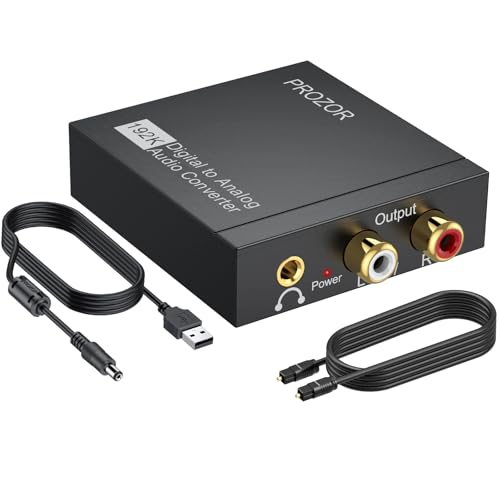
This PROZOR model mirrors the first in offering simultaneous L/R RCA and 3.5mm jack outputs from coaxial or Toslink/SPDIF sources. It reiterates the need to set the TV to PCM and adjust volume via the output device. It supports uncompressed LPCM/PCM, ensuring low distortion with 192kHz sampling and 24-bit depth. It is suitable for 5.1 decoding considerations, though its primary function is two-channel PCM conversion with higher-fidelity amplification for clearer sound reproduction.
LiNKFOR 3.5mm to SPDIF Converter

This converter turns 3.5mm analog audio into digital SPDIF output (Toslink). It is designed for two-channel PCM playback, offering a straightforward path from analog to digital, which is ideal for using older analog sources with modern digital soundbars or receivers. It supports 48kHz sampling for stable digital output and preserves audio fidelity through precise conversion. This device is best for preserving fidelity when routing analog sources toward digital input-capable systems.
AUTOUTLET 192kHz Optical to RCA DAC

AUTOUTLET’s converter targets professional-grade audio processing, sending optical Toslink digital audio to RCA analog outputs while including a built-in amplification stage. The device requires PCM/LPCM output settings, with guidance to configure your TV’s digital audio output accordingly. It emphasizes low-noise transmission and high-resolution support up to 192kHz/24-bit. This unit is well-suited for users who need robust amplification in conjunction with modern TVs or set-top boxes to drive larger or more demanding audio systems.
Buying Guide: Key Purchase Considerations And Comparisons
- Output format compatibility: Most devices support PCM/LPCM and up to 192kHz/24-bit. If you require 5.1 or Dolby decoding, these converters are typically not decoders, so verify your source can send PCM/LPCM before purchasing.
- Input type: Choose Toslink (optical) or coaxial (S/PDIF) depending on your source and cables. Some models offer both inputs, increasing flexibility for multiple devices.
- Amplification and output level: Some units include built-in amplifiers to boost RCA output levels, which helps drive older or less powerful receivers. If your system already has strong amplification, a basic converter without a built-in amp may suffice.
- Ease of use: Look for plug-and-play operation with clear PCM/LPCM setup directions on your TV or Blu-ray player. Some units require specific settings like PCM output on the source device to avoid distortion.
- Build quality and form factor: Aluminum housings and compact designs tend to be more durable and easier to hide in a home theater setup. Consider cable length and included accessories (like optical cables or power adapters) when evaluating value.
- Downstream compatibility: Ensure the analog outputs (RCA or 3.5mm) match your speaker system or amplifier inputs. Some setups benefit from a dedicated DAC with a robust analog stage; others may work fine with a simple RCA path.
- Price and warranty: Compare models with similar specifications. A longer warranty can provide peace of mind for a device designed to stay in a home theater rack for years.
In selecting a SPDIF to analog converter, consider your primary source devices, the required output connections, and whether you need additional amplification. If you regularly switch sources, a model with multiple inputs or a simple remote control can streamline daily use. For users focusing on high-resolution audio, prioritize DACs rated at 192kHz/24-bit and verify that your content is PCM/LPCM to avoid unexpected downsampling. Always ensure the TV or source device is configured correctly to PCM to maximize fidelity and prevent distortion in the analog path.