Choosing the right solder terminals for printed circuit boards (PCBs) is essential for secure connections and durable prototyping. This guide highlights five well-regarded PCB mount solder terminals, covering common pitches, materials, and current ratings. Each option is suitable for hobbyists and professionals seeking dependable electrical connections in low- to medium-power projects. The selections emphasize a range of pitches (2.54 mm to 5.08 mm), wiring compatibility, and easy installation. Read on to compare key specs and find the best fit for your next electronics build.
| Product | Brand | Pitch / Size | Material | Key Use |
|---|---|---|---|---|
| Board Mount PCB Solder Tab Terminals | uxcell | 4 mm / 0.16″ pitch; 6.3 mm spade width | Brass, silver plated | 2-pole terminals for solder tab connections |
| 2 Pin 5mm Pitch Screw Terminal Block | Xiaoyztan | 5.08 mm | Not specified; typical plastic housing | Prototyping and breadboard interfacing |
| 4-Pin 2.54mm Pitch Terminal Block | Qjaiune | 2.54 mm | Brass pins, plastic shell | Low-voltage electronics and wiring |
| 72Pcs 5mm Pitch Block Connectors | Tugermoola | 5 mm | Plastic body with metal pins | Multiple pin configurations for flexible wiring |
| 52Pcs 2.54mm 0.1″ Pitch Block | minidodoca | 2.54 mm | Brass pins, plastic shell | Varied pin counts; convenient screw terminals |
uxcell Board Mount PCB Solder Tab Terminals

These uninsulated solder tab terminals are designed for board mounting. The product features brass construction with silver plating, 2 poles, and a 4 mm/0.16″ pole pitch. Hole diameter is 2 mm/0.8″, with a spade width of 6.3 mm/0.25″. They are suitable for secure solder connections on PCBs, balancing conductivity with ease of use in compact layouts. The dual-pole setup supports straightforward wiring for power or signaling paths on small projects. Consider for test fixtures or compact PCB assemblies where a solder tab is preferred over screw terminals.
Xiaoyztan 2 Pin 5mm Pitch Terminal Block

This 2-pin screw terminal block is built for quick prototyping and breadboard interfacing. It features a 5.08 mm pitch and a compact footprint (about 0.4″ x 0.6″ x 0.3″ per unit). The blue blocks are 2-pin and designed for easy insertion and secure clamping of 14-22 AWG wiring. This style is widely used in beginner to intermediate projects for reliable connections that can be adjusted rapidly during testing and development.
Qjaiune 4-Pin 2.54mm Terminal Block

The Qjaiune 4-pin terminal block uses a 2.54 mm pitch, rated up to 150V and 6A, with a brass inner pin and a flame-retardant, insulated plastic shell. It supports wiring ranges from 24 to 12 AWG, making it suitable for small electronics projects, hobbyist kits, and low-power appliances. The plastic housing adds safety for handling and reduces the chance of accidental shorts during assembly, while the screw terminals ensure secure and removable connections as needed.
Tugermoola 72Pcs 5mm Pitch Terminal Block

This set includes 2-pin, 3-pin, and 4-pin screw terminal blocks, all at a 5 mm pitch. With a rated voltage of 300V and current of 10A, these connectors handle a range of wiring from 26 AWG to 14 AWG. They are rated for operation between -40°C and 105°C and are designed for plug-and-play assembly, making it easy to splice wires to fit various circuit configurations on a PCB. The supply is ideal for rapid prototyping where multiple terminal configurations are frequently needed.
minidodoca 52Pcs 2.54mm Pitch Terminal Blocks
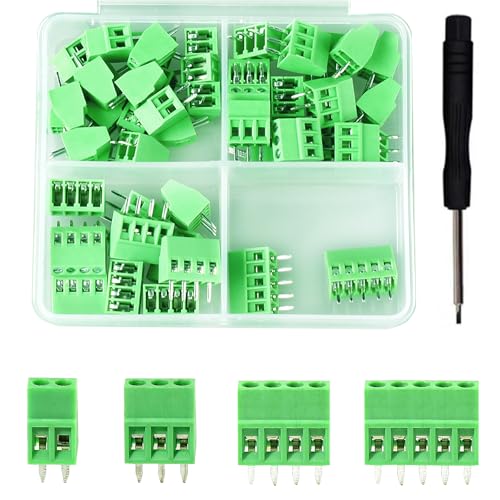
The minidodoca kit provides 52 pieces across 2P, 3P, 4P, 5P, and 2P configurations with a 2.54 mm pitch and an included screwdriver. Each terminal supports up to 150V and 6A, suitable for 18 AWG to 26 AWG wires. The assortment is practical for compact electronics projects, allowing designers to select the exact pin count needed for a given sensor, display, or microcontroller interface. The included screwdriver helps streamline assembly and maintenance tasks.
Buying Guide: Key Purchase Considerations
- Pitch and footprint: Choose a pitch that matches your PCB layout and available space. 2.54 mm and 5.08 mm pitches are common for breadboard-friendly and compact boards, respectively.
- Current and voltage ratings: Ensure the terminals handle the expected load. For hobby projects, look for components rated at least 150V and 6A; for higher-power needs, select higher ratings.
- Material and durability: Brass terminals with plating offer good conductivity. Plastic housings should be flame retardant if used in higher-risk environments.
- Wiring compatibility: Confirm wire gauge compatibility (AWG) to avoid damage during crimping or screw tightening. Screw terminals accommodate a range like 18–26 AWG.
- Mounting style: Board-mount terminals are ideal for permanent PCBs, while plug-in blocks offer quick changes during prototyping.
- Number of poles: Plans for 2P, 3P, or 4P configurations should guide your selection to minimize excess parts and maximize connection density.
- Safety and insulation: Insulated shells reduce the risk of shorts on exposed conductors; flame-retardant plastics add a safety margin in busy builds.
- Ease of use: Consider whether you prefer quick-connect (screw) terminals for repeatable modifications or fixed solder tabs for compact, robust connections.
- Availability and ecosystem: A broad selection with compatible accessories (screwdrivers, spacers, or mating headers) can simplify future expansions.
In summary, the best PCB mount solder terminals combine reliable materials, appropriate pitches, and practical wiring options. This spread covers common needs from compact consumer electronics to breadboard-friendly prototyping, enabling stable connections across a range of project scales. When selecting, align your choice with the board’s footprint, the anticipated wire gauge, and the intended lifecycle of the assembly.