Finding the right 1000-watt solar inverter helps bridge the gap between solar panels and household‑grade AC power. This guide reviews five reliable 1000W inverters that convert 12V DC to 120V/110V AC with pure sine wave output, suitable for RVs, off‑grid homes, camping, and emergency backup. Each product is chosen for stability, safety features, and real‑world compatibility with common devices. Use the summary table below to compare core specs at a glance.
| Product | Brand | Key Benefit | Peak Surge | Notable Feature |
|---|---|---|---|---|
| Renogy 1000W Pure Sine Wave | Renogy | Grid‑like power quality | 2000W | Built‑in USB port, multiple protections |
| BELTTT 1000W Pure Sine Wave | BELTTT | Smart LCD with real‑time data | 2000W | Intelligent LCD display |
| LANDERPOW 1000W Pure Sine Wave | LANDERPOW | All‑in‑one ports | 2000W | 3 AC outlets, USB‑C, remote |
| Renogy PUH 1000W Pure Sine Wave with UPS | Renogy | UPS transfer for critical loads | 2000W | Bluetooth & app control |
| CELYYPU 1000W Pure Sine Wave | CELYYPU | Dual LCD monitoring | 2000W | 14.76 ft remote display |
The products above all deliver stable, grid‑quality AC power from a 12V source, with surge capacity suitable for starting motors or compressors. They include safety protections and practical features like USB charging, remote monitoring, and transfer switching, which help protect electronics and extend component life in mobile or off‑grid environments.
Renogy 1000W Pure Sine Wave Inverter

This Renogy model provides 1000W of continuous DC‑to‑AC power with a 2000W peak surge for startup loads. It delivers a pure sine wave with efficiency above 90%, reducing energy loss and improving compatibility with sensitive electronics. Built‑in LED indicators show under/over‑voltage, over‑temperature, overload, and short circuit conditions. The unit includes cooling fans and ground‑fault circuit interrupter protection, helping ensure safe operation for flood lights, TVs, or laptops. It’s designed for quiet, reliable performance in off‑grid or motorhome scenarios.
Key considerations for Renogy 1000W include its protection suite and its emphasis on clean power delivery. Users should ensure adequate ventilation to manage heat during heavy, sustained loads. The built‑in USB port simplifies charging small devices without a separate adapter, and the robust 12V input keeps compatibility with most battery banks used in solar setups.
BELTTT 1000W Pure Sine Wave Inverter

BELTTT’s 1000W inverter shares the standard 1000W continuous rating with a 2000W surge. It emphasizes a grid‑like output with high efficiency, supporting inductive and capacitive loads without excessive noise or flicker. The intelligent LCD display shows input/output voltages, battery status, and load in real time, aiding troubleshooting and monitoring in mobile installations.
Its smart display helps operators verify that the battery is healthy and that the inverter is delivering expected power. The unit’s practical design makes it suitable for RVs or cabins, especially when you want a quick read on system health. As with most inverters, ensure your battery bank maintains appropriate voltage during heavy draws to avoid triggering protection circuits.
LANDERPOW 1000W Pure Sine Wave Inverter
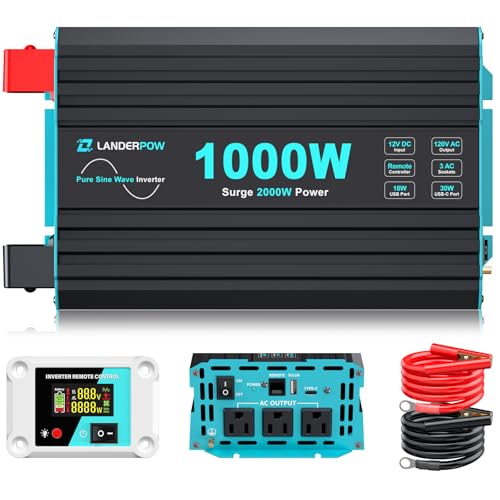
LANDERPOW combines 1000W continuous output with 2000W surge and an efficiency rating above 91%. It features three AC outlets and a 5V USB port plus a USB‑C port, supporting a wide array of devices from laptops to small kitchen appliances. The remote control adds convenience for behind‑the‑panel operation, while the unit’s power design aims to minimize hum and flicker with inductive loads like kettles and heaters.
For users prioritizing multiple charging options, LANDERPOW’s multi‑port setup is advantageous, especially on longer trips or during outages. As with any pure sine wave inverter, keep loads within the continuous rating and avoid excessive startup spikes that could trip protections. Proper ventilation remains important to maintain steady performance in hot climates.
Renogy Inverter PUH With UPS Transfer

This Renogy PUH model pairs a pure sine wave inverter with a built‑in UPS transfer switch. It ensures an automatic, seamless shift between battery backup and grid power for critical loads, such as refrigerators or servers. With 1000W continuous power and 2000W surge, it supports moderate household and RV needs while maintaining grid‑quality AC power. Bluetooth and an accompanying app enable real‑time monitoring and control, facilitating remote supervision of voltage, load, and error codes.
UPS integration is a key feature for users who depend on background equipment that cannot tolerate interruptions. The transfer switch adds resilience in hybrid solar setups. Users should confirm compatibility with their battery chemistry and ensure the charging regime aligns with their battery protection strategy to avoid unnecessary cycling or overcharging.
CELYYPU 1000W Pure Sine Wave Inverter

CELYYPU’s 1000W inverter emphasizes a dual LCD display approach with a 14.76‑foot wired remote, allowing flexible placement while you monitor input/output voltage and load. It includes protection against under/over voltage, overtemperature, overload, and short circuits. The aluminum/plastic housing aims to balance durability with portability for RVs, campsites, or emergency kits. The product supports a broad spectrum of devices with stable, noise‑free power.
Prospective buyers should verify remote reach and ensure the remote control cable length fits their installation. Consider the availability of spare parts or service if you rely on this unit as a long‑term power solution, and keep a mind to proper battery storage and charging profiles to maintain inverter health.
Buying Guide
Key considerations when selecting a 1000W pure sine wave inverter include compatibility with your battery system (12V DC), peak surge handling, and the cleanliness of the AC waveform. A true pure sine wave minimizes humming and stress on sensitive electronics, essential for laptops, TVs, CPAPs, or medical devices.
Protection features are critical: look for over‑voltage and under‑voltage warnings, over‑temperature shutdown, overload protection, short‑circuit protection, and reverse polarity safeguards. Some models offer UPS transfer, Bluetooth monitoring, or LCD displays for real‑time diagnostics, which can simplify maintenance in RVs or off‑grid cabins.
Port selection matters: multiple AC outlets plus USB ports (including USB‑C) increase versatility for charging phones, tablets, and small appliances without needing adapters. Remote controls or mobile apps can improve usability when the inverter is placed out of reach.
Efficiency and heat management influence long‑term reliability. Inverters with efficiency above 90% reduce energy loss from battery discharge, and units with effective cooling minimize thermal throttling during startup surges. Ensure adequate ventilation, especially in enclosed spaces like vehicle compartments or small cabins.
Battery compatibility should guide your choice. If you plan to use LiFePO4 or AGM batteries, confirm that the charger and MPPT integration (where applicable) aligns with your battery’s charging profile. For hybrids that include MPPT solar charging, verify maximum PV input and recommended cable sizes to prevent voltage drop.
Finally, assess service availability and build quality. A robust warranty and responsive customer support help address field issues. Consider the environment where the inverter will operate—dust, vibration, and temperature extremes can affect performance. Selecting a model with protective housings and reliable connectors is a prudent investment for any off‑grid or mobile power system.