Choose a soil hygrometer detection module to automate your watering routines and monitor soil moisture with ease. This guide highlights five well-supported options, detailing their capabilities, voltage ranges, and practical uses for Arduino, Raspberry Pi, or standalone projects. Explore how capacitive and resistive sensors differ, what outputs they provide, and how to select the right module for your garden or smart irrigation setup.
| Product | Brand | Voltage Range | Output Type |
|---|---|---|---|
| HiLetgo 5pcs LM393 Soil Moisture Detect Sensor | HiLetgo | 3.3V-5V | Dual output: digital and analog |
| Ferwooh 3PCS LM393 Soil Moisture Detect Sensor Module | Ferwooh | 3.3V-5V | Digital output; adjustable threshold |
| Stemedu 5PCS Capacitive Analog Soil Moisture Sensor Module | Stemedu | 3.3V-5.5V | Analog output |
| KEAcvise LM393 Soil Moisture Sensor Pack | KEAcvise | 3.3V-5V | Digital output; simple humidity detect |
| Podazz 6pcs 3.3V-5V Soil Hygrometer Modules | Podazz | 3.3V-5V | Dual output (digital + analog) |
HiLetgo LM393 Soil Moisture Sensor Module – 5-Pack
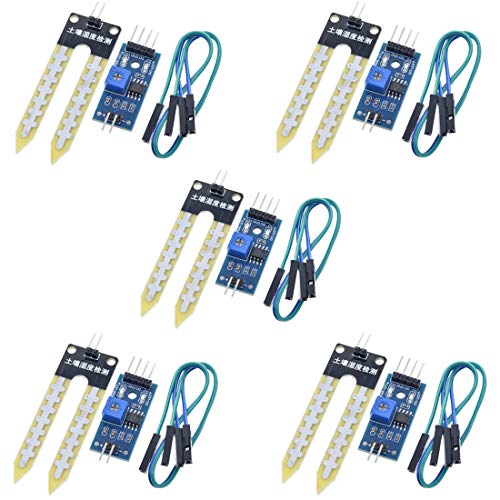
The HiLetgo set uses the LM393 comparator to detect soil moisture with a simple digital output and an additional analog output option. Suitable for automatic watering systems, its dual output mode supports straightforward threshold-driven watering or more precise moisture sensing. The sensors operate across 3.3V-5V, making them compatible with common microcontrollers such as Arduino and ESP-based boards. The kit is designed for scalable projects, enabling multiple sensor points for larger gardens or greenhouses.
Ferwooh LM393 Soil Moisture Sensor Modules – 3-Pack

The Ferwooh modules use the LM393 comparator for stable moisture detection. They feature a compact PCB size and a straightforward installation with fixed mounting holes. The 3.3V-5V operating range matches typical microcontroller hobby kits. The product emphasizes durability with nickel-plated surfaces to improve conductivity and longevity in soil contact. Output behavior is designed so that soil dryness yields a high-level digital signal, enabling reliable triggering of watering relays or microcontroller logic.
Stemedu Capacitive Analog Soil Moisture Sensor Modules – 5-Pack

Stemedu offers capacitive analog moisture sensing, which reduces soil corrosion effects on probes and improves longevity in moist environments. This version operates within 3.3V-5.5V and provides an analog output (0–3.0V) suitable for direct reading by microcontrollers. Its PH2.54-3P interface ensures easy wiring, and the sensor is compatible with common microcontroller platforms such as Arduino and Raspberry Pi. The capacitive approach generally offers less soil compaction and longer-lasting results in fluctuating moisture conditions.
KEAcvise LM393 Soil Moisture Sensor Pack – 5 Pieces

The KEAcvise set provides multiple LM393-based moisture detectors with a simple high/low digital output. They are designed for easy integration into automated irrigation setups, hydroponics, or garden systems. Operating in a 3.3V-5V range, these modules fit most microcontroller ecosystems and support quick scaling from a single plant bed to larger landscaped areas. The documentation highlights straightforward use in smart garden projects and robotics contexts.
Podazz 6-Piece Soil Hygrometer Modules

Podazz presents a six-pack of soil moisture modules with dual output: digital and analog. The nickel-plated surface on the probes helps resist corrosion and extend service life in soil contact. Dual output supports both simple relay triggering and more nuanced analog sensing for precise irrigation control. The device operates on a 3.3V-5V range, making it compatible with most hobbyist-grade controllers and development boards. The blue potentiometer allows for on-board threshold adjustment to tailor sensitivity to local soil conditions.
Buying Guide: Key Purchase Considerations
- Sensor type: Decide between resistive LM393-based sensors (digital and/or analog outputs) and capacitive sensors (analog output with longer probe life). Capacitive types tend to be more durable in moist soils.
- Voltage compatibility: Most modules run on 3.3V-5V, suitable for Arduino, Raspberry Pi, and ESP boards. Confirm your controller’s logic level before wiring.
- Output needs: For simple on/off irrigation control, digital outputs are enough. For precise moisture mapping, prioritize modules with accurate analog outputs.
- Durability: Modules with nickel-plated probes offer better corrosion resistance in wet soil. Consider the environment (potting mix vs. garden soil) when choosing.
- Mounting and spacing: If deploying multiple sensors, check PCB mounting holes and overall footprint to fit your garden bed layout or irrigation rail.
- Calibration and threshold control: Some units include a pot or potentiometer to adjust the activation threshold. Plan for calibration against your soil type and plant requirements.
- Wiring and accessibility: Look for kits with included jump wires or clear pinouts to speed up installation and future maintenance.
- Expansion potential: For larger systems, choose modules that are readily scalable and support multiple sensors with consistent readings.
- Documentation and community support: Favor products with clear wiring diagrams and active online communities for troubleshooting and project ideas.