Small serial LCD displays offer straightforward, low-footprint ways to show text and simple graphics from microcontrollers, single-board computers, and embedded systems. This guide highlights five compact options that pair easy I2C interfaces with reliable performance, helping you choose the right display for Arduino, Raspberry Pi, ESP32, and similar projects.
| Product | Brand | Display Type | Interface | Approx. Size |
|---|---|---|---|---|
| Dorhea 0.96 inch OLED I2C Display | DORHEA | OLED 0.96 inch, 128×64 | I2C | 0.96 inch |
| Hosyond 3pcs 1602 LCD I2C Module | Hosyond | 16×02 LCD | I2C | 16×2 characters |
| Freenove I2C 1602 Module | FREENOVE | 16×2 LCD | I2C | 16×2 characters |
| SunFounder IIC 2004 LCD Module | SunFounder | 20×4 LCD | I2C | 20×4 characters |
| WayinTop 20×4 LCD with I2C Adapter | WayinTop | 20×4 LCD | I2C | 20×4 characters |
Note: This selection focuses on compact, widely compatible I2C displays that are easy to integrate with common hobbyist boards. All descriptions and compatibility details reflect typical use cases across Raspberry Pi, Arduino, and similar platforms.
Dorhea 0.96 Inch OLED I2C Display

This 0.96-inch OLED module uses an I2C interface and supports 3.3V-5V operation. It delivers a 128×64 graphical display with a wide viewing angle (> 160°) and low power consumption. The display features a yellow/blue color scheme and allows the I2C address to be changed, which is useful for systems with multiple I2C peripherals. Four mounting holes simplify installation in compact enclosures or fixtures. Compatible with Raspberry Pi, 51 MCU, STMicro STIM32 families, and other microcontrollers for graphical and textual output directly from your project controller.
Key specifications and notes:
– Diagonal: 0.96 inches; Resolution: 128×64; Viewing angle: >160°
– Voltage: 3.3V–5V; Power: 0.04W (normal), 0.08W (full backlight)
– Color: Yellow/Blue; I2C address adjustable
– Mounting: Four square holes; Broad compatibility with popular MCU platforms
Hosyond 1602 LCD I2C Module

The 1602 LCD screen presents 2 lines of 16 characters with an I2C interface for reduced wiring. It includes a built-in potentiometer for backlight and contrast adjustment. Powered by 5V, the module uses address 0x27 by default and maps the standard GND, VCC, SDA (A4), and SCL (A5) wiring. This module is a straightforward choice for basic text displays in Arduino and Raspberry Pi projects, with easy integration and reliable readability in low-power applications.
Freenove I2C 1602 Module

The Freenove I2C 1602 module uses a 2-line by 16-character LCD with an I2C interface, reducing I/O usage compared to parallel interfaces. The new design integrates the conversion circuitry for stability and includes a detailed tutorial (available via a download link on the product box). This makes it a practical option for learners and makers working with Arduino, Raspberry Pi Pico, ESP32, and ESP8266 platforms.
Freenove 2-Pack I2C 1602 Module

This two-pack variant mirrors the single 1602 Freenove module, offering two identical I2C 1602 displays for multi-display projects or rapid prototyping. It preserves the same advantages: reduced I/O usage, integrated conversion circuitry for improved stability, and the accompanying tutorial set to help users through setup and programming with common boards like Arduino and Raspberry Pi Pico.
Coliao 5V 2004 1602 LCD IIC Module

The Coliao I2C serial interface adapter is designed to fit 2004 1602 LCD displays with a 2.5–6V supply. This module focuses on compatibility and straightforward I2C control, enabling easier integration into microcontroller projects with limited I/O. It supports standard I2C wiring and is suitable for hobbyist builds that require simple text output on a classic LCD panel.
SunFounder IIC I2C 2004 LCD Module Shield

The SunFounder I2C LCD 2004 module displays 4 lines of 20 characters each, with a backlight and a trim pot to adjust contrast. It uses the I2C interface to minimize I/O usage, making it easy to connect to Arduino MEGA and other boards. The kit emphasizes a compact, accessible solution for text-rich displays in embedded projects, with simple wiring and clear character output.
WayinTop 20×4 I2C LCD Display

The WayinTop 20×4 display offers a full 4-line, 20-character-per-line LCD experience with an integrated I2C/TWI interface. The module uses a minimal set of wires: VCC, GND, SDA, and SCL, with address 0x27 by default. Backlight and contrast are adjustable, and the kit is well-suited for Arduino and other microcontroller projects needing a larger text area without sacrificing compact form.
QCCAN 4-Pack 1602 I2C LCD Module
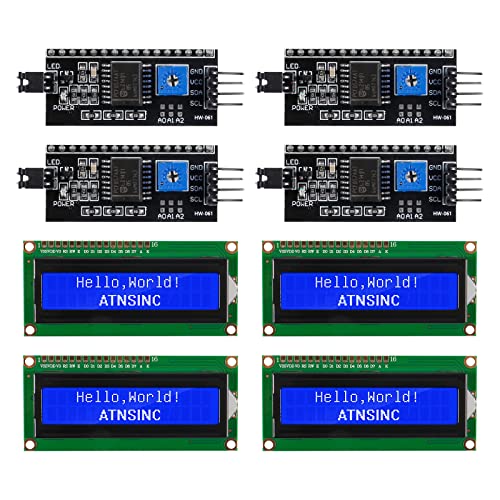
QCCAN offers a four-pack of 1602 LCD displays with I2C backlight and contrast control. Default I2C addresses are 0x27 or 0x3F depending on the PCF8574 chip variant, requiring users to verify their chip before coding. The modules are designed to reduce wiring complexity while providing reliable text output suitable for IoT prototypes and educational projects. A note on wiring: GND—GND, VCC—VCC, SDA—A4, SCL—A5, with proper I2C libraries to support operation.
Buying Guide
Choosing a small serial LCD display involves assessing readability, interface simplicity, and project constraints. Consider the following perspectives to ensure a good fit for your needs:
- Display type and readability: OLED displays, like the 0.96-inch model, offer high contrast and sharp graphics but may be more variable in backlight behavior. LCD modules are typically easier for text-based projects and have stable backlight control via a potentiometer.
- Interface and wiring: I2C is preferred for saving I/O pins, but some projects may benefit from more direct parallel interfaces. Ensure your microcontroller has the necessary I2C library support and that the address can be configured if you’re using multiple displays.
- Voltage and power: Most modules support 3.3V–5V operation. Verify your board’s voltage level compatibility to prevent damage and ensure stable operation.
- Physical fit and mounting: Check mounting holes and overall form factor to suit your enclosure or project box. For compact builds, 0.96-inch OLEDs and 1602 LCDs offer good density with straightforward mounting.
- Documentation and tutorials: Modules with clear setup guides and example code accelerate development, especially for beginners or those integrating with Raspberry Pi, Arduino, ESP32, or STM32 platforms.
- Addressing and libraries: Know the I2C address range (commonly 0x27 or 0x3F) and ensure you have compatible libraries (LiquidCrystal, Adafruit_SSD1306, etc.) for quick integration.
- Cost and quantity: For multi-display projects, consider multi-pack options if you need several modules. Balance the cost against the complexity of wiring and maintenance.
Across these options, the Dorhea OLED and the Freenove/SunFounder LCD modules stand out for projects requiring both readability and easy integration with popular development boards. If your project prioritizes compact size and minimal wiring, OLED-based displays or 1602 LCDs with I2C interfaces offer reliable, scalable solutions for text and simple graphics. Always validate compatibility with your chosen microcontroller, and test with a basic example to confirm correct wiring and display behavior.