When choosing a single-channel video encoder, reliability, protocol support, and compatibility with common streaming workflows are essential. This guide highlights five capable options that fit a single-channel workflow, spanning SDI to IP, HDMI to RTSP/RTMP, and USB-to-SDI conversions. Each option is evaluated for core specs, connectivity, and typical use cases to help you pick the right encoder for live streaming, education, or event broadcasting.
Summary of chosen products:
| Product | Brand | Primary Output | Key Protocols | Notes |
|---|---|---|---|---|
| Zowietek ZowieBox | zowietek | SDI I/O | RTSP, RTMP, SRT, NDI | SDI to NDI or AVoIP to NDI decoding |
| ORIVISION Ultra Mini EH1211 | ORIVISION | HDMI In, HDMI Loopout | RTSP, RTMP/RTMPS, SRT, HLS | Ultra compact; updated ports |
| URayCoder HEVC/H.265 HDMI to IP Encoder | URayCoder | HDMI to IP | RTSP, RTMP(S), SRT, HLS, WebRTC | 4 streams; strong multi-protocol support |
| URayCoder HEVC H.265 H.264 HDMI to IP Encoder (4K) | URayCoder | HDMI to IP | RTSP, RTMP(S), SRT, HLS, WebRTC | 4K capable; multi-protocol |
| Axis Q7401 Video Encoder | Axis Communications | One-channel encoder | HTTP, RTSP, RTMP(S) | New hardware; reliable brand |
ZowieBox: SDI/NDI Single-Channel Encoder/Decoder

ZowieBox functions as a versatile single-channel solution, encoding SDI to NDI or decoding NDI to SDI. It supports NDI|HX2, HX3, and certified HX formats, enabling integrated workflows between SDI production and IP-based pipelines. AVoIP to NDI decoding further expands compatibility with RTMP, RTSP, and SRT, enabling diverse sources to feed into NDI-enabled setups. A notable limitation is that it cannot operate as both an encoder and decoder simultaneously; users must switch between modes as needed. UVC to SDI conversion adds webcam-to-SDI capability up to 1080p60, with USB capture not supported. This makes ZowieBox a compact, flexible option for studios and live events with mixed formats.
ORIVISION Ultra Mini EH1211 HDMI Encoder

ORIVISION’s ultra-mini EH1211 packs HDMI input with loopout and supports multiple streaming protocols including RTSP, RTMP/RTMPS, SRT, and HLS. It introduces added USB and TF card ports for local recording of RTSP streams or HDMI sources to external storage, plus a cropped or zoomed encoding option. While the device is compact, it can manage 1080p at 30fps and deliver dual-channel output with multiple protocol feeds, making it well-suited for mobile setups, small studios, or field broadcasting where space is at a premium.
URayCoder HEVC H.265 HDMI to IP Encoder

This URayCoder HDMI-to-IP encoder leverages H.265/H.264 dual encoding to deliver 1080p at 60fps and supports advanced HDMI decryption for broad compatibility with HD sources. It supports a wide range of protocols (HTTP, RTSP, RTMP(S), SRT, HLS, MP4, UDP, RTP, FLV, ONVIF, WebRTC, TRTC, ICECAST) and can push up to four streams to multiple platforms simultaneously. The customizable options include static text, captions, logos, and timestamps, with flexible input options (HDMI embedded audio and line-in). This makes it a robust option for multi-platform live streaming and professional broadcasts.
URayCoder 4K HDMI To IP Encoder (HD-SDI Transmitter option)
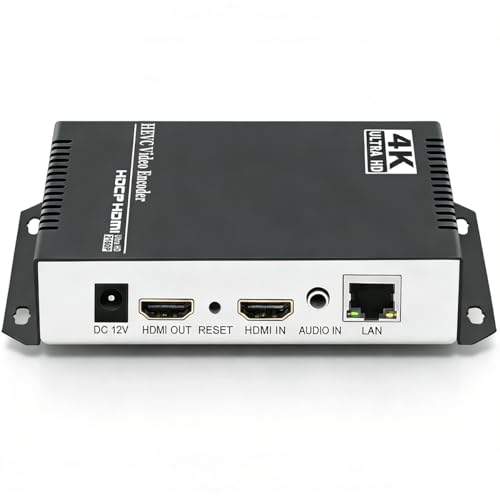
This URayCoder device supports 4K UHD input and 4K output, with a maximum of 30fps at 4K and higher frame rates at lower resolutions. It supports a multitude of streaming protocols including RTSP, RTMP(S), SRT, HLS, and WebRTC, enabling multi-protocol distribution to multiple services like YouTube, Facebook, and Twitch. It is designed for professional live streaming and 4K content transmission, with formatting tools for captions, logos, and timestamps, plus dual HDMI audio input options for enhanced sound control. If your workflow requires higher resolution and multi-protocol distribution, this encoder provides a strong option within a single-channel framework.
Axis Q7401 Video Encoder

Axis Q7401 provides a reliable one-channel encoder solution backed by Axis communications. The product is marketed as new with a standard warranty and is suitable for installations needing a solid, reputable single-channel encoder. While the feature set is concise, Axis devices are known for robust reliability in surveillance and broadcasting workflows and often integrate well with Axis and non-Axis ecosystems for consistent streaming performance.
Buying Guide
Key purchase considerations for single-channel video encoders:
- Input and output formats: Confirm HDMI, SDI, or USB-C inputs, and whether the device supports SDI or HDMI loopouts, and whether you need NDI or IP streaming outputs (RTSP/RTMP/SRT/HLS).
- Protocols and platforms: Look for multi-protocol support (RTMP(S), RTSP, SRT, HLS, WebRTC) and compatibility with platforms like YouTube, Facebook, and Twitch, plus enterprise options such as ONVIF for surveillance use.
- Resolution and frame rate: Ensure the encoder handles your target resolution (1080p, 4K) and desired frame rate (up to 60fps in many models).
- Local recording: USB/TF card ports or internal storage can be valuable for backup or archiving streams, especially in unstable network conditions.
- Bitrate and quality controls: Look for adjustable bitrate, encoding presets, and options for text overlays, logos, and timestamps to support branding and consistency.
- Latency and reliability: For live events, consider devices with low-latency output and proven reliability in continuous operation scenarios.
- Power and connectivity: PoE support reduces cable clutter and simplifies installation; consider wall-mount or compact designs for space-limited setups.
- Brand ecosystem and support: Reputable brands often offer longer warranties, clearer documentation, and better customer support, which is valuable for ongoing production needs.
Bottom line: A well-chosen single-channel encoder should align with your source formats, preferred streaming protocols, and deployment environment. The options above cover a range from ultra-compact HDMI-to-IP solutions to SDI-enabled workflows, ensuring suitable choices for studios, classrooms, houses of worship, and live events.