Finding a clear, stable TV signal can be challenging in rooms far from broadcast towers or with obstructed lines of sight. This article highlights top signal boosters designed for indoor use that help strengthen weak over-the-air signals for better HD and 4K reception. Each option is evaluated on ease of installation, compatibility, and key features to help you choose the right booster for your setup.
| Product | Brand | Key Benefit | Gain / Output |
|---|---|---|---|
| THE CIMPLE CO | Adjustable gain for indoor distribution | Up to 24 dB | |
| GE Indoor HD Digital TV Antenna Amplifier | GE | Low-noise boost with LTE filtering | Not specified (built-in boost) |
| Channel Master TV Antenna Booster 4-4-Port | Channel Master | Multi-room distribution | 7.5 dB gain |
| Indoor TV Antenna Amplifier, 25dB High Gain | GZMJRD | High gain with LTE filter | 25 dB |
| Antop HD Smart Boost Antenna Amplifier | ANTOP | Smart boost with dual outputs | Not specified (dual outputs) |
THE CIMPLE CO Antenna Amplifier Kit
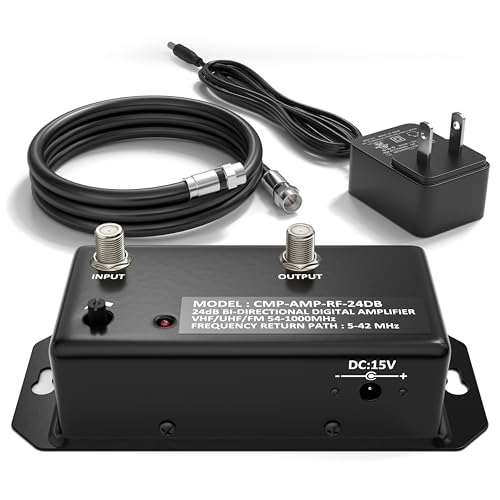
The THE CIMPLE CO Antenna Amplifier Kit combines a compact indoor amplifier with included RG6 coaxial cable, designed to strengthen existing weak signals from an antenna to a TV. It supports VHF / UHF / FM bands and is compatible with ATSC, NTSC, FTA, and OTA signals. This model offers adjustable gain up to 24 dB for distributing amplified signals to multiple TVs while preserving signal integrity and limiting distortion. It is intended for indoor use and is suitable for antennas that already have a solid signal in the area. The kit is best suited for households with single or multiple indoor TVs relying on local broadcast channels.
GE Indoor HD Digital TV Antenna Amplifier
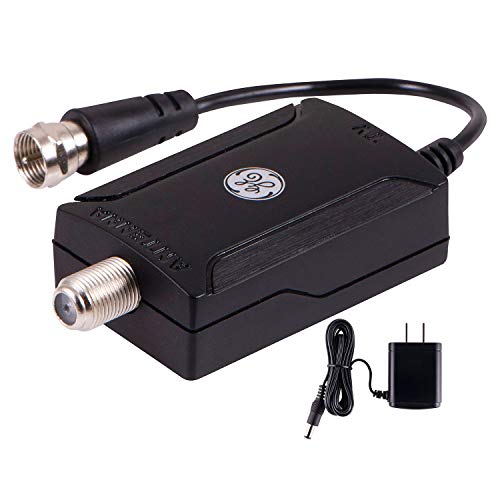
The GE Indoor HD Digital TV Antenna Amplifier focuses on delivering clearer reception by reducing signal noise and blocking interference from 4G/5G LTE networks via built-in filtering. It’s designed to be compatible with current HDTV standards, including 1080p and 4K Ultra HD, and supports both VHF and UHF bands. The amplifier helps compensate for cable loss and minimizes reception dropouts, improving picture and sound quality for channels that your antenna already picks up. Real-world results depend on tower distance, terrain, and obstruction factors.
Channel Master TV Antenna Booster 4-4-Port
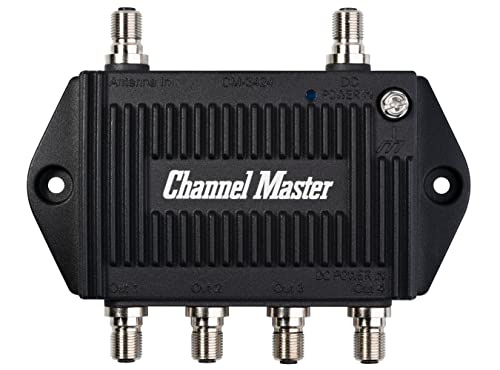
The Channel Master 4-4-Port TV Antenna Booster is engineered to distribute boosted signals to four rooms, replacing basic 4-way splitters with a more robust internal booster. It’s designed for versatility with indoor, outdoor, or attic installations, featuring a weatherproof housing for harsher environments. This model is suitable for homes with multiple TVs in different rooms, allowing synchronized amplification across several channels while maintaining signal integrity across the distribution network. Performance varies with antenna type, placement, and nearby obstructions.
Indoor TV Antenna Amplifier, 25dB High Gain

The Indoor TV Antenna Amplifier from GZMJRD emphasizes a 25 dB high-gain boost with a built-in 4G/5G LTE filter to minimize cell interference. It is marketed as compatible with any antenna type and includes guidance on signal strength in the area to determine if amplification is necessary. The device is intended for indoor use, and its effectiveness will depend on local broadcast availability, antenna positioning, and obstacles like buildings or trees that affect signal strength.
TV Antenna Amplifier Signal Booster, 25dBi High Gain

This HIDB model provides 25 dBi high-gain amplification with a clear emphasis on reducing interference via a 4G/5G LTE filter. It is positioned for users who need stronger reception across all channels and emphasizes compatibility with various TV antennas. Like other indoor boosters, its performance depends on proximity to towers, antenna quality, and environmental factors. The product integrates simple installation steps and warns that excessive local channels may reduce the perceived need for an amplifier.
TV Antenna Amplifier, Indoor Antenna Signal Booster

The WHE28-based TV Antenna Amplifier from GZMJRD touts the latest 4G/5G LTE filtering and a strong 25 dB-like boost, designed to clear up low-strength or pixelated channels. It advises buyers to assess local channel availability before purchasing and notes straightforward installation between the antenna and TV. It’s compatible with a broad range of indoor antennas and aims to improve overall stability and clarity of local broadcasts.
TV Antenna Amplifier, Indoor Signal Booster

The CSUXYD TV Antenna Amplifier emphasizes a 2026 upgrade with a built-in 4G/5G LTE filter to block wireless interference. It recommends evaluating your local signal landscape before boosting and notes compatibility with a wide range of antennas. Installation is described as simple—place the booster between the antenna and TV or set-top box. Channel stability and the degree of improvement will depend on distance to towers, tree coverage, and building layouts.
WHE28 Series: Extra Indoor Booster
If you’re evaluating multiple boosters, consider the following: gain level, noise figure, and whether LTE filtering is included. Indoor installations require attention to antenna placement and line-of-sight to towers. Dual outputs are advantageous for setups with multiple TVs or devices, while higher gain can improve distant signals but may increase the risk of signal distortion if the source is already strong. Look for filters to minimize interference from cellular networks and other wireless devices.
Buying Guide: Key Purchase Considerations
- Signal strength in your area: Check local tower distance and terrain. If many channels are already strong, a booster may not be needed.
- Band compatibility: Ensure the booster supports VHF/UHF and the specific channels you watch (ATSC/NTSC/OTA compatibility).
- Gain and distribution: Indoor boosters range from single-channel amplification to multi-output distribution. Consider how many TVs you want to service.
- LTE/4G interference filtering: LTE filters help reduce interference from cell networks, improving picture clarity in crowded RF environments.
- Installation environment: Indoor use is standard; outdoor or attic installations require weatherproof designs and may not be suitable for all models.
- Connections: Look for included coax cables and ease of connection to existing antennas and TVs.
- Power requirements: Some boosters are USB-powered or plug directly into a power outlet; verify compatibility with your setup.
- Future-proofing: If you plan to upgrade to new antennas or additional TVs, consider a booster with multiple outputs and adjustable gain.
- Manufacturer support and compatibility notes: Read product notes carefully to ensure you’re within a supported operating range and that the booster won’t amplify channels that you don’t actually receive well.