When building electronics projects, a reliable 16×2 character LCD with an I2C or IIC serial interface can save time and pins. This article highlights five popular options, detailing compatibility, wiring, and standout features to help you select the best fit for your Arduino, Raspberry Pi, or DIY IoT projects.
Summary Table
| Product | Brand | Interface | Notable Benefit |
|---|---|---|---|
| I2C | |||
| I2C | |||
| I2C | |||
| I2C | |||
| IIC/I2C |
Hosyond 3pcs I2C 1602 LCD Display Module

The Hosyond 1602 LCD modules use an I2C serial interface to minimize pin use while delivering a clear blue backlit display. Each module supports a 2×16 character format and includes a built-in adjustable potentiometer for contrast. The device operates at 5V and default I2C address 0x27, with straightforward GND—GND, VCC—VCC, SDA—A4, SCL—A5 wiring. This kit includes three modules, offering options for multi-screen projects or testing in parallel systems.
Freenove I2C IIC LCD 1602 Module

The Freenove 1602 I2C module provides a compact 2-line, 16-character display with an integrated I2C conversion circuit for enhanced stability. It reduces port usage compared to parallel interfaces and is suitable for Arduino, Raspberry Pi, Pico, ESP32, and ESP8266. Step-by-step tutorials are available via a box-documented download link, helping users quickly wire and program the module in various projects.
GeeekPi 2-Pack I2C 1602 LCD Module

GeeekPi’s I2C 1602 LCD modules emphasize reduced I/O usage and broad development-board compatibility, including Arduino, Raspberry Pi, Tinker Board, Nano Pi, Banana Pi, and STM32. The modules feature a yellow backlight, 2-line by 16-character display, and rely on the I2C interface to streamline wiring and integration into IoT and DIY projects.
GeeekPi 2-Pack I2C 1602 LCD Display
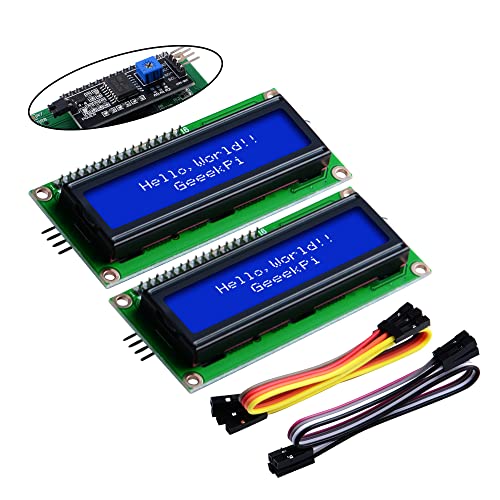
This GeeekPi pair also uses I2C to minimize pin usage and simplify wiring. It targets a wide range of development platforms—from Arduino to Raspberry Pi and STM32—making it a flexible option for IoT builders and classroom makers seeking easy add-ons to existing projects.
Teyleten Robot LCD1602 Display Module (3PCS)

The Teyleten Robot LCD1602 module features a blue backlight and a wide viewing angle with high contrast. It uses a standard HD44780-compatible controller, ensuring broad compatibility with common microcontroller platforms. The triple-pack design enables simultaneous labeling, data display, or separate status indicators across multiple projects.
QCCAN 4-Pack I2C 1602 LCD Display
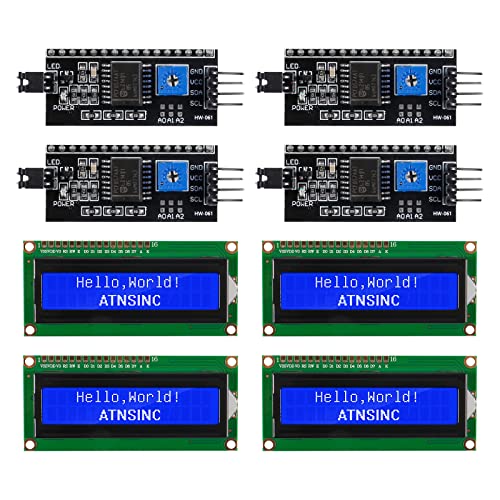
QCCAN’s 4-pack uses an I2C PCF8574T/AT-based interface to drastically reduce I/O usage. Default addresses are 0x27 or 0x3F depending on the chip variant, with a 5V supply and a built-in potentiometer for backlight and contrast control. It’s designed to be easy to wire (GND—GND, VCC—VCC, SDA—A4, SCL—A5) and suitable for Arduino projects, IoT devices, and educational kits.
FREENOVE I2C IIC LCD 1602 Module (2 Pack)

The FREENOVE 2-pack continues to emphasize the stability of an integrated I2C conversion circuit. It displays two lines of text with 16 characters per line and is compatible with a broad set of boards including Arduino, Raspberry Pi, Pico, ESP32, and ESP8266. As with other modules, it includes a detailed tutorial bundled with the product box to facilitate setup.
4PCS I2C IIC 1602 LCD Display Module

Ransanx offers a 4-pack of I2C 1602 LCD modules with blue backlight and PCF8574 I2C interface, designed for Arduino, Raspberry Pi, STM32, and other DIY devices. The design emphasizes simplified wiring and compact form, enabling several screens to display real-time data, statuses, or simple messages in parallel projects.
Buying Guide: Key Considerations for Serial 16×2 LCDs
When choosing a serial 16×2 LCD for your project, consider the following factors to ensure compatibility, ease of use, and long-term reliability.
- Interface and pin usage: Most modules use I2C/IIC to minimize IO pins. Confirm your microcontroller’s I2C support and the required address (commonly 0x27 or 0x3F).
- Controller compatibility: Look for HD44780-compatible LCD controllers for broad software compatibility and straightforward libraries.
- Backlight and contrast: A built-in potentiometer for contrast and adjustable backlight improves readability in varying lighting conditions.
- Voltage and power: Most modules run on 5V; verify your board’s power capabilities and consider level shifting if needed on 3.3V systems.
- Wiring simplicity: I2C adapters reduce wiring; ensure you can access SDA/SCL on your microcontroller and that you have space for the required jumpers.
- Software support: Check for tutorials and library compatibility with your development environment (Arduino IDE, Raspberry Pi Python, ESP32/ESP8266 environments).
- Physical packaging: Some sellers provide multi-pack options (2-pack, 3-pack, 4-pack). For learning or multi-display setups, a multi-pack can be cost-effective.
- Documentation and tutorials: Look for modules that come with wiring diagrams and example codes to accelerate setup and debugging.
- Longevity and community: Modules with broad user bases often have more troubleshooting resources and compatible example projects.
These modules are suitable for a variety of projects, including IoT dashboards, sensor readouts, and microcontroller education. Always verify the exact I2C address and ensure you have up-to-date libraries for reliable operation.