The following article highlights top SC to ST fiber patch cables commonly used to connect network devices, switches, and transceivers. Each pick focuses on single-mode or multimode compatibility, durability, and stability across varied environments. Read on for concise product details, key features, and a practical buying guide to help select the right patch cord for your fiber optic setup.
| Product | Brand | Length | Mode |
|---|---|---|---|
| Eardion SC to ST Fiber Patch Cable, 3M (9.84ft) Single-Mode Duplex Jumper | Eardion | 3m | Single-mode |
| StarTech.com 1m Fiber Optic Cable – Multimode Duplex 62.5/125 | StarTech.com | 1m | Multimode |
| PacSatSales – Fiber Optic Patch Cable – Single Mode – Simplex | PacSatSales | 1m | Single-mode simplex |
| Eardion SC to ST Fiber Patch Cable, 3M (9.84ft) Single-Mode Duplex Jumper | Eardion | 3m | Single-mode |
| Xiaoyztan 2Pcs ST to SC Single-Mode Fiber Patch Cable | Xiaoyztan | 2 cables | Single-mode simplex |
Eardion SC To ST Patch Cable, 3M Single-Mode Duplex Jumper

Eardion’s single-mode duplex patch cable connects SC to ST interfaces with 9/125 μm fiber. It features a robust PVC jacket and a small outer diameter compatible with cramped enclosures. The cable performs across a wide temperature range from -40°C to +80°C and is designed for low insertion loss and stable return loss. Interchangeability and repeatability are emphasized, providing dependable performance in typical data-center or lab deployments.
StarTech.com 1m Multimode ST to SC Patch Cable
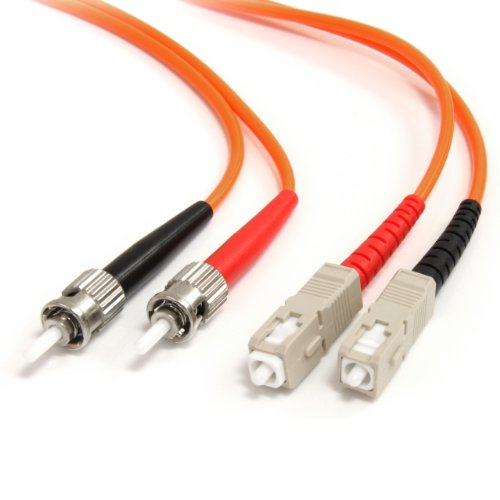
This StarTech patch cable offers a 1-meter ST to SC connection using 62.5/125 μm multimode fiber with an LSZH (low smoke zero halogen) jacket. The OM1 fiber supports moderate-distance, high-speed links in office and data-center environments. The product emphasizes safety, durability, and clear labeling, suitable for quick rack-to-device connections where short runs and reliable signaling are required.
PacSatSales – Simplex SC/APC to ST Single-Mode Patch Cable

PacSatSales offers a 1-meter SC-APC to ST single-mode fiber patch cable, designed for optical networks demanding precision and reliability. The cables are UL, cUL, IEC, and RoHS compliant, with OS1 9/125 μm fiber. They are independently tested for insertion loss to ensure quality, making them suitable for FTTH, FTTB, and FTTP deployments where low signal loss is critical.
Eardion SC To ST Patch Cable, 3M – 2 Pack

This 2-pack offers the same SC to ST duplex single-mode design in a value bundle. It covers temperature tolerance, low insertion loss, and robust performance features, with a PVC jacket for durable handling. The product highlights interchangeability, temperature stability, repeatability, and good return loss—beneficial for stable link integrity in mixed hardware environments.
Xiaoyztan 2Pcs ST to SC Single-Mode Patch Cables

Xiaoyztan provides a 2-pack of simplex single-mode fiber patch cables with ST to SC connectors. This solution targets Ethernet-like fiber networks and is suitable for FTTH, FTTB, and FTTP scenarios where a straightforward, reliable SC/ST transition is needed. The simplex configuration emphasizes easy endpoint connections and compact runs.
Buying Guide
Key considerations when selecting SC to ST patch cables include the following:
- Single-mode vs. multimode: Single-mode (9/125 μm) is ideal for long-distance, low-loss links; multimode (50/125 or 62.5/125 μm) supports shorter runs with higher bandwidth in data centers and campus networks.
- Connector type compatibility: Ensure the patch cable’s connectors (SC, ST, APC/UPC) align with your transceivers and patch panels. APC connectors typically have a angled ferrule for lower back-reflection.
- Jacket material and durability: PVC outdoors or in harsh environments may benefit from LSZH or armored jackets. Consider moisture resistance and temperature range for your installation location.
- Insertion loss and return loss: Lower insertion loss improves signal, while higher return loss indicates less reflected light. Certification and testing results are helpful indicators of quality.
- Length and flexibility: Measure the distance between devices and plan for slack. Short runs reduce loss and clutter, while longer runs may require stronger sheathing or protective routing.
- Compliance and standards: Look for UL, RoHS, IEC, and RoHS compliance, especially in enterprise or telecom environments to meet safety and environmental standards.
Buyers should balance cost against performance needs. For backbone or long-haul links, prioritize single-mode with low insertion loss and APC connectors if applicable. For internal data-center links, multimode options may offer practical performance at a lower cost for shorter distances. Always verify connector compatibility with your devices and the intended operating environment to avoid latency or signal integrity issues.