Finding the right RS232 stepper motor controller involves balancing ease of use, compatibility with NEMA 17/23 motors, available control modes, and reliable serial communication. This guide highlights five solid options that integrate control logic with driving capability, emphasizing RS-232/RS-485 or TTL serial interfaces for PLCs, PCs, and industrial systems. Each product below is evaluated on setup simplicity, mode variety, and real-time control features to support precise motion in automation projects.
| Product | Brand | Core Feature | Communication |
|---|---|---|---|
| Stepper Motor Driver Controller Integrated Board Forward/Reverse Pulse Speed Angle Control Module | BANRIA | Integrated controller and driver with forward/reverse control | UART / 4 control modes |
| Stepper Motor Driver Controller for Nema 17 23 34 | BANRIA | All-in-one stepper controller with LCD and memory | TTL Serial |
| Ransanx Stepper Motor Controller | Ransanx | 1.8″ color screen, Modbus connectivity | Modbus Serial/RS-485 |
| DC 5-30V 4A Stepper Motor Driver and Controller | GODIYMODULES | Integrated controller with manual/TTL serial options | TTL serial |
| TKXEC DC 5-30V 4A Stepper Motor Driver Controller | TKXEC | 2-in-1 controller and driver with multiple modes | Serial |
BANRIA Integrated Controller & Driver with Multi-Mode Control

The BANRIA solution combines motor drive and control in a single module, designed for NEMA 17 and similar stepper motors. Its built-in controller supports forward and reverse operation, with real-time state monitoring to facilitate precise motion. A potentiometer and a dedicated mode selector enable quick switching between operating scenarios, while the board accommodates several working modes for flexible integration into automation sequences. This device supports UART-style commands and external interfacing, making it suitable for PLC-driven systems and custom control logic where RS-232-like serial streams are translated to motor actions.
Key capabilities include real-time direction control, multi-scene operation, and adjustable response through external inputs. For engineers seeking compact, all-in-one functionality without a separate driver module, this BANRIA unit provides a streamlined path to implement speed, timing, and angle control in single-axis applications. While it is feature-rich, readers should verify compatibility with their exact motor current ratings and power supply requirements to ensure optimal torque and thermal performance in continuous operation.
BANRIA 42/57/86 Stepper Controller with LCD & Serial
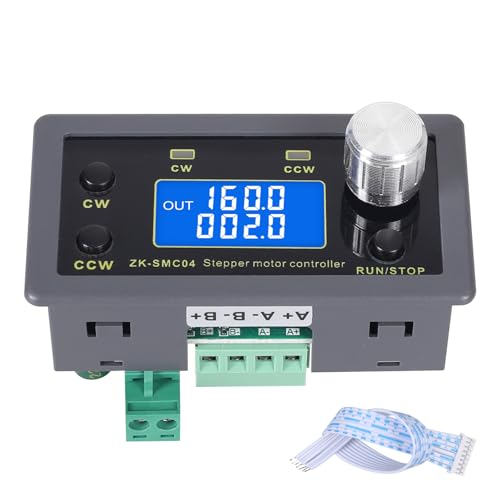
This BANRIA model packages a comprehensive controller with a high-resolution LCD display for instantaneous feedback on speed, delay, and cycle counts. The device is designed to drive 42/57/86 series motors with up to 6.6A, making it suitable for mid- to high-load applications such as CNC tools and automated platforms. The TTL serial interface ensures straightforward communication with PLCs or PCs as part of an industrial control loop. Power-off memory maintains essential motion parameters, reducing setup time after power interruptions. The integrated architecture simplifies wiring and reduces footprint in compact automation projects.
Its preprocessing options and built-in modes support rapid setup for repetitive tasks and testing. The absence of a dedicated external drive unit may require users to confirm that the power supply can comfortably deliver peak currents during acceleration. For projects needing tight motion control with robust state visibility, this unit offers a practical balance of user-friendly features and industrial-grade performance.
Ransanx DC Stepper Controller with Modbus Capability

The Ransanx controller emphasizes industrial connectivity through Modbus over RS-485, enabling reliable wired integration with PLCs and PCs. Its 1.8-inch color display presents real-time speed and pulse data for straightforward parameter adjustments. The device supports universal PWM-style pulse and direction control across Nema 17, 23, and 34 motors, with a voltage range suitable for 12–24V DC operation. This makes it a versatile option for automation lines, CNC modules, and robotic arms where straightforward Modbus communication is a key requirement for system-wide control.
As a Modbus-enabled controller, setup focuses on mapping registers to desired motion profiles. While the display aids in rapid configuration, users should plan for master-slave configurations and ensure proper termination and shielded wiring in electrically noisy environments. This model suits users prioritizing interoperable industrial protocols and clear, on-device monitoring during trials and production runs.
GODIYMODULES 5-30V Stepper Driver with TTL Serial

The GODIYMODULES kit offers a compact integrated controller and driver with straightforward TTL serial communication. Designed for DC operation in the 5–30V range and up to 4A, it supports direct connection to a stepper motor with a simple control interface. The unit emphasizes ease of wiring and quick deployment for basic forward/reverse motion, adjustable speeds, and timing adjustments. It is especially suitable for hobbyists and lightweight automation projects where a ready-to-use module reduces development time while maintaining dependable motion control.
Engineers should confirm whether the built-in controls meet the required precision for their application, and consider external control software compatibility. The TTL serial path can be a straightforward bridge to PLCs or microcontrollers, but users may need to implement higher-level routines to achieve advanced trajectory planning or synchronization with other axes.
TKXEC SMC02: Dual-Role Controller & Driver

TKXEC’s SMC02 model combines a motor controller and driver in one compact package, designed for DC 10–30V, two-phase operation across 4- and 6-wire configurations. It includes nine working modes with built-in motion profiles to accommodate different automation needs, enabling users to quickly select trajectories without external programming. The unit is compatible with standard NEMA 17/23 motors and provides a flexible platform for simple test benches or embedded automation tasks that require reliable, repeatable motion control with minimal wiring complexity.
Serial communication support helps integrate the controller with PLCs and other industrial systems. When planning integration, consider how the nine modes map to your application’s motion requirements and whether additional software tools are needed to calibrate speed, acceleration, and positioning across multiple axes. This device offers a practical, space-saving route to configurable motion in compact automation projects.
Zuomeng Stepper Controller Driver with Nine Modes

Zuomeng’s offering emphasizes a robust set of nine motion modes within an integrated controller and driver, supporting DC 10–30V input and 4A continuous output. The design focuses on forward/reverse pulse timing, speed control, and loop features, with a safety profile that includes reverse wiring protection. The included PLC/serial communication path ensures compatibility with standard industrial control systems. This module suits applications requiring a mix of ready-to-run programs and manual control flexibility, such as packaging lines or conveyor systems where varied motion sequences are routine.
For system integrators, it’s important to align the nine modes with your exact motion profile and verify that the power supply and motor ratings match to prevent overheating. The combination of integrated control and user-programmable options offers a useful balance between simplicity and configurability for mid-scale automation tasks.
Buying Guide
Key considerations when selecting an RS232-compatible stepper motor controller:
- Motor compatibility: Ensure the controller supports your motor’s NEMA size (e.g., 17, 23, 34) and current rating. Higher current requirements demand suitable power supplies and heat management.
- Communication interface: RS-232/RS-485, TTL serial, and Modbus are common. Verify compatibility with your existing PLC, PC, or controller network and confirm required protocol support.
- Control modes: Look for a mix of built-in profiles (forward/reverse, acceleration/deceleration, loops) and external interfaces (buttons, UART, serial) for flexible integration with automated systems.
- Power range and protection: Check voltage ranges (typical 5–30V) and protections such as reverse wiring to guard against wiring mistakes in field installations.
- Diagnostics and feedback: An LCD display or real-time on-device readouts can simplify setup and debugging, especially during commissioning and maintenance.
- Form factor and wiring: Integrated controllers save space, but ensure the footprint fits your enclosure and that wiring harnesses align with motor and driver connectors.
- Expandability: If your project may scale to multi-axis or CNC-like applications, prioritize modules with modular interfaces (serial, USB, CAN, Modbus) for future upgrades.
- Documentation and support: Look for clear manuals, example codes, and vendor support for troubleshooting and firmware updates, which speed up deployment.
Comparison snapshots: For projects prioritizing industrial integration, Modbus-enabled devices or TTL serial with robust alarm protections provide strong reliability in production lines. For hobbyist or compact systems, integrated controllers with multiple preset modes and LCD feedback can reduce setup time. Always map your motion requirements to the controller’s modes, verify power supply margins, and test thermal behavior under expected duty cycles to ensure consistent performance over time.