For professionals and tech enthusiasts, converting coaxial signals to Ethernet can simplify diagnostics, testing, and temporary network extensions. This guide reviews five reliable rg6 to ethernet converter options, highlighting key features, usability, and technical notes to help you choose the right adapter for testing, monitoring, or temporary network tasks. Each product is evaluated for compatibility, ease of use, and durability in field conditions.
| Product | Brand | Notes |
|---|---|---|
| BERANMEY RF to RJ45 Converter Adapter | BERANMEY | F Female to RJ45 Male; 50 ohm impedance; for testing in pairs |
| MEIRIYFA RF to RJ45 Converter (4PCS) | MEIRIYFA | F Female to RJ45 Male; testing with test equipment |
| Alrhso Coax to Ethernet Adapter (2PCS) | Alrhso | F-Type Female to RJ45 Male; easy press button |
| Reidubo Coax to Ethernet Adapter | Reidubo | Coaxial IP extender; 10/100 Mbps over RG6/RG59/RG11 |
| Alrhso F-Type To RJ45 (2PCS) Coaxial Converter | Alrhso | F Female to RJ45 Male; testing-focused |
Note: All products are presented for reference in testing and signal extension contexts. They may not replace dedicated network hardware in production environments. Please review compatibility with your specific coaxial cable type (RG6/RG59) and the devices you intend to connect.
BERANMEY RF to RJ45 Converter Adapter

The BERANMEY adapter provides an F jack to RJ45 male connection, designed for coaxial to Ethernet testing. It specifies a 50-ohm impedance and notes that it should be used in paired tests rather than standalone router or WiFi configurations. The housing combines plastic and metal for durability and a lighter profile, making it suitable for field work where physical robustness matters. While not a general-purpose networking converter, this unit can facilitate signal probing and compatibility checks when paired with a matching adapter set.
MEIRIYFA RF to RJ45 Converter (4PCS)

The MEIRIYFA kit is geared toward line testers and monitoring equipment. It features an F female to RJ45 male interface and emphasizes that these adapters are intended for testing BNC lines and related equipment rather than standard networking. The 4-pack provides flexibility to perform paired connections and test multiple paths or devices without reusing the same adapter. This set is useful for field technicians validating signal integrity or converting connector types during testing workflows.
Alrhso Coax to Ethernet Adapter (2PCS)
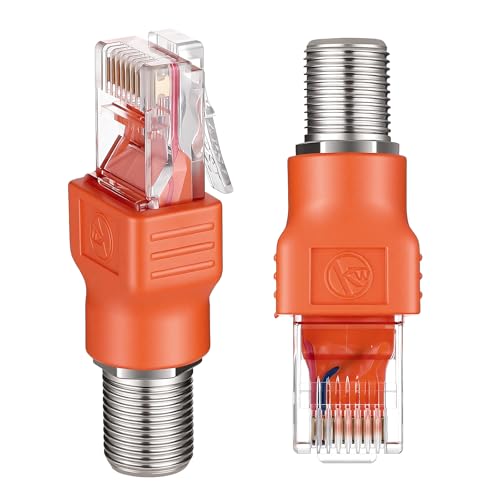
This orange Alrhso adapter features an F-type female connector paired with an RJ45 male plug. It is constructed with ABS and stainless steel for durability and wear resistance. The design includes a simple press-button operation to connect or disconnect, reducing user force and potential wear. While positioned as a coaxial-to-Ethernet solution, it is primarily suitable for testing and conversion tasks rather than long-range network deployment. The visual design and material choice aim to withstand field use and frequent handling.
Reidubo Coax to Ethernet Adapter

The Reidubo device is described as an Ethernet over Coax (EoC) extender with longer distance capabilities. It supports up to 3938 feet (1200 meters) of IP signal over coax and lists 10/100 Mbps performance, making it suitable for upgrading analog CCTV or other surveillance systems to IP-based networks without rewiring. It includes BNC-F and RJ45 interfaces and notes compatibility across coaxial and twisted-pair deployments. This option emphasizes long-range transmission and practical field deployment in large properties or industrial sites.
Alrhso 2PCS F-Type Female to RJ45 Male Coaxial Converter (Black)

This Alrhso offering mirrors the coaxial-to-Ethernet theme with an F-type female connector and RJ45 male plug. The user-focused design emphasizes simplicity: press a button to connect or disconnect, and rely on robust ABS and stainless steel construction for wear resistance. It targets quick, field-friendly transitions between coaxial and Ethernet-style connections, making it a practical tool during site surveys, temporary network rollouts, or testing scenarios.
MEIRIYFA BNC to RJ45 Ethernet Adapter

The MEIRIYFA BNC-to-RJ45 adapter is designed for RF coaxial contexts, enabling testing with BNC monitoring cables, testers, or line finders. It converts BNC female to RJ45 male, broadening the range of test setups and allowing flexible switching between connectors. It is clarified that these RF adapters do not transmit video signals over standard Ethernet and should be used within testing or diagnostic workflows rather than as a primary network interface.
Buying Guide: Key Purchase Considerations
- Intended use: Distinguish between testing/diagnostic adapters and true network extenders. Many options are designed for signal analysis, not production networking.
- Connector compatibility: Look for F-Type or BNC interfaces and ensure the RJ45 side matches your equipment’s ports and standards. Verify impedance (commonly 50 ohms for RF) aligns with your test setup.
- Distance and speed: Coax-based extenders vary in achievable distance and throughput. If your goal is CCTV upgrades, prioritize devices that support long-range transmission; for lab testing, precision adapters may suffice.
- Durability and build: Field use benefits from ABS/plastic and metal components, with features like quick-connect buttons to reduce wear during frequent connections.
- Pairing requirements: Some products require using adapters in pairs or with specific cables to function correctly. Read notes on pairing and test conditions before purchase.
- Compliance and safety: Ensure devices do not interfere with existing networks or violate local regulatory requirements. Use compliant equipment for the intended environment.
- Application context: For surveillance upgrades, verify compatibility with existing coaxial cabling like RG6/RG59 and the IP-based devices in your system.
- Cost vs. value: The set-based products may offer lower per-unit costs and convenience for testing, while single-purpose adapters can provide higher reliability for critical tasks.
When selecting a rg6 to ethernet converter, match the product’s stated use case with your actual needs—whether testing, monitoring, or light-duty extension. Always ensure safe operation and follow manufacturer instructions for paired testing scenarios and cable compatibility to achieve reliable results.