RF signal strength meters help hobbyists and professionals measure radio field strength across a broad range of frequencies. This guide reviews five notable meters suitable for walkie-talkie work, field testing, and DIY projects. Each product section highlights core capabilities, supported frequency ranges, and practical considerations to help you compare options.
| Product | Brand | Link |
|---|---|---|
| Mcbazel Surecom SS10 100K-3GHz RF Signal Strength Meter | Mcbazel | Amazon |
| Mcbazel Surecom SS11 Portable Field Strength Power Test Meter RF Signal Strength Meter with Antenna | Mcbazel | Amazon |
| EMF Meter, Advanced GQ EMF-390 Multi-Field EMF RF Meter | GQ | Amazon |
| SureCall Five-Band RF Signal Meter for 4G LTE, SC-METER-01 | SureCall | Amazon |
| 100KHz-1000MHz Broadband Passive Field Strength Meter | GODIYMODULES | Amazon |
Below are five detailed product sections. Each section presents the model, key features, and what to consider when choosing a meter for RF work.
Mcbazel Surecom SS10: Wideband RF Signal Meter
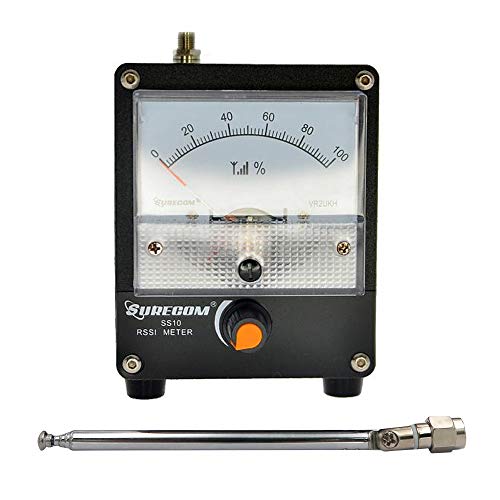
The Mcbazel SS10 covers a broad range from 100 KHz to 3 GHz, making it suitable for walkie-talkie testing and broader RF field assessments. Its high bandwidth and sensitivity support measurements across typical communications bands, including passively monitored signals. The meter’s pointer can be adjusted to protect the display during stronger readings, helping preserve calibration over time.
Key considerations:
– Coverage and sensitivity: 100 KHz–3 GHz with antenna; suitable for many consumer and professional RF applications.
– Protection features: adjustable pointer amplitude to guard the meter against overload.
– Practical use: good for quick field checks and antenna compatibility across multiple bands.
– Limitations: external antenna required; performance depends on the quality of the attached whip or directional antenna.
Mcbazel SS11 Portable Field Strength Meter

The SS11 is designed for field testing with a focus on RF signal strength across a wide frequency span. It notes high sensitivity and a 1,000 KHz to 3,000 MHz bandwidth range. The meter requires an Amp to operate and emphasizes the need to orient the antenna properly for accurate readings. A reminder to test with different frequency antennas can improve sensitivity and measurement reliability.
Key considerations:
– Field use: portable design supports on-site testing with compatible whip antennas.
– Frequency range: 1,000 KHz to 3,000 MHz broad coverage suitable for many cellular and Wi‑Fi bands.
– Setup notes: ensure whip antenna polarity is aligned with the target signal; consider multiple antenna options for accuracy.
– Limitations: external amplification and correct orientation are necessary for optimal readings.
GQ EMF-390: Multi-Field EMF and RF Detector
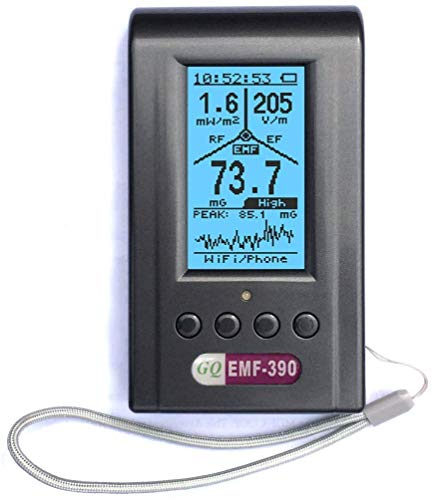
The GQ EMF-390 combines multiple high-sensitivity sensors to detect power lines, smart meters, cell phones, microwaves, and RF up to 10 GHz with data logging and a 2.5 GHz spectrum analyzer. It helps identify common RF sources and provides safety guidance based on readings. This model emphasizes a 3‑in‑1 approach to field analysis, useful for home, office, or professional environments where multiple EMF sources may be present.
Key considerations:
– Multisensor design: detects EF, MF, and RF with a unified display to simplify interpretation.
– Source identification: helps distinguish power-line, cellular, Wi-Fi, and 5G sources.
– Data logging and spectrum analysis: supports longer-term monitoring and signal characterization.
– Limitations: higher complexity; may be more suited for users needing comprehensive EMF profiling rather than a simple level check.
SureCall SC-METER-01: Five-Band RF Signal Meter
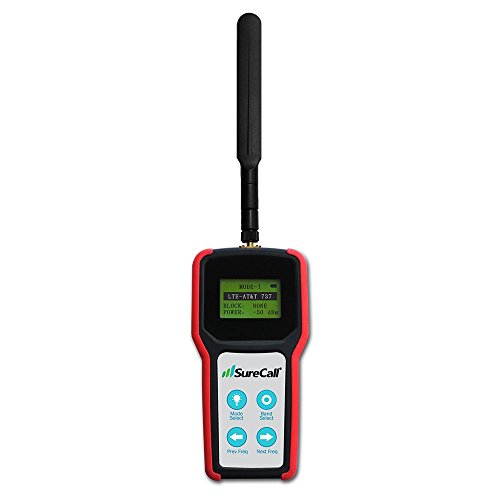
This meter is tailored for cellular booster installations, covering five bands: PCS, Cellular, AWS, and two LTE bands. It provides practical guidance on installation and signal presence, with a design that supports 2.5–3.5 hours of operation from rechargeable NiMH batteries. It is well-suited for field technicians installing or troubleshooting signal boosters in homes or businesses.
Key considerations:
– Band coverage: 1930–1995 PCS, 869–894 Cellular, 2110–2155 AWS, and two LTE bands.
– Duration and power: moderate runtime with rechargeable batteries; portability is a benefit for on-site work.
– Application fit: ideal for evaluating booster performance and coverage in real-world environments.
– Limitations: primarily oriented toward cellular booster tuning rather than general RF field surveying.
GODIYMODULES 100KHz-1000MHz Passive Field Meter
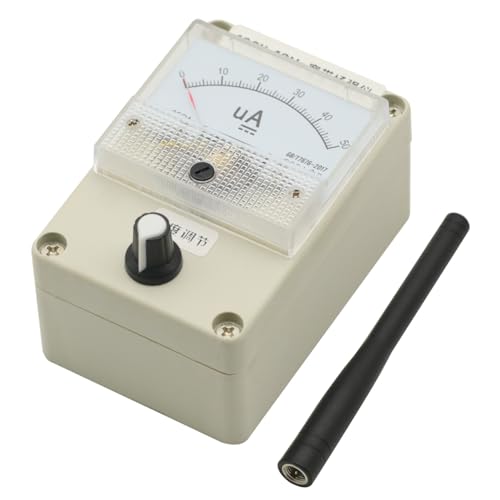
This broadband, passive field strength meter covers 100 KHz to 1000 MHz, offering a wide range for DIY projects and Arduino-based experiments. The device emphasizes a simple, efficient aesthetic, high sensitivity across its range, and an adjustable pointer amplitude to protect the meter head. It’s a practical choice for hobbyists exploring signal strength across diverse bands with a straightforward interface.
Key considerations:
– Band coverage: 100 KHz–1000 MHz; suited for educational projects and experimentation.
– Usability: straightforward design with adjustable pointer to guard the meter.
– Antenna compatibility: the original 400–470 MHz antenna may require replacement for testing at other frequencies.
– Limitations: sensitivity and performance depend on antenna choice; may require additional accessories for full-spectrum testing.
Buying Guide: Key Purchase Considerations For RF Signal Meters
Choosing the right RF signal meter depends on how you plan to use it, your frequency needs, and your environment. Consider these factors to balance performance and cost:
-
<liFrequency range: Identify the essential bands for your work—cellular, Wi‑Fi, RF hobby experiments, or general field testing. Broad, multi-band meters enable flexible use, while single-band units can be more affordable for focused tasks.
<liSensitivity and dynamic range: Higher sensitivity helps detect weak signals; a wide dynamic range reduces overload during strong signals. For field work, ensure the sensor design minimizes saturation risks.
<liAntenna requirements: Many meters rely on external whips or directional antennas. Compatibility with various frequency antennas improves accuracy across bands.
<liProtection features: Adjustable pointer amplitude, overload protection, and data logging capabilities protect the instrument and aid analysis after field testing.
<liPower and portability: Battery life and weight matter for on-site work. Rechargeable options are convenient for extended field sessions.
<liEase of use and display: A clear interface and readable display, especially in bright outdoor conditions, help reduce measurement errors during quick surveys.
<liData capture capabilities: Some meters offer data logging and spectrum analysis, which is valuable for trend analysis and detailed signal characterization.
<liIntended application: Booser installations, DIY experiments, or general RF surveying all have different meter requirements. Align features with your primary use case to avoid overpaying for capabilities you won’t use.
In summary, for broad-field testing and versatile use, select a meter with wide frequency coverage, reliable sensitivity, and robust antenna options. For more specialized tasks such as cellular booster installation, a targeted multi-band meter with clear guidance for that application could be the better fit. Always verify compatibility with your preferred accessories and consider whether data logging or spectrum analysis is necessary for your projects.