Choosing the right 16-channel relay board can simplify automation, control multiple devices, and protect critical circuits. This guide highlights five dependable options for 16-channel interfaces, focusing on durability, isolation, and ease of integration with microcontrollers, PLCs, and automation systems. Whether you’re building a smart home, a manufacturing prototype, or a robotics project, these boards offer solid performance for 12V, 24V, and varied control signals.
Summary of selected products
| Product | Brand | Key Feature |
|---|---|---|
| GUETNEU Relay Board, 16 Channel | GUETNEU | Premium insulation, silver-alloy contacts, DIN rail mount |
| Good BNTai 16 Channel Interface Relay Module | Good BNTai | DIN Rail option, independent NO/NC relays, high current |
| ANMBEST 16 Channel 5V Relay Module | ANMBEST | Opto-isolated, low-level trigger, direct microcontroller compatibility |
| ACEIRMC 5V 16-Channel Interface Board | ACEIRMC | Low trigger voltage, high-current relays |
| SainSmart 16-Channel USB Relay Module | SainSmart | USB control, isolated relays, ready for home automation |
GUETNEU 16-Channel DIN Rail Relay Board

The GUETNEU 16-channel relay board is designed to amplify control signals while safeguarding critical control systems. It features 16 independent SPDT relays, each with robust insulation and durable silver-alloy contacts for reliable switching and low contact resistance. The module is built to fit on a DIN rail, and can be mounted in a wall- or panel-mounted setup, with options to remove it from the green bracket for compact spaces. This versatility makes it suitable for industrial PLCs, automation, and time relay applications.
Key benefits include high insulation, helps prevent control-side faults from affecting devices, and modularity for scalable projects. The board supports flexible channel configurations and is compatible with a range of control signals, making it a pragmatic choice for both prototyping and field deployments.
Good BNTai 16 Channel Interface Relay Module
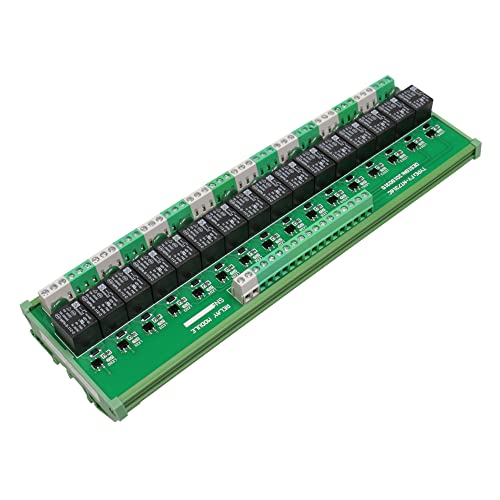
The Good BNTai 16-channel DIN rail panel-mount automation board offers 16 independent relays with a No/NC configuration and a high switching current. Its DIN rail compatibility supports streamlined integration into control panels and automation racks. With robust load ratings, it can handle 250VAC or 30VDC switching, making it suitable for a variety of control tasks from lighting to motor control. The module’s independence of each relay helps prevent a single point of failure from affecting other channels.
This board emphasizes straightforward installation and dependable performance in industrial environments. If your system requires modular expansion or a compact DIN-rail solution, this option provides a balanced combination of current rating, isolation, and ease of wiring for reliable operation.
ANMBEST 16 Channel 5V Relay Module

The ANMBEST 16-channel 5V relay module is designed for direct microcontroller interfacing. Each relay is opto-isolated and independently switchable, providing noise rejection and reliability in noisy electrical environments. It supports common microcontroller platforms such as Arduino, AVR, PIC, ARM, and DSP systems. The module also specifies strong load handling with AC and DC ratings and a safe trigger current for the opto-isolator, contributing to stable operation even in less-than-ideal control conditions.
With fault-tolerant design, the module helps ensure that a control line fault won’t cause all relays to misbehave. This makes it well-suited for hobbyist projects as well as compact automation tasks where robust isolation and predictable performance are required.
ACEIRMC 5V 16-Channel Interface Board

The ACEIRMC 5V 16-channel board is built for Arduino-style projects and DIY kits, offering 5V drive with each relay requiring a modest input current. It features high-current relays with AC250V 10A and DC30V 12A ratings, making it compatible with a wide array of loads. The trigger logic is designed to be low voltage, ensuring compatibility with typical microcontroller output pins. This module is a practical choice for developers seeking a straightforward 16-channel control solution for hobby projects or light automation tasks.
SainSmart 16-Channel USB Relay Module
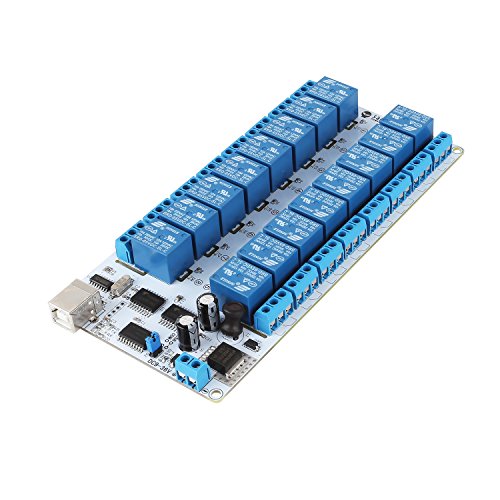
The SainSmart USB relay module provides 16 SPDT relays controlled via USB, suitable for quick, computer-driven control tasks. Its opto-isolated design reduces interference from motor loads or noisy devices, making it a good fit for home automation projects, robotics, and lab experiments. The module enables straightforward ON/OFF switching of electrical devices, which is useful for prototyping, automated testing rigs, and educational demonstrations. The USB connectivity simplifies setup for systems that require direct PC control or software-driven automation sequences.
Buying Guide: Key Considerations For 16-Channel Relay Boards
When selecting a 16-channel relay board, consider the following factors:
- Voltage and current ratings: Match the relay coil voltage (5V, 12V, or 24V) and the load ratings (AC/DC) to your project requirements. Higher current ratings expand load options but may require sturdier drivers.
- Isolation and protection: Opto-isolation helps protect control logic from high-voltage surges. Check for independent NO/NC contacts and fault-tolerance features to avoid cascading failures.
- Control interface: Determine whether you need microcontroller compatibility (Arduino, Raspberry Pi, ESP), or PC/USB control. Some boards offer DIN rail mounting for industrial setups, while others favor compact DIY projects.
- Wiring and installation: Consider board layout, terminal accessibility, and whether you need DIN rail compatibility. Some boards allow easy removal from mounting brackets for tight spaces.
- Expansion and scalability: If future growth is likely, choose a modular or expandable design that supports more relays without complex reconfiguration.
- Reliability and build quality: Look for robust contact materials (silver alloy), good insulation, and stable switching performance, especially for inductive loads.
- Documentation and support: Clear wiring diagrams, trigger specifications, and example projects help reduce setup time and debugging effort.
For applications in automation and control, these boards provide various pathways to connect sensors, actuators, and devices while protecting control systems. The right choice balances voltage compatibility, current demands, isolation level, and ease of integration with your existing hardware and software stack.