The right radar golf ball tracker can deliver precise swing metrics and ball flight data, helping players of all levels improve consistency. This guide highlights top radar-based devices and how they compare, from compact launch monitors to multi-sport speed radars. The selections below emphasize accuracy, ease of use, and value for American golfers looking to train smarter on the range or at home.
| Product | Brand | Key Benefit |
|---|---|---|
| PRGR HS 130-A Portable Launch Monitor | PRGR | Accurate club head and ball speed with memory for 500 swings |
| TAG ONE Sports Radar | TAG SPORTS AND OUTDOOR | Multi-sport speed tracking with AI coaching and app integration |
| Rapsodo Mobile Launch Monitor | Rapsodo | GPS-based tracking and video playback for swing analysis |
| Swing Speed Radar (US Made) | swing speed radar | Simple speed readings 20–200+ MPH with ball-free training |
| RYP Golf Radar (Rypstick) | Rypstick | No-ball speed tracking with accurate club head speed |
Below you’ll find five top products arranged by relevance to radar-based ball tracking and swing speed measurement, followed by a practical Buying Guide to help you choose the right tool for your game.
PRGR HS 130-A Portable Launch Monitor

The PRGR Launch Monitor uses advanced doppler radar to accurately track club head speed (with or without a ball), ball speed, smash factor, and total and carry distance. It operates without Wi-Fi or apps and runs on AAA batteries, making it highly portable. Notably, it stores up to 500 past swings, enabling long-term trend analysis and comparison against progress. This balance of affordability and reliable data makes PRGR a practical entry point for swing-speed training on the range or in practice bays.
TAG ONE Sports Radar
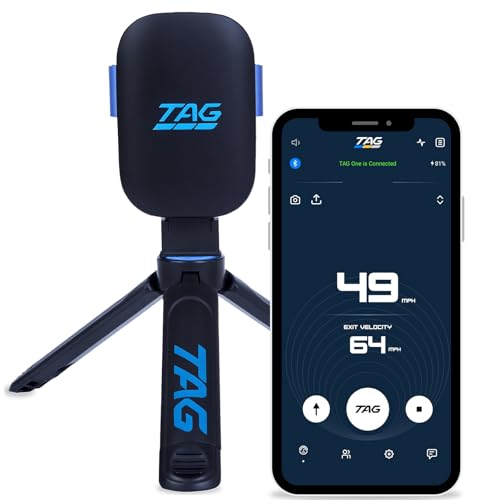
TAG ONE Sports Radar offers multi-sport speed tracking for baseball, softball, and golf, with a 6-hour rechargeable battery and a Bluetooth-connected app. It provides real-time speed data with a range of 20 to 225 MPH and ±1 MPH accuracy at distances up to 130 feet. The device includes a mini tripod and bracket for versatile mounting, and its AI-powered coaching feature (AiCE) within the app guides training sessions. This makes it suitable for individual practice and team drills, especially when integrated with video and data sharing.
Rapsodo Mobile Launch Monitor

Rapsodo delivers a pro-level launch monitor experience with GPS-based shot tracking for distances, ball speed, club speed, and launch angle. The integration with home or outdoor simulators allows real-time swing analysis, shot shape tracking, and interactive games. Its video playback and active shot tracers help visualize ball flight and refine technique, making it a strong option for golfers seeking in-depth swing feedback alongside distance measurements.
Swing Speed Radar (US Made)

This model emphasizes a simple, reliable user experience with Bluetooth app connectivity. It supports goal setting and progress tracking by club, with audible feedback through connected devices. It can operate with or without an actual golf ball (use a surrogate like a sponge ball for practice). The design prioritizes instant speed reads, making it a practical training aid for speed-focused drills and consistency work.
RYP Golf Radar (Rypstick)

The RYP Golf Radar focuses on accurate club head speed measurements using a no-contact approach with the Rypstick. This enables swing speed tracking without hitting a ball, which can be advantageous for practicing indoor or restricted spaces. The device emphasizes training efficiency by offering precise data for swing improvements while eliminating ball-impact variables from measurement.
Buying Guide: Key Purchase Considerations
- Measurement scope: Determine whether you need ball speed, club speed, smash factor, launch angle, or GPS-based distance data. Some devices emphasize ball metrics, while others prioritize club metrics or video integration.
- Ball-contact requirements: Some trackers require hitting a ball, others measure no-contact swings. If you practice indoors or want to avoid chasing balls, no-ball options can be advantageous.
- Data presentation: Consider whether you prefer on-device readouts, Bluetooth/app dashboards, or integrated video playback. App coaching features can enhance training plans.
- Power and portability: Battery life, rechargeable vs. disposable, and overall size affect on-site convenience. Portability matters for range practice and travel.
- Mounting flexibility: Tripods, clamps, and brackets help position sensors for optimal measurements. Multi-surface compatibility expands training locations.
- Software ecosystem: Some products offer AI coaching, cloud data syncing, and team sharing. If you train with others, a robust app ecosystem adds value.
- Accuracy and range: Check the stated speed range and accuracy. Larger ranges and tighter tolerances benefit players seeking precise comparisons over time.
- Budget and value: Compare entry-level launch monitors to multi-sport radars. Consider whether you want a single-function device or a system that covers multiple sports and training uses.
When choosing a radar golf ball tracker, align the device with your training goals—whether it’s improving swing speed, tracking ball flight, or integrating with a broader practice routine. Consider how you’ll use the data (range, training room, or home simulator) and how the accompanying software can help you interpret results and translate data into tangible improvements.