Finding a reliable power bank for a notebook means balancing capacity, output, and portability. The following selections are tailored for laptops, MacBooks, and high-demand devices, with fast charging, built-in cables, or premium efficiency. This guide compares five top models to help remote workers, students, and travelers keep devices powered on the go.
| Product | Brand | Capacity | Max Output | |
|---|---|---|---|---|
| Anker Laptop Power Bank, 25,000mAh | Anker | 25,000mAh | 3 x 100W USB-C | Built-in retractable cables |
| UGREEN Nexode 25,000mAh | UGREEN | 25,000mAh | 145W (PD3.1) | Ultra-fast three-port charging |
| LHUOED Laptop Power Bank | LHUOED | 20,000mAh | 130W | Dual USB-C with smart display |
| Ansody 65W Power Bank | Ansody | 25,000mAh | 100W total | Triple-port design |
| INiu 27,000mAh Power Bank | INIU | 27,000mAh | 140W PD3.1 | Airline-approved capacity |
Anker Laptop Power Bank, 25,000mAh
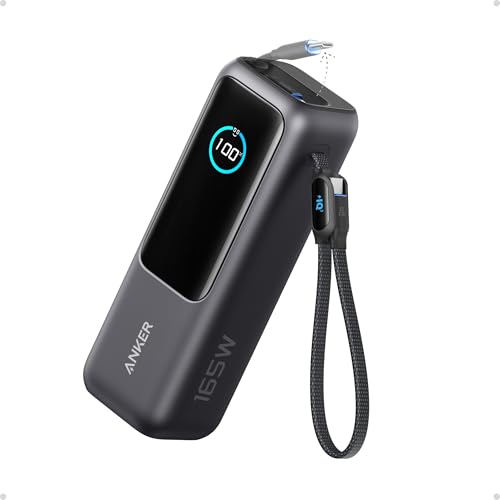
The Anker power bank combines substantial capacity with triple 100W USB-C ports, enabling simultaneous charging of a notebook, tablet, and smartphone. Its 25,000mAh capacity supports extended work sessions away from outlets, while airline-friendly compliance ensures travel flexibility. Built-in retractable cables reduce clutter, with one cable extending up to 2.3 feet and another fixed at just under a foot. This model emphasizes fast charge readiness for busy professionals.
UGREEN Nexode 25,000mAh, 145W

UGREEN’s Nexode model delivers a high total output of 145W across its USB-C PD ports, making it particularly capable for MacBook Pros, Dell XPS, and other high-demand laptops. The 25,000mAh battery yields multiple laptop charges, with the option to recharge the pack quickly via a compatible 65W charger. It also supports bi-directional fast charging, enabling fast replenishment of both the bank and connected devices.
LHUOED Laptop Power Bank, 130W
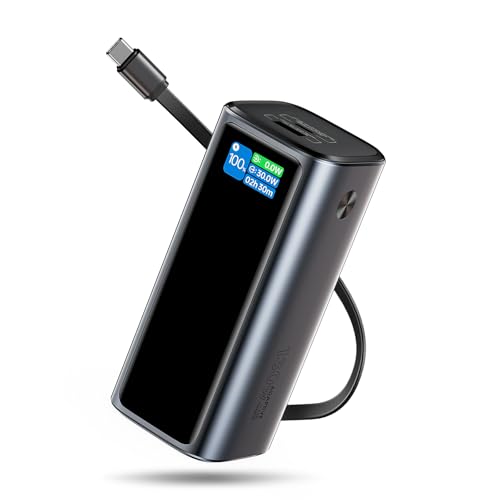
The LHUOED model focuses on rapid output with a total 130W across its two USB-C ports and USB-A. Its 20,000mAh capacity supports quick top-ups for laptops and phones on the move. The unit highlights a smart digital display to monitor output and input, and emphasizes travel-friendly design for professionals and students who need dependable performance in transit.
Ansody 65W Power Bank, 25,000mAh

The Ansody power bank emphasizes distribute-ability with a 100W total output that can be shared across devices, including laptops and smartphones. Its 25,000mAh capacity supports multiple recharges, making it a practical option for long flights or camping trips. A triple-port design enables charging two laptops and a mobile device concurrently, enhancing group travel scenarios or shared use in a classroom or office setting.
INIU 27,000mAh Power Bank, 140W

The INIU Power Bank emphasizes safety and speed with a 27,000mAh capacity and 140W PD3.1 charging. It’s designed for high-demand devices like MacBooks and gaming laptops, offering rapid top-ups while meeting airline-safety restrictions. A digital display provides real-time charge and discharge information, helping users plan recharges during travel or long work sessions.
Buying Guide
Key considerations when selecting a power bank for notebooks include capacity, output, and device compatibility. Higher wattage and multiple USB-C ports support fast charging for laptops while keeping phones and tablets topped up. Look for PD 3.1 or similar fast-charging standards to maximize charging speed, especially for 16- or 14-inch MacBooks and Windows laptops.
- Capacity and airline rules: Choose a model with a capacity that aligns with travel regulations (usually around 100Wh to 27000mAh). Ensure it is airline-friendly if you fly frequently.
- Output and ports: Prioritize devices with USB-C PD ports and at least 60W or higher per port. A three-port or multi-port design benefits families or teams sharing one battery.
- Recharging speed: A compact power bank should recharge quickly itself. Look for 65W or higher input where possible to minimize downtime.
- Build and portability: Consider retractable cables or built-in cables to reduce cable clutter. Lightweight designs improve portability for daily commutes.
- Display and safety: A digital display helps monitor input/output. BMS protection and overcharge safeguards extend battery life and device safety.
- Compatibility notes: Some laptops require higher wattage than others; verify that the power bank supports the specific notebook model and charging protocol (USB-C PD, QC, etc.).
- Travel features: If you travel with multiple devices or family members, choose a bank with multiple ports and durable construction designed for frequent handling and potential drops.
In practice, users who require all-day notebook performance often prefer models with 25,000–27,000mAh capacity and at least 100W total output, plus at least one 100W USB-C port for fast laptop charging. For travelers, airline compliance and compact, modular cables can offer meaningful advantages. When evaluating options, compare real-world charging times with your notebook’s power requirements to ensure the bank meets your daily workflow needs.