Choosing the right power amplifier rack mount can dramatically improve clarity, headroom, and reliability in live sound, DJ setups, or home studio rigs. The following selections emphasize solid build quality, practical features, and compatibility with common pro audio configurations. Each entry includes key specs and notable features to help you compare at a glance.
| Product | Brand | Approx. Power (per channel / bridged) | Notable Features |
|---|---|---|---|
| Pyle PTA1000 | Pyle | 1000W (per channel in stereo); bridgeable | Bluetooth streaming; cooling fans; safety power switch |
| Technical Pro AX1200 | Technical Pro | 465W @ 2Ω; 375W @ 4Ω; 210W @ 8Ω | 2U rack, LED meters, multiple inputs |
| MUSYSIC SYS-4500 | MUSYSIC | 4500W peak; typical high-output performance | ATR Technology; wide freq response; digital amp tech |
| Gemini XGA-3000 | Gemini Sound | 2x200W RMS @ 4Ω; 400W RMS bridged | XLR/quarter inputs; Speakon + binding posts; protection suite |
| Rockville D14 | Rockville | 2000W RMS @ 4Ω; 7000W peak | 1.5U rack-mount; built-in limiter; cooling fans |
Pyle PTA1000: 2-Channel Bluetooth Rack Mount Power Amp

The Pyle PTA1000 is a rack-mountable, 2-channel power amplifier with bridgeable capability, designed for applications ranging from DJ setups to small venues. It includes built-in Bluetooth for wireless device streaming and a safety-focused power switch that activates a brief delay to minimize turn-on transients that could affect connected loudspeakers. LED indicators show when power is supplied and channels are active, aiding quick diagnostics during gigs or practice sessions. The compact 1000W power profile suits mid-sized PA configurations, and the cooling system helps maintain stable operation during extended use.
Technical Pro AX1200: 1200W 2-Channel Rack DJ Power Amp

The AX1200 provides robust 2-channel power in a 2U rack footprint, suitable for DJ booths and live sound rigs. Its specification set includes 465W at 2 ohms, 375W at 4 ohms, and 210W at 8 ohms, with an iridescent blue LED meter that helps monitor output levels. The unit offers RCA inputs and per-channel power, level, and clipping indicators, along with standard banana binding post outputs. This configuration supports reliable performance in fast-paced environments, with a compact form factor ideal for portable setups.
MUSYSIC SYS-4500: 4500W Peak 2-Channel Amplifier

The SYS-4500 is a high-output, two-channel professional amplifier designed for DJs, live performances, and large PA systems. It features 4500W peak power with a broad frequency range for clear, distortion-free sound. ATR Technology enhances transient response for punchy bass and fast dynamics, while the amplifier supports multiple input/output configurations and potential bridge/expansion capabilities. Performance-oriented listeners will appreciate the extended bandwidth and low distortion characteristics that help maintain audio fidelity at high levels.
Gemini XGA-3000: 3000W Pro Power Amplifier
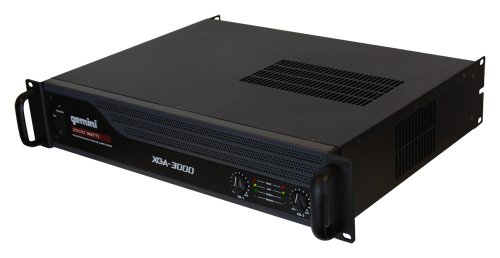
The Gemini XGA-3000 delivers 2x200W RMS at 4Ω, or 400W RMS when bridged, making it suitable for mid-to-large scale PA and DJ applications. It offers balanced XLR and 1/4″ inputs, RCA jacks, and multiple outputs (3 Speakon + binding posts) for flexible speaker connections. A built-in protective suite—including limiter, DC output protection, and short-circuit protection—helps safeguard connected equipment and maintain stable performance during demanding events.
Rockville D14: 7000W Peak/2000W RMS Rack-Mount Amp

The Rockville D14 provides a strong 2000W RMS per channel in a compact 1.5U rack-mount chassis, with a peak capability of up to 7000W. Its design emphasizes portability for mobile rigs while maintaining enough headroom for demanding live sound. The unit includes built-in cooling fans and a built-in limiter to prevent distortion and protect the system in dynamic environments. The versatile power and protection features make it a solid choice for DJs and venues seeking ample output in a rack-mount format.
Buying Guide: Key Considerations For Power Amplifier Rack Mounts
- Power rating and headroom: Distinguish between peak power and continuous (RMS) power. For most live applications, prioritize RMS ratings at the expected impedance (4Ω, 8Ω) and ensure the amp can comfortably handle occasional peak requirements without clipping.
- Impedance compatibility: Match amplifiers with your speaker impedance. Common values are 4Ω and 8Ω. Some amps offer multiple channels that can be bridged for higher power to a single speaker.
- Inputs and outputs: Verify available input types (RCA, XLR, TRS) and outputs (Speakon, binding posts) to ensure compatibility with your cabling and speakers. Consider RCA/dual-XLR inputs for redundancy in mixing setups.
- Rack dimensions and cooling: Check the unit’s rack unit (U) size and ensure adequate ventilation. Some models include cooling fans; assess noise levels if used in quiet environments or studios.
- Protection features: Look for limiters, thermal protection, DC protection, and short-circuit protection. These features help preserve loudspeakers and minimize downtime during performances.
- Bridge mode and expansion: If you plan to drive a single high-power speaker or multiple speakers, confirm whether the amplifier supports bridge mode and how it integrates with other gear.
- Connectivity features: Bluetooth and digital inputs offer convenience for wireless playback and integration with modern devices. Consider whether such features suit your setup or add unnecessary complexity.
- Build quality and reliability: Rack-mount amps with solid construction, dependable power supplies, and reputable brands tend to offer longer service life under demanding use.
- Maintenance and upgrades: Assess availability of service options, spare parts, and firmware updates if applicable to digital components in the amplifier.