Photosynthetic Active Radiation (PAR) meters quantify the light wavelengths integral to plant growth, helping greenhouses, indoor farms, and researchers optimize lighting for healthier, faster yields. This guide reviews five reliable PAR meters from reputable brands, highlighting how their features meet common horticultural needs—from real-time PPFD readings to data logging and rugged outdoor use. Whether you’re dialing in LED grow lights or monitoring solar exposure, these meters provide objective, actionable data.
| Product | Brand | Core Benefit |
|---|---|---|
| Sper Scientific Detachable Full Spectrum PAR Meter 860054 | Sper Scientific | Precise PAR with remote sensor for flexible positioning |
| The SpotOn Scientific Quantum PAR+DLI Meter | FGI | Real-time PAR with DLI mode and area scanning |
| PAR Meter for LED Grow Lights (Landtek) | Landtek | High-precision PPFD with multiple measurement modes |
| Photosynthetic Active Radiation Sensor RS232 (PODSJD) | PODSJD | RS232 output for integration with monitoring systems |
| Photosynthetic Active Radiation Sensor Aluminum Shell IP67 (NUMNBE) | NUMNBE | Rugged, outdoor-ready PAR sensing with durable housing |
Sper Scientific Detachable Full Spectrum PAR Meter 860054
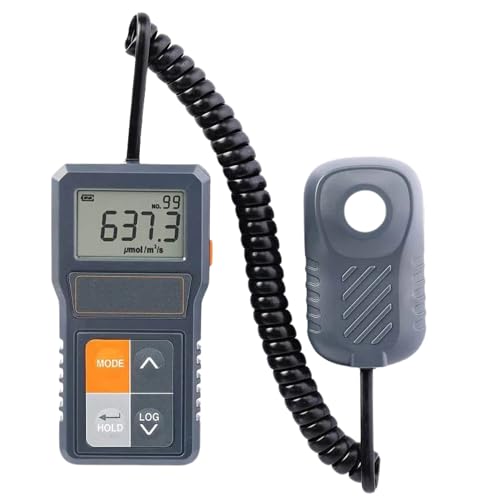
The Sper Scientific PAR meter provides precise measurement of photosynthetically active radiation in the 400–700 nm range, a key window for optimizing greenhouse and indoor farming conditions. Its detachable remote sensor comes with a 12-foot cable (plus a coiled option), enabling versatile placement for accurate readings whether mounted on tripods or positioned around plant canopies. A large LCD display, ZERO and RESET controls, and a rapid update time of 0.5 seconds deliver real-time, stable PPFD results. This model is well suited for plant physiology studies and horticultural research where measurement flexibility matters.
Features in practice include accurate PAR measurement across the essential spectrum and sensor versatility for difficult-to-reach plant canopies. The remote sensor aids in maintaining consistent data across multiple growth zones, making it easier to compare light environments within a single facility or across experiments. Precision, user-friendly controls, and rapid updates help growers and researchers align lighting with plant growth stages and photoresponse curves.
The SpotOn Scientific Quantum PAR+DLI Meter

The SpotOn PAR meter is a true quantum PAR device capable of sensing actual photosynthetic radiation from any light source, including modern LED grow lights. It features a DLI (Daily Light Integral) mode that calculates average 24-hour PPFD, enabling direct comparisons with global daylight benchmarks. Its scan mode analyzes light uniformity across an area, which is valuable for ensuring even canopy illumination in larger grow spaces. In standard mode, the device delivers instant PPFD readings on a readable LCD, combining scientific rigor with practical usability. A lightweight, robust design makes it suitable for field work and laboratory use alike.
From a data perspective, the SpotOn combines real-time PPFD with spatial averaging, making it a strong choice for researchers studying light distribution, photoperiod effects, or crop responses under variable lighting. While priced to be accessible, it remains a scientifically capable instrument that can serve greenhouses, university labs, and expert hobbyists seeking reliable, repeatable measurements.
PAR Meter for LED Grow Lights (Landtek)

This Landtek PAR meter focuses on high-precision PPFD measurement to capture photosynthetic photon flux density from 400 to 700 nm. It is designed to help growers dial in lighting across growth stages, preventing overexposure in seedlings and underexposure during flowering. The meter offers multiple modes, including dynamic updates and a hold or logged mode, so users can capture real-time readings or document the last readings for later analysis. A large LCD display makes it straightforward to read PPFD levels at a glance, while data logging supports tracking light fluctuations over time.
Key strengths include its three measurement modes and data-logging capability, which facilitate both day-to-day management and long-term experiments. The device is well-suited for indoor cultivation setups, where precise light control can influence yield and quality. Its portability also supports spot checks across different benches or rooms, making it a versatile tool for growers who rotate crops or test new lighting configurations.
Photosynthetic Active Radiation Sensor RS232 (PODSJD)

The PODSJD PAR sensor emphasizes RS232 output for easy integration with existing monitoring systems and data acquisition setups. It measures radiation energy within the 400–700 nm band with an all-aluminum shell for stability and durability, making it suitable for greenhouse applications and external sensor deployments. The combination of rugged construction and standard RS232 connectivity supports straightforward incorporation into larger environmental monitoring networks, enabling researchers and facilities to centralize PAR data alongside temperature, humidity, and other metrics.
In practice, this sensor supports long-term deployments in challenging environments due to its aluminum shell and IP67-style protection. The RS232 interface provides reliable data transmission to control systems, PLCs, or data loggers, reducing the need for frequent recalibration or complex interfacing hardware. This makes PODSJD a practical choice for facilities that require robust, scalable PAR sensing within an integrated environmental management strategy.
Photosynthetic Active Radiation Sensor Aluminum Shell IP67 (NUMNBE)
The NUMNBE PAR sensor combines a rugged aluminum shell with IP67 waterproofing to handle outdoor conditions typical of greenhouses, field trials, or solar research. It measures PAR in the 400–700 nm band with a design emphasis on high accuracy and stability, supporting long-term monitoring in harsh environments. The sensor’s robust construction and protective enclosure help safeguard against moisture, dust, and temperature fluctuations, while maintaining reliable data transmission for environmental monitoring systems. This model is a practical option for researchers and growers who require durable PAR sensing in challenging outdoor settings.
Overall, these five meters cover a broad spectrum of use cases—from compact indoor setups to field-scale outdoor monitoring. Selection should reflect the balance between measurement needs (real-time PPFD, DLI, data logging), data connectivity (RS232, USB, or simple LCD readouts), and environmental conditions (indoor greenhouse vs. outdoor). Each device brings a distinct combination of accuracy, durability, and ease of use to support precise light management for plant growth.
Buying Guide: Key Considerations for Choosing a PAR Meter
- Wavelength range: Ensure the device measures 400–700 nm, the PAR band relevant to photosynthesis.
- Measurement mode: Look for PPFD (instantaneous), DLI (daily light integral), and area scan for uniformity assessments.
- Sensor type and placement: Remote sensors offer flexible positioning; built-in sensors are compact but less adaptable to canopy geometry.
- Data output: Decide between LCD readouts, memory logging, or RS232/USB connectivity for integration with data systems.
- Durability: IP ratings, aluminum housings, and weather resistance matter for outdoor or greenhouse use.
- Power and portability: Battery-powered units enable spot checks; USB-powered devices suit lab environments.
- Ease of use: Large displays, intuitive controls, and quick data updates reduce measurement error and user fatigue.
- Calibration and traceability: Consider models with clear calibration references or the ability to calibrate against a standard.
- Price-to-performance: Weigh the value of features like remote sensors, data logging capacity, and build quality against budget.
- Compatibility: For integration with existing systems, prioritize RS232 or other standardized interfaces and Modbus compatibility where available.
In summary, the right PAR meter depends on your growing environment, data needs, and long-term monitoring goals. Whether you’re optimizing LED spectra for specific growth stages, studying light uniformity across benches, or integratingPAR data with environmental controls, these meters provide objective measurements to support informed decisions for better yields and plant health.