Choosing the right parallel port relay board can simplify CNC setups, automation tasks, and hobbyist projects. This guide highlights five well-matched options that leverage parallel or parallel-inspired interfaces, along with compatibility notes, installation tips, and practical considerations for safe, reliable control of motors, spindles, and other devices. Each option below provides dedicated input/output capability, isolation features, and clear integration paths with common control software and microcontroller ecosystems.
Summary of Selected Products
| Product | Brand | Interface Type | Key Use | URL |
|---|---|---|---|---|
| DAOKI DC 12-24V CNC 5-Axis Interface Board | DAOKI | Parallel Port with Optical Isolation | Spindle control, limit switches, emergency stop | Product Link |
| R223C16 16-Channel Relay Board | Jeanoko | DB9 RS232/Serial | Multi-channel control, automation projects | Product Link |
| C10 – BI-Directional Parallel Port CNC Breakout Board | CNC4PC | IEEE-1284 compatible parallel | CNC breakout, buffered I/O | Product Link |
| AEDIKO 8-Channel 12V Relay Module | AEDIKO | Opto-isolated inputs, 12V | 8-channel automation and I/O expansion | Product Link |
| GUETNEU 4 Channel 24V DIN Rail Relay | GUETNEU | DC 24V, DIN rail | Industrial control, compact expansion | Product Link |
DAOKI CNC Interface Board For 5-Axis Control

The DAOKI board provides a robust optical isolation setup for all input signals, enabling safe connections to emergency stops, tool setting references, and limit switches. It features a one-way relay output port suitable for spindle switching, with an output port at P17 and an ability to open all ports to connect to optocoupler drives. The P1 pin also serves as a PWM output, allowing spindle governor control via optocoupler input. A key design emphasis is the separation of USB power and peripheral power to enhance computer security, while the device operates on a 12–24V supply with reverse-polarity protection. This makes it a strong candidate for hobby CNC builds or small-shop automation that requires reliable, isolated control signals.
Features to note include isolation via optical coupling, support for connecting to limit switches and emergency stops, and a secure, isolated power scheme. The board also supports interfacing with a 5-axis stepper motor setup, making it versatile for multi-axis CNC projects. For users prioritizing robust electrical isolation and straightforward integration with Mach3 or similar software, this is a compelling option.
R223C16 16-Channel Relay Board

This 16-channel relay module offers a serial (DB9) interface, making it straightforward to integrate with legacy control systems or microcontroller projects that rely on RS232 communication. It supports eight distinct operation modes such as open, close, inch, self-lock, interlock, delay, full open, and full close, with immediate recognition of two commands in the at-command scheme. The module is designed for low-delay operation and reliable multi-channel control, providing a compact solution for orchestrating multiple devices from a single controller. Its straightforward RS232 interface and multi-mode capabilities help simplify automation tasks in labs or workshop environments.
CNC4PC C10 Parallel Port Breakout Board
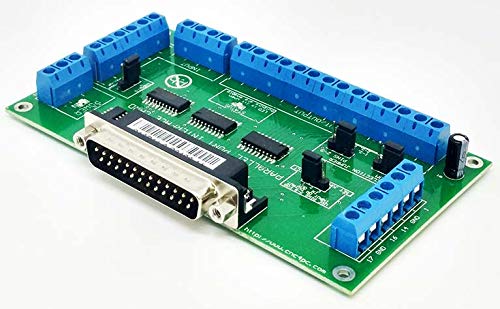
The C10 CNC4PC board is a classic parallel port breakout designed for CNC and motion-control tasks. It adheres to IEEE-1284 standards, and offers pull-up or pull-down input options along with buffered inputs and outputs. This configuration helps deliver predictable signal levels to external stepper drivers or relays, reducing noise susceptibility and improving timing accuracy in milling or routing setups. Its DIN-rail friendly form factor and straightforward assembly make it a reliable backbone for older PCs or dedicated CNC controllers that rely on parallel communications.
AEDIKO 8-Channel 12V Opto-Isolated Relay

The AEDIKO 8-channel relay module operates at 12V and features opto-isolated inputs, reducing ground-loop and cross-talk issues when wiring multiple devices. Each relay is individually switchable with a dedicated opto-isolated digital input, allowing straightforward expansion for automation tasks or CNC ancillary equipment like coolant pumps, fans, or tool changers. The 12V supply and opto-isolation contribute to safer control of high-current devices while maintaining clean logic levels for microcontroller interfaces. This module is well-suited for users who need moderate-scale expansion with strong isolation at a compact price point.
GUETNEU 4-Channel DIN Rail Relay Module

Designed for DIN rail installation, the GUETNEU 4-channel relay board offers 24V DC or AC operation with a rated load of 10A at 250VAC or 30VDC. This compact module is ideal for expanding control across a small automation panel or industrial control cabinet. Its DIN rail mounting, multiple channel options, and compatibility with standard control signals make it a practical choice for panel builders, PLC projects, or retrofits requiring a tidy, professional look with reliable switching performance.
Buying Guide: Key Considerations For Parallel Port Relay Boards
- Interface compatibility: Confirm whether the project relies on a true parallel port (IEEE-1284) or a modern alternative (DB9 RS232, USB-C, or I2C). Some devices offer hybrid options, but compatibility with your controller software is critical.
- Isolation and protection: Optical isolation reduces ground loops and protects upstream controllers from relay coil transients. Look for boards that clearly specify input/output isolation and polarity protection on power rails.
- Input/output configuration: Determine the number of channels you need, the type of inputs (pull-up/pull-down options), and whether buffered I/O is required for timing accuracy in CNC or automation tasks.
- Powering strategy: Consider whether the module uses a separate logic power supply or is powered from the same supply as the MCU/PC. Power isolation can improve safety and stability, particularly in CNC or motor-control contexts.
- Voltage compatibility: Ensure the relay coil voltage matches your control electronics (commonly 5V, 12V, or 24V). Mismatches can cause damage or unreliable operation.
- Maneuverability and form factor: DIN-rail vs. PCB-mounted modules impact installation in panels or chassis. Choose based on space, wiring ease, and future expansion plans.
- Latency and switching characteristics: Some systems require low-latency triggering for synchronized motion or time-critical automation. Review maximum delay specs and command-response behavior where available.
- Software and ecosystem support: Check compatibility with Mach3, GRBL, Raspberry Pi, Arduino, ESP32, or PLC environments. Clear documentation and example wiring help accelerate deployment.
- Safety and compliance: Look for features like reverse polarity protection, fuse recommendations, and certifications that align with your project’s safety requirements.