Discover parabolic cell phone antennas designed to extend your reach to distant towers, boost 4G/5G performance, and improve WiFi connectivity. This guide highlights five top options, covering outdoor directional grids, wideband parabolic designs, and MIMO configurations. Each product is evaluated for gain, frequency range, installation considerations, and compatibility with common carriers and home networks. Whether you’re battling weak signals in rural areas or chasing stable high-speed internet, these parabolic antennas offer measurable improvements. Explore practical use cases and a clear buying guide to match your needs.
| Product | Brand | Best Use |
|---|---|---|
| Bolton Technical Long Ranger Antenna | Bolton Technical | Long-range cell/ WiFi gains > 20 miles |
| Nooelec GOES Weather Satellite Mesh Antenna | NooElec | Satellite imagery and near real-time weather data |
| MIMO 4G LTE/5G Antenna Outdoor | SIGNALPLUS | Outdoor long-range 4G/5G with high gain |
| CEL-FI GO X with Grid Parabolic Antenna | CEL-FI | Home booster with grid parabolic antenna |
| Waveform Griddy Grid Parabolic Kit | Waveform | Broadband grid parabolic for high-speed data |
Bolton Technical Long Ranger Antenna

The Bolton Long Ranger delivers substantial gain across a wide frequency band, making it suitable for cellular and WiFi use with multi-carrier compatibility. With up to +28 dB of gain, this directional antenna is designed to extend signal reach well beyond typical indoor coverage, enabling clearer connections to towers or distant WiFi sources. Installation features include improved N-Female ports and sturdy clamps to simplify mounting and setup in outdoor or indoor environments. It targets modern networks from 600 MHz to 6500 MHz, positioning it as a versatile option for homes seeking reliable long-range performance.
Nooelec GOES Weather Satellite Mesh Antenna

This parabolic mesh is engineered for satellite data reception, not cellular networks alone. It centers on 1.7 GHz with a broad bandwidth, supporting GOES, HRIT/LRIT, and related satellite feeds. The setup commonly incorporates SDR, LNA, and decoding software to render near real-time weather information. Suitable for users pursuing satellite imagery, this antenna excels in linearly or circularly polarized signals and benefits from compatible decoding tools like SatDump. A precise alignment and software workflow are essential for optimal results.
MIMO 4G LTE/ 5G Antenna Outdoor Directional

This 30 dBi parabolic antenna is designed for long-range cellular and WiFi applications, with a focus on 4G/5G networks such as those from major carriers. The kit emphasizes precise aiming for best performance and comes with a substantial outdoor cable setup for elevated installations. It notes wide-band coverage from 698 to 6000 MHz, enabling compatibility with many devices, boosters, routers, and signal-extending systems. As with most parabolic designs, line-of-sight to the tower dramatically influences results.
CEL-FI GO X with Grid Parabolic Antenna Bundle
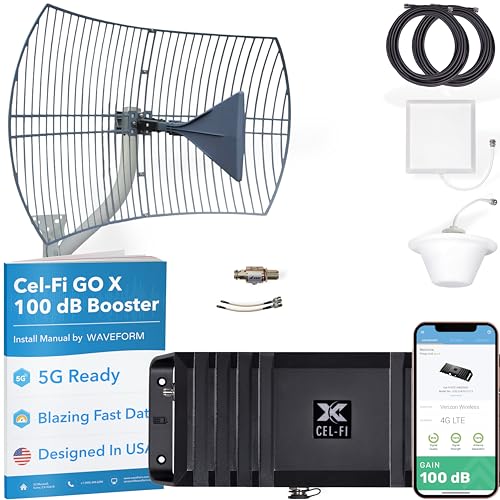
The CEL-FI GO X bundle combines a grid parabolic antenna with a robust booster, designed to push cellular signal gains toward high dB levels in a home setup. The Grid Parabolic Advantage is highlighted as a key differentiator, with line-of-sight conditions recommended for easier aiming. The kit includes a single dome and a panel antenna, offering flexibility in choosing the best configuration for a given home or office layout. FCC compliance is noted, emphasizing regulatory adherence in boosting performance responsibly.
Waveform Griddy: Grid Parabolic Kit

Waveform Griddy offers an ultra-wideband grid parabolic antenna with notable gain across multiple bands, including sub-6 GHz and higher frequency ranges. The kit includes a long feeder cable and adapters, supporting flexible deployment with cell boosters, modems, routers, and gateways. Griddy’s performance hinges on line-of-sight to the target signal source; obstructions can significantly degrade results. The design emphasizes a balance between broad coverage and focused directionality to maximize data throughput in demanding environments.
Buying Guide: Key Purchase Considerations
- Gain and frequency range: Higher dBi gains improve distant signal capture but require precise aiming and line-of-sight. Check if the antenna covers the frequencies you use (cell bands, 4G/5G, and WiFi).
- Directional vs. omni: Parabolic and Yagi designs are highly directional and suited for long-range targets. Omni designs provide broader, though shorter-range, coverage, useful when towers are nearby or scan flexibility is needed.
- Installation: Outdoor mounting demands weather resistance, mounting hardware, and away-from-obstructions placement. Cable quality (low loss) and connectors (SMA, TS-9) affect overall performance.
- System compatibility: Ensure compatibility with your booster, router, modem, or signal amplifier. Some kits pair grid parabolic antennas with specific booster models for optimal performance.
- Line of sight: Parabolic antennas perform best with a clear line to the signal source. Urban landscapes with trees or tall structures may require higher mounting or alternative orientations.
- Regulatory considerations: When using booster systems, confirm compliance with local regulations and carrier policies to avoid interference issues.
- Maintenance and durability: Outdoor antennas face weather exposure. Look for UV-resistant materials, corrosion resistance, and warranties to gauge long-term reliability.
- Cost vs. benefit: High-gain parabolic antennas can deliver strong improvements but require careful alignment and potential professional installation in complex environments. Weigh the expected gain against installation effort.
Overall, the right parabolic antenna depends on your location, target signals, and existing equipment. For distant towers or remote setups, a high-gain directional antenna paired with a suitable booster can provide meaningful improvements. In areas with broad coverage gaps or where multiple bands are used, a wideband grid parabolic option may deliver the most versatile performance. Always verify line-of-sight conditions and ensure the selected antenna aligns with your network hardware for best results.