Optical to RJ45 converters, also known as media converters, bridge fiber networks to copper Ethernet for scalable, cost-efficient expansion. This article highlights top-rated options that support various fiber types, wavelengths, and distances, helping American network admins choose the right device for extending or integrating LANs. Each selected product offers plug-and-play setup, reliable auto-negotiation, and durable casings suitable for both home labs and small to mid-size business environments.
Summary of Selected Products
| Product | Brand | Key Feature | Distance Support |
|---|---|---|---|
| TP-Link MC220L | TP-Link | Gigabit fiber to RJ45 with auto-negotiation | Up to 1,000 Mbps |
| BMKZAYR 1.25G Module Converter | BMKZAYR | Auto-Negotiation, Plug-and-Play | 1 Gbps |
| H!Fiber.com Fiber to Ethernet Converter | H!Fiber.com | SMF 1310nm, up to 20 km | Up to 20 km |
| H!Fiber.com BiDi SC to RJ45 | H!Fiber.com | BiDi 1310/1550nm, 20 km | Up to 20 km |
| TP-Link Gigabit SFP to RJ45 | TP-Link | 1000BASE-SX/LX to 1000Base-T, auto MDI/MDIX | Gigabit |
TP-Link MC220L Gigabit Fiber To RJ45 Converter
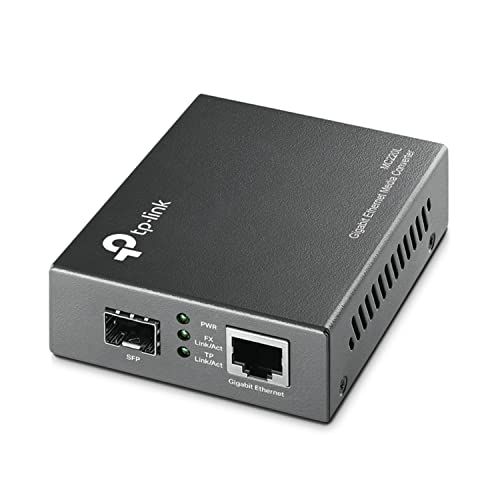
Overview and suitability: The TP-Link MC220L is a Gigabit media converter designed to bridge 1000BASE-SX/LX fiber with 1000Base-T copper Ethernet. It supports both single-mode and multimode SFP modules and is fully compatible with 10/100/1000 Base-T networks. The device emphasizes plug-and-play usability, requiring no software installation or configuration, which makes it ideal for quick network extensions in small offices or home labs. Its metal housing adds durability for rack mounting or transportation between locations.
Key features and implications: This converter excels where fiber-to-Ethernet translation is needed without complex setup. Auto-negotiation on the RJ45 port helps ensure seamless integration with existing switches and routers. The broad fiber compatibility means it can work with various SFP modules, enabling flexible distance options and fiber types. The rugged build and simple operation appeal to users seeking reliable, low-maintenance fiber extensions.
Best use cases: Extending a fiber backbone to a copper Ethernet segment, connecting a fiber uplink to a copper PoE switch, or creating a simple fiber-to-Ethernet link in small office networks. It is suitable where users prefer a straightforward, plug-and-play approach without additional management features.
BMKZAYR 1.25G/s Single Mode SFP to RJ45 Converter
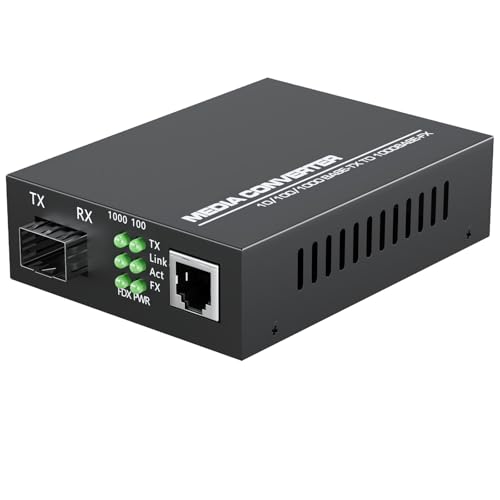
Overview and suitability: This 1.25G/s SFP to RJ45 converter offers a plug-and-play experience with auto-negotiation on the RJ45 port. It supports full-duplex/half-duplex operation and auto-MDI/MDIX, making it compatible with most standard Ethernet links up to 1 Gbps. The metal construction and straightforward design suit demanding environments where quick deployment is essential, such as temporary data centers or remote sites needing fiber-to-Ethernet bridging.
Key features and implications: Auto-negotiation simplifies device pairing with existing switches, routers, or end devices, reducing configuration steps. The device’s broad compatibility with 10/100/1000 Base-T ensures it can handle a wide range of network speeds and devices. The no-fuss, plug-and-play model minimizes downtime during installations or upgrades.
Best use cases: Deploying quick fiber-to-Ethernet links in small offices, upgrades to existing fiber infrastructures, or laboratories requiring modular, easy-to-install converters without complex management interfaces.
H!Fiber.com Fiber To Ethernet Converter (SMF, 20 Km)

Overview and suitability: This gigabit single-mode converter uses a 1310 nm 1000Base-LX module to bridge SMF fiber with RJ45 copper Ethernet. It ships with a single-mode SFP module, external power supply, and manual, plus a warranty program. Its maximum distance of up to 20 km makes it suitable for campus networks or longer-haul connections between buildings. The device supports full/half duplex modes and auto MDI/MDIX, enabling straightforward deployment without manual configuration.
Key features and implications: The package offers a complete, ready-to-use solution with essential accessories, making it appealing for deployments requiring longer fiber links. The 1310 nm wavelength is standard for SMF links, ensuring compatibility with common fiber infrastructures. The 20 km reach provides flexibility for campus or multi-building layouts.
Best use cases: Campus connectivity, building-to-building connections, or data center edge links where fiber-to-Ethernet bridging is needed across greater distances without switches in the middle.
H!Fiber.com BiDi Gigabit SC to RJ45 Converter

Overview and suitability: This BiDi (bidirectional) solution combines a BiDi SC fiber port with a 1000 Mbps RJ45 Ethernet port. It ships as a pair containing two external power supplies and a user manual, with a three-year warranty and lifetime support. The system supports SMF at 1310/1550 nm and up to 20 km, enabling long-range fiber links with minimized fiber count—ideal when fiber run limits or budget constraints favor single-fiber solutions.
Key features and implications: BiDi transceivers reduce fiber strand requirements, lowering installation complexity and fiber costs for certain layouts. The converter supports full/half duplex on the RJ45 side and auto-crossover features, ensuring reliable operation with common network devices. A robust warranty and ongoing support add resilience for business environments needing dependable gear.
Best use cases: Networks that require long-haul fiber connectivity with minimal cabling, or scenarios where fiber availability is limited and BiDi options simplify installations in small-to-medium networks.
TP-Link Gigabit SFP To RJ45 Media Converter

Overview and suitability: This TP-Link model converts 1000BASE-SX fiber to 1000Base-T copper, or vice versa, delivering up to gigabit speeds in full-duplex mode for both TX and FX ports. It includes auto MDI/MDIX support and offers a switch-like configuration option for FX port, allowing a balance between auto and forced settings. This flexibility is useful in mixed networks where some devices require explicit port behavior.
Key features and implications: The auto-negotiation capability simplifies integration with diverse endpoints. The dual-mode operation (TX and FX ports) provides adaptability for various network topologies, enabling you to adapt as you restructure your LAN. The device is compact and straightforward, suitable for adding fiber links to existing copper networks without complex management software.
Best use cases: Small offices expanding with fiber uplinks, labs adding fiber connectivity to a copper core, or scenarios needing a simple, reliable media converter with mixed-port behavior.
10Gtek Gigabit Ethernet Media Converter With 1000Base-SX Module

Overview and suitability: This device includes a 1000Base-SX module and supports MMF with a distance of up to 550 meters. It has a multi-criteria feature set including RTL8213B-based stability, full/half duplex on the RJ45 port, auto/MDI-X crossover, and compatibility with IEEE standards. It’s UL certified and designed for broader compatibility across various networks requiring short-to-mid-range fiber extensions.
Key features and implications: The 550-meter capability with multimode fiber makes it a robust option for office floors or data closets within a single building. The RTL chipset supports low latency and stable data transmission, which is beneficial for real-time applications. The device’s UL certification adds a layer of safety assurance for enterprise environments.
GESD 2-Pack BiDi SFPs and RJ45 Media Converters
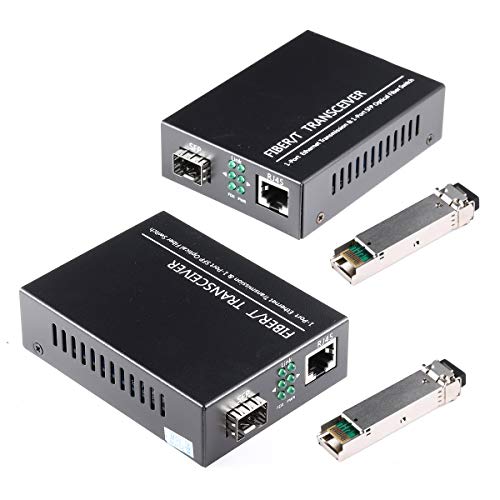
Overview and suitability: This kit includes two gigabit BiDi media converters with two BiDi SFP LC transceivers, two power supplies, and a user manual. The package emphasizes UL certification, wide voltage compatibility, and 30-day return policy with extended warranty and support. It’s designed for users needing multiple concurrent BiDi fiber-to-Ethernet links, suitable for small data centers, campuses, or office networks.
Key features and implications: The BiDi approach reduces fiber count and simplifies cabling while enabling long-haul links (up to 30 km with included transceivers). The included power supplies and universal voltage support make it convenient for varied electrical environments. The robust warranty and support provide assurance for mission-critical applications.
ipolex Gigabit Single-Mode LC Fiber To Ethernet Converter

Overview and suitability: This ipolex model combines a 1.25G SFP LX module with 1310 nm wavelength to convert LC-fiber to 10/100/1000Base-T RJ-45 copper, covering full duplex Ethernet connectivity. It supports transmission up to 20 kilometers and is designed for straightforward, plug-and-play installation, with a focus on reliable long-range fiber-to-copper bridging.
Key features and implications: The 1310 nm SFP LX module targets standard single-mode fiber networks, enabling long-distance connections between buildings or remote segments. The device’s hot-swappable design reduces downtime during maintenance. It’s a practical choice for institutions or businesses expanding fiber reach while keeping copper endpoints intact.
Buying Guide: Key Considerations When Selecting an Optical To RJ45 Converter
- Distance and fiber type: Determine whether you need MMF or SMF, and confirm the required link distance. SMF with LX modules supports longer runs, while MMF with SX modules is suitable for shorter indoor spans.
- Wavelength and compatibility: Check that the SFP module wavelength (1310 nm or 1550 nm) matches your fiber and that the converter supports 1000 Mbps or higher on the RJ45 port for your network speed requirements.
- Duplex and negotiation: Look for auto-negotiation and auto-MDI/MDIX features to simplify device integration with switches, routers, and end devices.
- Management and configuration: Decide between plug-and-play devices and those with management features. Most small offices benefit from no-fuss, plug-and-play units, while larger deployments may require advanced options.
- Power and durability: Consider external power supplies, voltage compatibility, and the physical build (metal housing) for rack mounting or portable usage.
- Warranty and support: A robust warranty and accessible customer service are valuable for business environments that depend on consistent uptime.
- Cost efficiency: BiDi configurations can reduce fiber cabling needs but may involve higher per-link component costs. Assess total cost of ownership based on your topology.
In summary, optical to RJ45 converters provide flexible, scalable ways to extend Ethernet networks across fiber, with options tailored for short or long-haul links, single- or multi-mode fiber, and varied installation contexts. The right choice balances distance, speed, compatibility, and ease of use to meet specific network expansion goals.