The following article highlights top optical-to-1/4 inch (6.35mm) DAC converters and related optical-to-aux options that support high-resolution audio. These devices translate Toslink/SPDIF signals into analog stereo for speakers, headphones, or older amps with 1/4″ inputs. All selections emphasize clear PCM/LPCM output, 192 kHz sampling, and reliable performance across common TV, Blu‑ray, and set‑top environments. Use this guide to compare features, compatibility, and installation steps to choose the right model for your setup.
| Product | Brand | Target Output | Key Benefit |
|---|---|---|---|
| NCGGY DAC Optical to Dual 6.35mm | NCGGY | Dual 6.35mm | Uncompressed stereo output with 192 kHz support |
| Tackston 192KHz DAC Optical to 3.5mm | Tackston | 3.5mm AUX | Easy TV-to-headphones or speakers via AUX |
| PROZOR 192KHz DAC Optical to Analog | PROZOR | RCA & 3.5mm | High‑resolution PCM, clear output |
| ESWN DNXB 192KHz Optical to 6.35mm | ESWN DNXB | 6.35mm AUX | Simple optical-to-1/4″ with 192 kHz support |
| Tackston 192KHz DAC Optical to 3.5mm | Tackston | 3.5mm AUX | Reliable optical-to-AUX with 192 kHz |
NCGGY 192KHz DAC Optical to Dual 6.35mm Converter

This optical-to-1/4″ splitter converts Toslink digital audio into two 6.35 mm outputs. It delivers dual-channel PCM output with a 192 kHz sampling rate, supporting 32, 44.1, 48, 96, and 192 kHz and 24-bit data streams. Note that it is unidirectional (optical to 1/4″), not suitable for 1/4″ to optical directions. The device provides EMI-free transmission with a focus on accurate channel separation, making it suitable for home theater setups where the TV or Blu-ray player outputs PCM or LPCM audio to wired speakers or amps.
Tackston 192KHz DAC Optical to 3.5mm Converter

This one-way SPDIF-to-AUX cable converts optical audio into a 3.5 mm analog signal for headphones, speakers, or a compact sound bar. It supports up to 192 kHz / 24-bit and handles common sampling rates (32, 44.1, 48, 96, 192 kHz). It’s ideal for late-night viewing or quiet listening, letting users enjoy TV audio without disturbing others. The design focuses on straightforward setup, with the 3.5 mm output feeding standard AUX inputs.
PROZOR 192KHz Digital to Analog Audio Converter
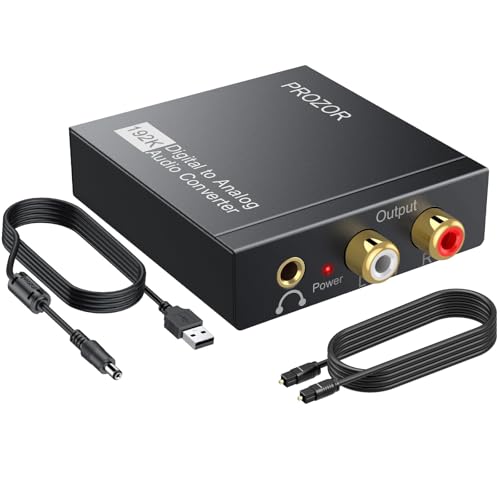
PROZOR’s DAC converts Toslink or coaxial SPDIF into analog L/R RCA and 3.5 mm simultaneously. It supports up to 192 kHz / 24-bit PCM and emphasizes clean output with an upgraded amplifier stage. The setup requires PCM/LPCM output selection on the TV for proper channel decoding. While optical output is not supported in some variants, this model focuses on a reliable stereo path for home cinema or gaming systems with simple installations and a compact form factor.
ESWN DNXB 192KHz Optical to 6.35mm Converter

This model converts optical audio to a 1/4″ TRS output and supports 192 kHz sampling with 24-bit depth. It’s a unidirectional optical-to-analog converter, designed for straightforward connections to amplifiers or powered speakers. The included optical cable simplifies setup, and the device is suitable for HDTVs and set-top boxes where a direct optical-to-6.35 mm path is needed, with clear guidance that 5.1 formats should be switched to PCM/LPCM for compatibility.
Tackston 192KHz DAC Optical to 3.5mm Converter
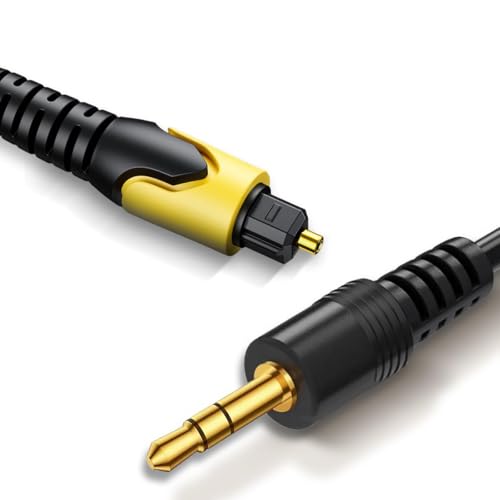
The Tackston converter translates optical audio to a 3.5 mm AUX output with 192 kHz / 24-bit capability. It supports common optical input rates (32–192 kHz) and is designed for TV-to-headphone or speaker connections. The device targets quiet listening experiences and accessibility, enabling easy use for hearing-impaired individuals or anyone who wants to enjoy TV audio through headphones or external speakers without compromising signal quality.
Buying Guide: Key Considerations For Optical To 1/4 Inch Converters
- Directionality and output type: Most optical-to-1/4″ adapters are unidirectional (optical to analog). Confirm that the model outputs to the correct 1/4″ port (mono/stereo) for your setup and that you do not require bi-directional conversion unless explicitly stated.
- Sampling rate and bit depth: Look for 192 kHz / 24-bit support for high-resolution audio. Ensure the device handles PCM/LPCM and note any limitations on 5.1/Dolby/DTS formats that may require changing TV audio settings to PCM.
- Output compatibility: Check whether the converter provides dual 6.35 mm outputs, a single 3.5 mm AUX jack, or both. Your choice should match your speaker, amplifier, or headphone input configuration.
- Installation simplicity: Favor models with included optical cables and easy-to-follow setup instructions. Less cable clutter helps reduce EMI and interference in home theater racks.
- Emissions and noise: EMI-free or low-noise transmission is beneficial for accurate audio reproduction, especially in quiet listening environments.
- Use-case fit: For TVs and set-top boxes, ensure the device supports PCM/LPCM output and that your TV’s audio settings are configured accordingly. Some devices require you to disable 5.1 decoding in favor of stereo PCM.
- Build and compatibility notes: Some units specify non-reversible directions (optical to analog only). If you need reverse direction (analog to optical), you will need a different product built for that purpose.
- Budget and form factor: If you need a compact solution for a media cabinet, consider the footprint and portability of the unit. If you require robust dual-channel outputs for Bi-amping or stereo separation, a dual-output model may be preferable.