Choosing reliable noise level testing equipment helps organizations and households measure sound exposure, verify compliance, and settle disputes with objective data. The products below cover a range of environments—from workplaces and construction sites to homes and studios. Each device offers essential features like A-weighting, fast/slow responses, data logging, and clear displays, making it easier to capture precise decibel readings and build a data trail when needed.
Summary table of selected products:
| Product | Brand | Max Range | Key Feature |
|---|---|---|---|
| eS528L Decibel Meter and Recorder | ennoLogic | 30-130 dB | Long-term data logging |
| BINTA Decibel Meter | BINTA | 30-130 dB | A/C weighting, data hold |
| RISEPRO HT-80A | RISEPRO | 30-130 dB | Fast/Slow, broad use |
| TopTes TS-501A | TOPTES | 30-130 dB | 2.25″ backlit LCD |
| Triplett SLM400-KIT | Triplett | 35-130 dB | IEC/ANSI compliant, calibrator |
ennoLogic eS528L Decibel Meter And Recorder
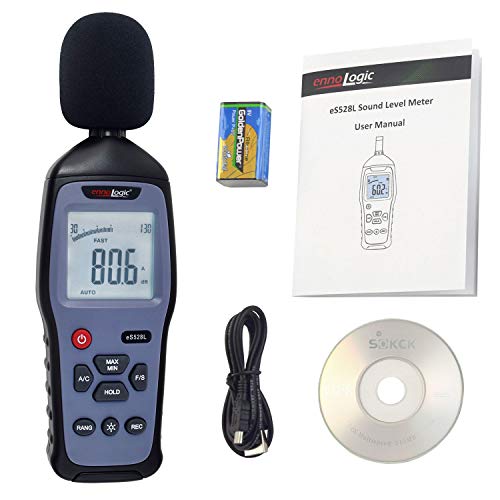
The eS528L measures sound levels from 30 to 130 dB with ±1.5 dB accuracy, providing a credible data source for workplace safety, neighborhood noise disputes, and vehicle or equipment audits. Its ability to log long-term measurements supports area monitoring on job sites or outdoor areas, helping to document trends over hours or days. This Type 2 device is designed to produce defendable measurements for conversations with neighbors, employers, or regulatory bodies.
Key features include: hour-by-hour noise logging, broad measurement range, and data that can be revisited later to verify peak and average levels. Users can compare readings against noise ordinances or occupational exposure limits, enabling informed decisions about mitigation or communication with stakeholders.
Ideal use cases: construction zones monitoring, car audio or exhaust noise checks, leaf blowers and lawn equipment comparing against standards, and any scenario requiring verifiable decibel data to support or resolve disputes.
BINTA Decibel Meter With A/C Weighting

The BINTA meter provides a wide 30 dB to 130 dB measuring range with high accuracy (±1.5 dB) suitable for homes, offices, and industrial spaces. It supports A-weighting for human hearing simulation and C-weighting to capture low-frequency industrial noise, offering more tailored analysis depending on the context. The device presents results in both dB and Sone units, with fast and slow response options for different monitoring needs.
The MAX/MIN function and data hold feature help capture instantaneous peaks and maintain reference values for later review. This makes it well-suited for evaluating noisy neighbors, factory floors, or home workshops where precise trends over time are important for compliance or mitigation decisions.
RISEPRO Digital Sound Level Meter HT-80A

The RISEPRO HT-80A covers 30–130 dB with a ±1.5 dB accuracy, making it a versatile choice for both casual and professional use. It supports Fast (125 ms) and Slow response modes to capture quick spikes or steadier trends, respectively. The meter’s dual measurement approach suits environments ranging from home studios to construction sites, where different analysis needs may arise.
Designed for practical field application, this tool supports straightforward operation and clear readouts, helping users determine whether noise levels meet or exceed applicable guidelines and to document measurements when needed for reporting or complaint processes.
TopTes TS-501A Decibel Meter

The TS-501A uses A-weighting to measure noise from 30 to 130 dB with a ±1.5 dB accuracy and a 2.25-inch backlit LCD for easy reading in various lighting. It provides MAX/MIN readings and data hold to capture peak levels and maintain snapshots for later analysis. The compact, portable design makes it suitable for home use, noisy neighborhoods, or small workshop monitoring, with a clear interface for quick checks.
Typical applications include monitoring noisy neighbors, evaluating home improvement projects, and verifying compliance with local noise ordinances. The device’s display and functionality emphasize practical day-to-day measurement needs while maintaining reliable accuracy across common scenarios.
Triplett SLM400-KIT Decibel Meter With Calibrator

The SLM400-KIT combines a sound level meter with a calibrator, covering 35 to 130 dB with ±1.5 dB accuracy. It includes A and C weighting options and a selectable fast/slow response time, making it suitable for OSHA-related compliance checks and community noise assessments. The included calibrator supports accurate calibration of the meter’s readings, ensuring reliability for regulatory or professional use.
Buying Guide: Key Purchase Considerations
- Measurement range and accuracy: Most devices here cover 30-130 dB with ±1.5 dB accuracy, which is typical for consumer and professional meters. If your work involves strict compliance, consider models with IEC/ANSI Type 2 ratings and documented calibrators.
- Weighting options: A-weighting is standard for human hearing relevance, while C-weighting helps capture low-frequency industrial noise. Choose devices with both if you monitor environments with varied noise characteristics.
- Response time: Fast (short) vs. Slow response affects how quickly readings react to spikes. For peak noise events, Fast is useful; for longer-term trends, Slow provides smoother averages.
- Data logging and reporting: Long-term logging supports forensic or regulatory documentation. Look for meters that store readings, allow transfer, and support duration-based analysis.
- Display and portability: A larger backlit display helps readability in dim workspaces. Portable meters are ideal for field use, but check for robust construction if you’ll operate on construction sites or outdoor areas.
- Calibration and accessories: A calibrator or included calibration procedures improve measurement reliability. Consider products sold as kits for ready-to-use compliance checks.
- Multi-unit support: Some meters offer dB and Sone readings, expanding how you present perceived loudness to different audiences.
- Use case alignment: Home monitoring, neighborhood disputes, workplace safety, and studio or stage testing all have distinct needs. Match features to your primary environment, and consider a kit that includes a calibrator for higher assurance.
When selecting a noise level testing device, align your choice with the environment, required documentation, and the level of precision you need for decision-making or dispute resolution. The products listed above provide a spectrum of capabilities—from long-term logging to quick spot checks—so you can identify a tool that fits your objective measurement goals while supporting credible data collection.