Choosing a reliable decibel meter is essential for noise assessments in industrial, educational, and residential settings. This guide focuses on devices that deliver precise measurements, compliance with widely recognized standards, and practical features such as data logging, backlit displays, and NIST or IEC/ANSI traceability. The following five products represent a range of capabilities—from compact home-use meters to professional instruments suitable for OSHA and community noise compliance. Use the Buying Guide to compare essential factors before selecting the right instrument for your needs.
| Product | Brand | Key Features |
|---|---|---|
| Digi-Sense Data Logging Sound Meter with NIST-Traceable Calibration | Digi-Sense | Data logging, NIST-traceable calibration, ANSI/IEC61672-1 Class 2 |
| Decibel Meter, TopTes TS-501B | TOPTES | 2.25″ backlit LCD, A/C weighting, 30–130 dB, MAX/MIN, data hold |
| Triplett 3550 SoniChek PRO | Triplett | Certificate of Calibration to NIST, 30–130 dB, IEC/ANSI Type 2 |
| Triplett SLM400 | Triplett | NIST traceability, 35–130 dB, Type 2, 1.5 dB accuracy |
| INSTRUKART SL-4001 | INSTRUKART | IEC/IEEE compliant, 35–130 dB, Fast/Slow, multiple outputs |
Digi-Sense Data Logging Sound Meter With NIST-Traceable Calibration

The Digi-Sense data logging sound meter provides precision measurements with integrated data logging software and NIST-traceable calibration. It meets ANSI and IEC61672-1 Class 2 standards, offering four user-selectable ranges from 30 to 130 dB for flexible measurement in varied environments. This instrument is suitable for workplace sound monitoring, environmental assessments, and compliance documentation. Data logging helps build a detailed measurement history that can be exported for reporting or regulatory submissions. The device emphasizes accuracy and calibration traceability, essential for legitimate noise disputes or safety audits.
Decibel Meter, TopTes TS-501B Sound Level Meter

The TOPTES TS-501B is a portable decibel meter designed for quick spot checks with a large 2.25-inch backlit LCD screen for readability in dim environments. It provides A-weighted and C-weighted measurements across 30–130 dB with an impressive ±1.5 dB accuracy and a frequency range of 30–8000 Hz. Features include MAX/MIN readings and a data-hold function, making it ideal for monitoring noise in classrooms, offices, workshops, and residential settings. The backlit display ensures clarity during evening inspections or in poorly lit spaces.
Triplett 3550 SoniChek PRO With NIST Calibration
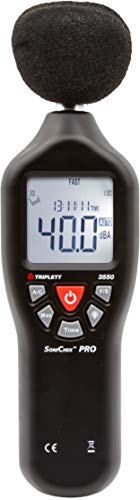
The Triplett 3550 SoniChek PRO is a professional-grade decibel meter calibrated to NIST standards. It measures 30 dB to 130 dB with a declared accuracy of ±1.5 dB (94 dB @ 1 kHz) and adheres to IEC651 Type 2 and ANSI S1.4 Type 2 standards for reliable occupational and environmental noise measurements. A/C frequency-weighted readings enable precise assessments for worker safety and compliance with noise ordinances. This model suits industrial, construction, and educational use where traceable calibration is essential.
Triplett SLM400 Decibel Meter With NIST Traceability

The Triplett SLM400 delivers a robust set of features with a certificate of calibration traceable to NIST. It measures 35–130 dB across two ranges and offers an accuracy of ±1.5 dB. This instrument aligns with IEC 61672-1 Type 2 and ANSI S1.4 Type 2 standards, making it suitable for OSHA-related safety checks and compliance verification in workplaces and public venues. The added traceability helps ensure confidence in measurement data used for audits and regulatory reporting.
Decibel Meter 130db Type 1 — INSTRUKART SL-4001

The INSTRUKART SL-4001 is designed for professional-grade noise measurements with a 30–130 dB (typical 35–130 dB) range. It features IEC 651 Type 2 and related standards conformance, a clear large LCD display, and support for MAX/HOLD, A/C weighting, and multiple measurement modes. It suits auditoriums, theaters, classrooms, and industrial environments where precise, legally defensible noise data is required. The device emphasizes long-term stability and user-friendly operation for field and lab use.
Buying Guide — Key Purchase Considerations
- Measurement Range and Resolution: Look for meters that cover at least 30–130 dB with a 0.1 dB resolution. For noisy environments or precise safety thresholds, dual-range or multiple-range configurations can improve accuracy around critical limits.
- Weighting and Frequency: Ensure the meter supports A-weighting for general noise and C-weighting for peak measurements. Frequency ranges around 31.5 Hz to 8 kHz are common; confirm compatibility with your regulatory needs.
- Calibration and Traceability: NIST or IEC/ANSI traceability adds credibility to measurements, especially for compliance and litigation. Certificates of Calibration can be time-bound; verify validity and renewal options.
- Readability and Display: A backlit LCD or large display improves readability in dim or outdoor environments. Data hold and MAX/MIN features help capture transient noise events.
- Data Logging and Outputs: Built-in data logging and export options (CSV, USB, or software) streamline reporting and trend analysis. Consider whether you need external outputs (analog/digital) for integration with data systems.
- Certification and Standards: If your use-case involves safety compliance (OSHA, workplace standards) or environmental monitoring, choose meters that explicitly state IEC/ANSI Type 2 or Class 2 classifications and relevant certifications.
- Portability and Durability: For fieldwork, a compact, rugged design, battery life, and stable form factor help reduce downtime and measurement errors in dynamic environments.
- Calibration Lead Time: Some models offer extended calibration lead times or quick-turn options. Plan for calibration cycles that align with your reporting schedule.
Choosing the right decibel meter involves balancing accuracy, calibration reliability, and practical features like data logging and readability. The products listed here provide a spectrum of capabilities—from basic, user-friendly meters to advanced devices suitable for professional, certified noise measurements. Consider your typical measurement scenarios, regulatory requirements, and data reporting needs when selecting the best instrument for your organization.