For swimmers and water athletes, finding reliable earphones that stay secure, deliver clear audio, and work underwater can be challenging. This guide covers five strong options designed for swimming use, featuring IP68/IPX8 ratings, bone conduction or open-ear designs, and built-in MP3 storage. We compare modes, battery life, fit, and water performance to help you choose the right pair for laps, snorkeling, or open-water sessions.
| Product | Key Benefit | Water Rating | Memory | Notes |
|---|---|---|---|---|
| SAMVEK Swimming Headphones | Bone conduction, wireless with MP3 option | IP68 | 32 GB | Bluetooth and MP3 modes; Bluetooth not underwater |
| AGPTEK IPX8 Earphones | Coiled cable, stereo extension included | IPX8 | None | Wired option; 3.5mm extension cable |
| MARLALL Swimming Headphones | Open-ear, dual-mode with MP3 and Bluetooth | IP68 | 32 GB | MP3 mode recommended underwater |
| KOPIDOE Swimming Headphones | Open-ear design, Bluetooth 5.4 with MP3 | IP68 | 32 GB | Stable up to 10m; MP3 for underwater use |
| FANISIC Swimming Headphones | Bluetooth 6.0 and MP3 with 32 GB | IPX8 | 32 GB | Multipoint support; MP3 mode for water |
Note: Bluetooth signals typically don’t travel well underwater. Most models switch to MP3 mode for underwater listening. Battery life and memory capacity vary by model and usage mode.
SAMVEK Swimming Headphones Overview

These bone conduction headphones use Bluetooth 5.4 to deliver a stable wireless connection for music and calls on land, with underwater use reserved for MP3 playback. The built-in 32 GB MP3 memory supports up to about 8,000 songs, and multiple formats such as MP3, WMA, WAV, APE, and FLAC are supported. A fully waterproof IP68 rating protects against water, sweat, and dust during swimming, snorkeling, or boating. Note: Bluetooth mode is not supported underwater; users should switch to MP3 mode when swimming.
Key strengths
- Stable Bluetooth 5.4 for on-land activities
- Robust 32 GB internal storage for offline listening
- IP68 waterproof design suitable for swimming environments
AGPTEK IPX8 Waterproof In-Ear Ears

AGPTEK’s wired, IPX8-rated swimming earbuds emphasize reliability with a coiled cord to prevent tangling and supplied extension cable to connect to devices. Inner nano-coating allows immersion up to 1.5 meters for 30 minutes without performance loss. The inclusion of two ear tip sizes (M/L for swimming and S/M/L for general use) helps secure fit and comfort during vigorous activity.
Key strengths
- IPX8 water resistance for robust protection
- Coiled cords reduce tangling; flexible extensions
- Multiple ear tip sizes for secure fit
MARLALL Swimming Headphones

This model emphasizes an open-ear, bone conduction design with IP68 waterproofing. It combines Bluetooth 5.4 connectivity with a 32 GB internal memory for MP3 playback, accommodating 5,000–8,000 songs depending on file size. It’s designed for swimmers who want to stay aware of their surroundings while enjoying music during workouts. Bluetooth is not supported underwater; MP3 mode is the recommended underwater option.
Key strengths
- Open-ear bone conduction promotes situational awareness
- IP68 protection for swimming and outdoor activities
- Dual-mode operation with sizable local storage
KOPIDOE Swimming Headphones With 32GB

These open-ear, bone conduction headphones feature 32 GB of built-in memory for offline listening and Bluetooth 5.4 for a stable wireless connection up to 10 meters. The IP68 rating ensures resistance to water and sweat. The design favors underwater MP3 playback while offering Bluetooth use above water for listening to playlists, audiobooks, or calls. The device supports formats such as MP3, WAV, WMA, and FLAC, with an emphasis on reliable underwater playback.
Key strengths
- Open-ear design for awareness and comfort
- Significant memory and Bluetooth range
- Strong IP68 waterproof rating
FANISIC 2026 Latest Swimming Headphones
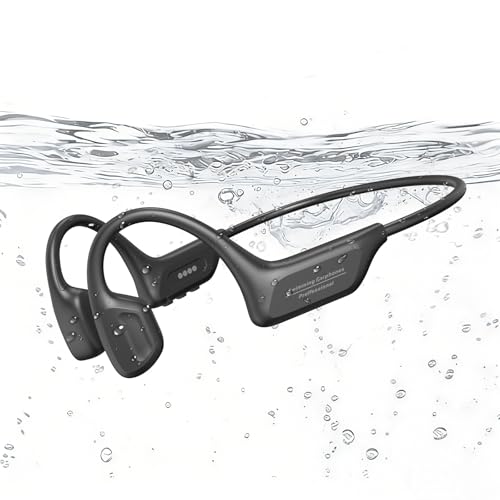
Fanisic offers Bluetooth 6.0 with MP3 playback and 32 GB internal memory. It supports multipoint connections, allowing one-to-two device pairing and seamless switching for calls or music across devices. IPX8 waterproofing ensures use during swimming sessions, and MP3 mode eliminates the need for a phone in the pool. A notable feature is the ability to switch modes easily, with automatic Bluetooth activation on startup, simplifying setup for routine workouts.
Key strengths
- Latest Bluetooth version with robust MP3 mode
- Multipoint support for multiple devices
- IPX8 rating suitable for intense water activities
Buying Guide: Key Purchase Considerations
When choosing music earphones for swimming, consider environment, listening mode, and comfort. Open-ear and bone conduction designs are beneficial for awareness and splash resistance, but underwater use typically relies on MP3 playback rather than Bluetooth. Here are essential factors to weigh:
- Waterproof rating: Look for IP68 or IPX8 for swimming and prolonged water exposure. Read product notes on submersion depth and duration.
- Underwater listening mode: Most models require MP3 playback underwater. Confirm how to switch modes and whether Bluetooth is used above water only.
- Memory capacity: Built-in memory (16–64 GB) enables offline playlists. Higher storage supports more songs and formats.
- Open-ear vs bone conduction: Open-ear allows ambient awareness; bone conduction sits near the cheekbone, reducing ear fatigue, but sound leakage varies by design.
- Fit and comfort: Ear hooks, soft silicone, and secure fit are critical for swimming with turns and strokes. Check for adjustable fits and lighter weight options.
- Battery life and charging: MP3 mode tends to consume less power than continuous Bluetooth streaming. Magnetic or USB-C charging are common; verify charging time.
- Compatibility and formats: MP3, WAV, WMA, FLAC support expands compatibility. Ensure formats match your library.
- Durability and maintenance: Rinse after sessions to extend life, and dry the microphone if you use hands-free calling.
In practice, top picks emphasize a secure fit, reliable underwater MP3 playback, and a comfortable open-ear or bone conduction experience. If you swim with caps or goggles, ensure the design accounts for headgear compatibility and won’t loosen during laps. Consider whether you prefer wired extensions for flexibility or a fully wireless setup for convenience above water.