Discover top all-in-one solar inverters with built-in MPPT controllers designed to simplify off-grid and home energy storage. This guide highlights five versatile models, covering 24V and 48V systems, pure sine wave output, and robust MPPT charge capabilities. Each unit integrates inverter, charger, and MPPT control for streamlined setup and efficient solar charging. Read on to compare features, compatibility, and performance to find the best fit for your off-grid needs.
Summary of Selected Products
- VEVOR Hybrid Solar Inverter 3000W (24V) – Built-in MPPT up to 100A
- VEVOR Hybrid Solar Inverter 6000W (48V) – Built-in MPPT up to 120A
- VEVOR Hybrid Solar Inverter 3500W (24V) – Built-in MPPT up to 100A
- Innisle 3600W Hybrid Inverter (24V) – 120A MPPT, high efficiency
- SGPWATT SUNGOLDPOWER 5000W Hybrid Inverter (48V) – 80A MPPT
VEVOR Hybrid 3000W All-In-One MPPT Inverter

The VEVOR 3000W hybrid inverter combines an inverter and MPPT controller in one compact unit. It delivers a 110/120V AC output with a pure sine wave and is designed for off-grid solar systems. A key feature is its MPPT charging capability, supporting up to 100A battery charging and improving solar conversion efficiency. The system targets 24V battery configurations and supports various battery chemistries, including lithium and lead-acid. An activation function optimizes lithium battery performance, enhancing long-term reliability in remote setups.
Application notes indicate strong compatibility with a range of solar arrays due to a broad DC voltage range (60V–500V) and a stated peak DC input. While marketed for lithium optimization, it remains versatile for mixed battery banks. Users should verify battery type compatibility and ensure the 24V configuration aligns with their storage strategy. The unit is suited for off-grid cabins, tutorials, or remote work sites where a compact all-in-one solution is preferred.
VEVOR 6000W All-In-One Hybrid Inverter (48V)

The 6000W VEVOR model is designed for larger off-grid systems, operating from 48V DC to 220/230V AC with a pure sine wave. It features a built-in MPPT controller rated up to 120A, delivering high efficiency with solar charging performance reaching up to 94%. The unit supports a wide DC input voltage window (60V–500V) and a high maximum PV power potential, enabling flexible solar configurations. It emphasizes compatibility with different battery chemistries, including lithium and lead-acid, and includes lithium activation for optimized performance.
Usage considerations include ensuring the system’s voltage matches the 48V battery bank and that adequate cooling is provided for sustained high-power operation. The product’s all-in-one design aims to reduce wiring complexity while offering robust charging options for demanding off-grid installations, such as remote dwellings or larger solar-powered RV setups. Parallel capabilities are not specified, so assess total system size accordingly.
VEVOR 3500W All-In-One Inverter (24V)
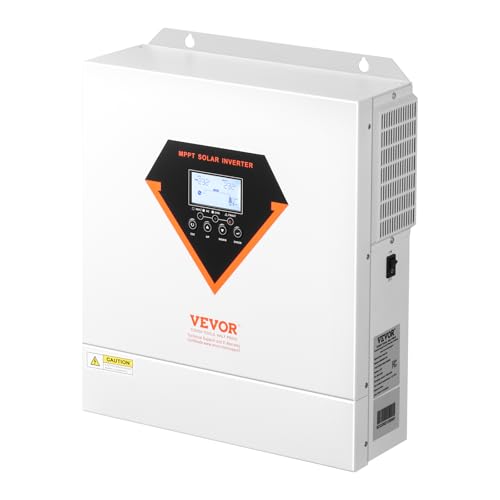
This 3500W model is built for 24V systems with a 220/230V AC output and a 100A MPPT charger. It advertises a high efficiency level around 94% and a DC input range that supports broad solar arrays, up to 500V DC. The design emphasizes compatibility with both lithium and lead-acid batteries and notes an activation function to boost lithium battery performance. It also mentions multiple charging modes and a responsive MPPT mechanism to optimize solar harvest.
Ideal applications include off-grid homes, tiny houses, or work sites where a balance of power and simplicity is desired. As with other all-in-one inverters, ensure proper amperage requirements and cooling capacity are aligned with load expectations, especially during peak solar production windows.
Innisle 3600W All-in-One Hybrid Inverter (24V)

The Innisle unit consolidates a 3600W inverter with a built-in 120A MPPT charge controller, designed for 24V battery systems. It covers both 110V/120V AC output and a wide PV input range up to 500V DC, enabling robust solar array configurations. The product highlights impressive MPPT efficiency at 98% and emphasizes compatibility with lead-acid and lithium batteries, including a no-battery operation mode. It includes a user-friendly LCD monitoring interface and supports multiple charging modes to tailor energy management to real-time conditions.
Consider the need for accurate battery sizing and load planning, as high-power loads can stress inverters. The dual-output capability mentioned offers flexibility for powering essential circuits while preserving energy in battery banks for longer durations. This model suits off-grid homes, campsites, and mobile installations that require dependable, compact all-in-one power management.
SGPWATT Sungoldpower 5000W Hybrid Inverter (48V)

The Sungoldpower 5000W model targets 48V systems with an all-in-one design that includes an 80A MPPT charger and a 40A AC battery charger. It supports pure sine wave output at 110V/120V and is intended for off-grid setups. This unit specifies UL1741 listing and notes no parallel operation, focusing on single-system reliability. With four charging modes and four output modes, users can optimize solar-first, grid-first, inverter-first, or hybrid charging strategies to match energy usage patterns.
For users building a mid- to large-scale off-grid installation, this inverter offers strong solar integration and flexible charging modes. It’s important to confirm battery compatibility, particularly with high-capacity lithium packs, and to plan for adequate ventilation to handle sustained high-power operation.
Buying Guide: Key Considerations For MPPT All-In-One Inverters
Choosing the right MPPT all-in-one inverter involves balancing power needs, battery chemistry, and installation context. Below are vital considerations and how different models address them.
- System voltage and battery compatibility: Most units in this selection target 24V or 48V battery banks. Verify that your battery type (lithium, lead-acid, or others) is supported and whether the lithium activation feature is available if you use LiFePO4 cells.
- MPPT controller capacity: MPPT current (A) determines how fast the system can harvest solar energy. Higher MPPT rating suits larger arrays and faster charging, particularly in bright sun or during winter days.
- Pure sine wave output: All listed models provide pure sine wave AC, essential for sensitive electronics and motor loads. This minimizes power surges and equipment stress.
- Voltage range and PV input window: A wide DC input range (often up to 500V) allows compatibility with various panel configurations and future expansions. Confirm maximum PV power (W) and whether the unit supports high-wrequency or bulk charging modes.
- Parallel operation: Some models offer parallel capabilities (up to several units) to scale capacity. If your project requires hundreds of amps or kilowatts, parallel-ready options are important. Several listed units note no parallel support, which guides planning.
- Load management and monitoring: Look for LCD displays, LED indicators, and RS485 or other communication interfaces for monitoring battery state, charging current, and inverter status. This helps optimize performance and protect battery health.
- Physical considerations: Check enclosure size, cooling requirements, and installation environment. High-power inverters may need adequate airflow and mounting considerations in RVs, cabins, or sheds.
- Safety and certifications: UL1741 listing or equivalent certifications indicate compliance with common safety standards for off-grid systems. This is important for long-term reliability and insurance considerations.
Overall, the best MPPT all-in-one inverter for your setup will depend on your battery voltage, desired AC output, and whether you want future expansion via parallel units. For smaller off-grid needs, a compact 3000–3500W 24V system may suffice. For larger homes or campsites with high daytime solar, a 48V system with 6000–12000W capacity and robust MPPT can better handle peak production and heavy loads. Always align the product specifications with your local solar conditions and load profile to optimize performance and longevity.