For aspiring producers and seasoned beatmakers, MPC-style MIDI controllers offer tactile pads, hands-on control, and instant feedback. This guide highlights five top options designed to integrate with popular DAWs, boost workflow, and unleash creative ideas—whether you’re looping in Ableton Live or crafting drums on the go. Each pick blends classic MPC-inspired pads with modern connectivity and software bundles.
| Product | Brand | Key Feature | Included Software |
|---|---|---|---|
| APC Mini MK2 | Akai Professional | 64 RGB pads with 1-to-1 Ableton Live integration | Ableton Live Lite |
| LPD8 | Akai Professional | 8 responsive RGB MPC-style pads plus 8 assignable knobs | Production software bundle |
| MPK Mini IV | Akai Professional | 25 mini keys, 8 knobs, MPC drum pads | Production software, NI sound package |
| MPK One+ (MPK One+ Standalone) | Akai Professional | Standalone drum machine with 16 RGB pads and touchscreen | WiFi/Bluetooth MIDI, NI integration |
| MPK Mini MK3 | Akai Professional | 25 mini keys, 8 backlit pads, 8 knobs, NKS | NI sound package, NKS |
The following selections emphasize a balance of classic MPC-style pads, portable form factors, and strong software integration. Each product is evaluated for ease of use, expandability, and how well it supports beat making, sampling, and live performance.
Akai APC Mini MK2: Clip Launching Pad Controller

The APC Mini MK2 combines Ableton Live integration with a compact 8×8 RGB pad matrix, ideal for clip launching, looping, and live performance. It ships with Ableton Live Lite and ships ready for 1-to-1 mapping with Ableton 11 and later, reducing setup time and enabling immediate creative workflows. The bright RGB pads provide immediate visual feedback for launched clips, scenes, and samples, helping you stay in sync during fast-paced sessions. This controller is well suited for home studios and live performers who want a plug-and-play Ableton experience with tactile control.
Akai LPD8: 8-Pad USB MIDI Controller

The LPD8 focuses on hands-on control with eight assignable Q-Link knobs and 8 RGB backlit pads designed for triggering samples, loops, or virtual instruments. Its compact layout makes it convenient for travel rigs or desk setups where space is at a premium. The device supports rapid mapping to DAWs and plugin parameters, allowing rapid tweaking during recording or performance sessions. It’s a solid choice for beat makers who want reliable, small-footprint control with strong tactile feedback.
Akai MPK Mini IV USB-C: 25 Keys and MPC Pads

The MPK Mini IV integrates 25 mini velocity-sensitive keys, eight assignable knobs, and eight RGB MPC-style pads. It includes a full-color display and a push/turn encoder for navigational ease, enabling quick access to presets, DAW controls, and instrument parameters without constant computer tethering. This model balances portability with deep control for performers who frequently travel or work in confined spaces, offering a straightforward workflow to capture ideas rapidly.
Akai MPC One+ Standalone Drum Machine

The MPC One+ is a standalone drum machine and MIDI controller designed for fast, on-the-table production. It features WiFi and Bluetooth MIDI, 16 velocity-sensitive RGB pads, a 7″ touchscreen, and a fully integrated workflow that reduces reliance on a computer. The device supports Native Instruments integration and features an enhanced main mode and studio mixer, offering advanced control for complex projects while preserving the familiar MPC-era workflow for sampling and sequencing.
Akai MPK Mini IV Grey: 25-Key MIDI Controller

This MPK Mini IV Grey model mirrors the standard MPK Mini IV feature set with 25 mini keys, eight knobs, and eight MPC pads with RGB feedback. The unit emphasizes real-time control and navigation, letting producers manage presets, DAW functions, and instrument parameters quickly. It’s a portable option for those who value both tactile control and a compact form factor that travels easily in bags or backpacks.
Akai MPK Mini MK3: 25 Keys and 8 Pads
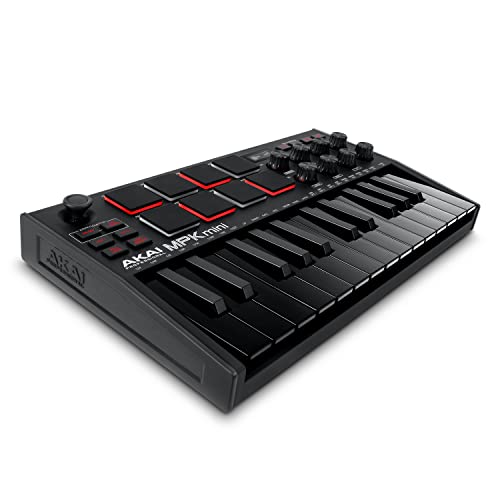
The MPK Mini MK3 adds a four-way thumbstick for nuanced pitch and modulation control, plus a built-in arpeggiator with user-adjustable resolution and modes. It supports Native Kontrol Standard (NKS) integration, enabling Kontrol-ready operation with NI plugins and software. The MK3 maintains the compact, portable format while expanding performative capabilities, making it a strong choice for users seeking expressive control in a small package.
Akai MPK Mini MK3 (NKS Enabled)

The MPK Mini MK3 with NKS integration extends the MPC-style experience by enabling seamless Kontrol of NI instruments and effects. The combination of 25 mini keys, eight pads, and eight knobs supports a versatile workflow for production, performance, and live triggering. NKS compatibility provides an expanded library and tighter DAW integration, allowing for more expansive sonic design directly from the controller.
Buying Guide: Key Purchase Considerations
When selecting an MPC-style MIDI controller, consider the following factors to tailor your choice to your workflow and setup:
- Pad quality and layout: Velocity-sensitive, RGB feedback, and pad count affect groove precision and visual cues during performance.
- Keyboard vs. pad emphasis: Choose a model prioritizing drum pads for beat-making or a keyboard-focused layout if melodic playing is central.
- DAW compatibility and software bundles: Look for native integrations (e.g., Ableton Live Lite, NI software) that minimize setup time and maximize usable features.
- Connectivity and power: USB-C and bus-powered designs are convenient for mobile rigs, while standalone units reduce computer dependence.
- NKS and plugin ecosystems: Native Kontrol Standard compatibility expands control over NI and other supported plugins, increasing versatility.
- Portability and build quality: Consider weight, form factor, and durability if you perform live or travel frequently.
- Expansion potential: Some models offer CV/Gate I/O and MIDI outputs for modular setups or additional hardware integration.
- Software workflow: Arpeggiators, onboard displays, and transport controls can streamline music creation or live looping.
For a mixed studio and stage setup, prioritize models with strong Ableton integration or standalone capabilities. If you primarily produce in a DAW, pads with clear visual feedback and robust mapping options can dramatically speed up workflow. If you travel or perform live, a compact, bus-powered unit with a reliable software bundle provides the best portability and value.