The following article highlights five top motion control stepper motor solutions that suit CNC projects, automation tasks, and precise positioning. Each product combines integrated control, reliability, and flexible operation modes to support a range of applications from hobbyist to light-industrial setups. Read on to compare capabilities, interfaces, and compatibility, then use the buying guide to choose the best fit for your system.
| Product | Brand | Key Capability | Output |
|---|---|---|---|
| SainSmart 1 Axis CNC Servo Stepper Motor Motion Programmable Controller | SainSmart | Single-axis positioning and auto-run | 8-digit display, panel control |
| Stepper Motor Driver Controller Integrated Board (Forward/Reverse) | BANRIA | Multi-mode control with direction via button or potentiometer | 4 control modes, UART-ready |
| Stepper Motor Controller Driver Board (4A, 9 Modes) | Zuomeng | Integrated drive with nine default programs | Speed/accel control, 10–30V |
| CNCTOPBAOS Single Axis Motion Controller | CNCTOPBAOS | 40KHz max frequency, auto-run and program editing | 8-digit display, 14 programming instructions |
| SWTHM 3 Axis GRBL Grblcontrol | SWTHM | 32-bit processor, GRBL firmware for CNC engraving | Limit inputs, PWM, manual control |
SainSmart 1 Axis CNC Servo Stepper Motor Motion Programmable Controller

The SainSmart unit is a single-axis controller designed for precise positioning and automated run sequences. It offers an 8-digit display for status and parameter visibility, manual/automatic operation indicators, and a dedicated autorun feature to start or stop operations via the terminal panel. This device is suitable for projects needing compact, easy-to-monitor single-axis control with clear feedback and programmable behavior.
Stepper Motor Driver Controller Integrated Board Forward/Reverse Pulse Speed Angle Control

This integrated controller and driver module supports forward/reverse rotation with direction changes via button or potentiometer. It offers multiple operation modes, including external control via UART. The unit is designed for real-time motor state management, making it a flexible option for multi-scene applications where quick direction changes and mode switching are required.
Stepper Motor Controller Driver Board, 4A, 9 Motion Modes

Zuomeng’s controller integrates the driver for NEMA 17/23 motors, supporting 10–30V input and up to 4A. It features nine built-in programs, including forward/reverse and loop modes, enabling quick deployment without programming. The device emphasizes safety with adjustable acceleration/deceleration to reduce wear and protect mechanical systems during operation.
Banria Stepper Motor Controller Driver Board, 6.6A
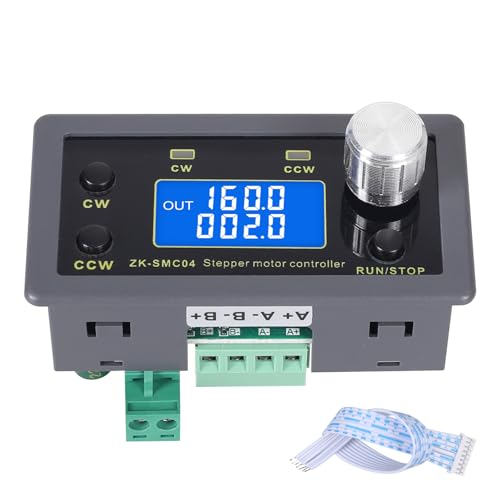
This all-in-one module combines driver and controller capabilities for unipolar two-phase stepper motors. It supports multiple control methods, including external signals and serial commands. The board is designed for robust motor control with a high current rating and expansion-ready interfaces for broader automation setups, suitable for CNC and robotic projects requiring flexible interfacing.
3 Axis GRBL Grblcontrol Stepper Motor Controller

Equipped with a 32-bit processor and GRBL firmware, this controller enhances computational power and responsiveness for CNC engraving. The Grblcontrol software provides an intuitive interface for adjusting motion parameters, speeds, and real-time monitoring. It supports limit switches, PWM outputs, and manual controls, offering a versatile option for multi-axis CNC projects with straightforward software integration.
Buying Guide: Key Purchase Considerations
- Number of axes and project scope: Choose a controller that matches your required axes (1–3+). Multi-axis setups benefit from integrated multi-channel controllers with clear interaction between axes.
- Control modes and interfaces: Consider whether you need built-in programs, external signal control, serial/UART communication, or GUI-based configuration. Ensure compatibility with your motor type (unipolar/bipolar, NEMA size).
- Power supply and current rating: Verify input voltage range (e.g., 10–30V) and output current (A) to match your motor’s spec. Higher current supports larger motors and heavier workloads but requires proper heat management.
- Safety features and protection: Look for reverse wiring protection, overload safeguards, and smooth acceleration/deceleration to minimize mechanical wear and damage.
- Feedback and monitoring: Displays and status indicators (speed, steps, program status) help in tuning and troubleshooting. Real-time monitoring improves debugging and maintenance.
- Software compatibility: If using GRBL or other firmware, ensure the software ecosystem (Grblcontrol, CNC software) aligns with your workflow and hardware.
- Physical form factor and mounting: Confirm compatibility with your enclosure, brackets, and motor mounting patterns (NEMA 17/23/34) to simplify integration.
- Expansion potential: For future upgrades, prefer modules with UART or serial interfaces that allow connecting additional controllers, PLCs, or automation systems.
Overall, selecting a motion controller involves aligning axis count, control method, electrical specs, and software compatibility with your specific CNC or automation goal. The products above offer a spectrum of single-axis to multi-axis capabilities, balancing built-in programming, external control options, and robust safety features to suit diverse use cases.