Flexible solar panels enable portable, easy-to-install power on curved surfaces such as RV roofs, boat decks, or irregular cabin roofs. This guide compares top options for efficiency, durability, and adaptability, helping you choose panels that maximize energy capture while fitting your vehicle or vessel’s contours.
The following table summarizes five notable flexible solar panels, focusing on efficiency, lightness, and adaptability. Use it as a quick glance before reading full product details.
| Product | Brand | Rated Power | Key Strength | Best Use |
|---|---|---|---|---|
| Renogy 100W Flexible Panel | Renogy | 100W | 240° bendability, PERC tech | Marine, RV, curved surfaces |
| ECO-WORTHY 130W Flexible Panel | ECO-WORTHY | 130W | Upgraded 130W, 4 pre-drilled holes | RV, boats, irregular surfaces |
| Callsun 100W Ultra-Thin Flexible Panel | Callsun | 100W | Designed for 240° bend, marine-grade coating | RV, marine, solar generators |
| BougeRV Arch 200W Flexible Panel | BougeRV | 200W | 270° bend, double fiberglass protection | Limited roof space, curved surfaces |
| ALLPOWERS SF200 200W Flexible Panel | ALLPOWERS | 200W | Ultra-thin 3mm, IP68 waterproof | RV, camping, marine uses |
Renogy 100W Flexible Solar Panel
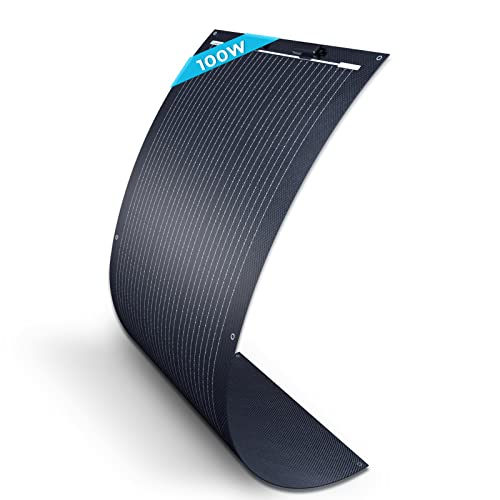
The Renogy 100W flexible panel is built for curved installations with up to 240 degrees of bendability while maintaining a low profile. It weighs roughly one-third the weight of a rigid panel, aiding transport and installation. Its all-black, glare-free appearance minimizes day-to-day visibility when installed on vehicles or cabins. The panel uses half-cut PERC cell technology to improve light capture and electrical performance, contributing to higher overall output relative to similar-sized flexible options. This combination makes it suitable for marine, RV, or boat-adjacent installations where flat panels aren’t feasible.
ECO-WORTHY 130W Flexible Solar Panel (2-Pack)

ECO-WORTHY’s 130W flexible panels provide a practical upgrade over typical 100W units, delivering approximately 520Wh per day under four hours of strong sunshine. The panels are designed for excellent flexibility, enabling installation on RVs, boats, cabins, tents, or other irregular surfaces. They feature four metal-reinforced holes along the edge for quick mounting and are easy to fix with adhesive, tape, or Velcro for semi-permanent setups. This kit is well-suited for travel trailers, boats, and other off-grid platforms needing more daily energy without sacrificing surface adaptability.
Callsun 100W Ultra-Thin Flexible Panel
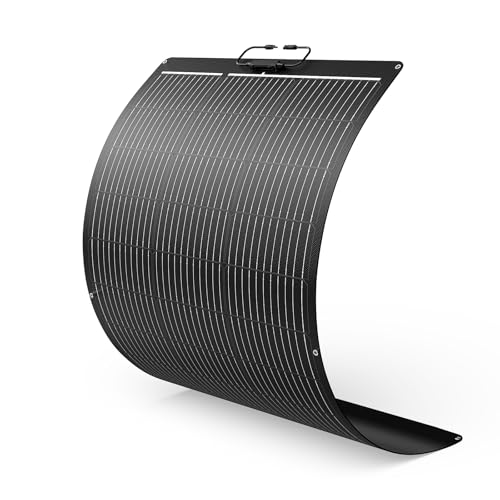
Callsun’s 100W panel emphasizes bendability and marine-grade durability. With a 240-degree folding range, it’s designed to hug curved surfaces on RVs, five-wheel trailers, and boats, while remaining 50% lighter than rigid panels. The ETFE-coated cells resist yellowing and corrosion, maintaining clarity and efficiency over time. The panel also aligns well with solar generators or battery banks through standard connectors, making it a solid option for recreational power systems that require a clean, aerodynamic install on curved roofs or hulls.
BougeRV Arch 200W Flexible Panel

BougeRV’s Arch 200W flexible panel maximizes space on curved surfaces with a 270-degree bend capability. Its double fiberglass protection enhances impact resistance, reducing risk of damage on installations that experience vibration or rough handling. The ETFE protective layer offers strong resistance to UV exposure, scratches, and environmental wear, helping ensure a long service life in challenging conditions. This panel is designed for RVs, boats, or any application where surface area is limited but power needs are higher.
ALLPOWERS SF200 200W Flexible Panel

The ALLPOWERS SF200 delivers up to 200W through a thin 3mm profile, enabling installation on curved surfaces with a bendable design. It features ETFE coating for weather resistance and an IP68 waterproof rating, making it well-suited for RV roofs, camping setups, or marine use. Its high-efficiency monocrystalline cells enable robust energy generation, and the panel is engineered to maintain performance in a range of environmental conditions, from rain and dust to temperature extremes. It’s designed to integrate with portable power stations or battery banks, offering versatile, curved-surface power.
Buying Guide: Key Considerations For Flexible Solar Panels
- Flexibility and bend radius: Decide how aggressively your surface curves. Panels with 240° to 270° bend capability fit more irregular shapes but may trade a bit of rigidity and durability for flexibility.
- Efficiency and cell technology: Look for panels with mono-crystalline cells and ETFE or other protective coatings. PERC technology and high-efficiency cells improve output, especially in partial shade or low-light conditions.
- Weight and thickness: Lighter and thinner panels simplify mounting on RVs or boats but ensure they still meet durability needs. Ultra-thin panels (2–3 mm) are easier to install on curves but can be more susceptible to field wear without proper protection.
- Durability and coatings: ETFE coatings resist UV damage, weathering, and yellowing better than PET. IP ratings (IP68) indicate water and dust resistance essential for marine environments.
- Mounting options: Check for pre-drilled holes, edge supports, or adhesive-friendly backings. Some panels are designed for semi-permanent installation with Velcro or silicone, which can be ideal for leased or temporary setups.
- System compatibility: Ensure compatible connectors and voltage ranges with your battery bank, solar generator, or power station. High-output panels pair best with capable battery systems or inverters designed for off-grid use.
- Warranties and service life: Flexible panels vary in warranty length and coverage. Consider expected lifespan under your climate and usage patterns, especially exposure to salt air, sand, or frequent temperature swings.
- Cost vs. power needs: While higher wattage panels deliver more energy, the best choice balances output with surface fit, weight, and mounting ease for your specific vehicle or vessel.
These considerations help balance the trade-offs between peak efficiency, installation practicality, and long-term durability. When selecting a flexible solar panel, prioritize those with proven bendability, durable coatings, and solid mounting options to maximize daily energy generation on curved surfaces.