Mini LED lights offer a simple, colorful way to illuminate science demonstrations, build interactive experiments, and prototype electronics projects. This article highlights five Amazon picks that cover a range of colors, voltages, and form factors suitable for classrooms, makerspaces, and home labs. Each option is evaluated for brightness, ease of use, and versatility to support STEM learning.
| Product | Brand | Colors / Varieties | Voltage / Current | Ideal Use |
|---|---|---|---|---|
| California JOS 50 PCS Colorful 5mm LED Light Diodes Kit | California JOS | White, Red, Green, Blue, Yellow | 3V-3.2V (White/Blue/Yellow), 1.8V-2.2V (Red/Green) | DIY projects, STEM experiments, indicators |
| DiCUNO 450pcs 5mm LED Diode Kit | DiCUNO | White, Red, Yellow, Green, Blue | Red/Yellow 2.0-2.2V; Blue/Green/White 3.0-3.2V | School science, breadboarding, signaling |
| (100 Pcs) MCIGICM 5mm LED Kit | MCIGICM | White, Red, Green, Blue, Yellow | White/Green/Blue 3.0-3.2V; Red/Yellow 2.0-2.2V | Comprehensive color kit for experiments |
| EBOOT 100 Pieces Clear 5mm LEDs | EBOOT | Yellow, Green, Blue, White, Red (+ assorted) | Red/Yellow/Green/Orange 1.8-2.0V; Blue/White 3.0-3.2V | Classroom demos, student projects |
| BOJACK 500 Pcs 5mm LED Diodes Assorted Kit | BOJACK | Five colors standard | R/Y 2.0-2.2V; B/G/W 3.0-3.2V | Large-scale kits, inventory for experiments |
The collection below includes five selections that stand out for science-focused projects. Each product section provides a concise overview, a direct link for quick purchase, and a note on how the LEDs can support hands-on learning, from circuit building to visual indicators and demonstrations.
California JOS 50 PCS LED Color Kit

The California JOS kit includes 50 color-matched 5mm LEDs with a water-drop style lens. Brightness is suitable for classroom demonstrations, with forward voltages around 3V for white and blue LEDs, and about 1.8-2.2V for red and green variants. The assortment supports STEM activities, Arduino experiments, signal indicators, and basic circuit lighting projects. This set is compact enough for individual student work or small-group labs, and its 5-color range helps illuminate color-moding lessons and color mixing experiments.
DiCUNO 450pcs 5mm LED Diode Kit

DiCUNO offers a large 450-piece kit with five colors in standard 5mm round LEDs. The kit provides a clear lab-ready assortment for extensive projects, including school science experiments, signaling circuits, and breadboarding where higher color variety enhances instructional visuals. Electrical parameters show red and yellow diodes at 2.0-2.2V, while blue, green, and white LEDs operate around 3.0-3.2V, with a typical maximum current of 20 mA. The kit’s volume makes it ideal for makerspaces and multi-class activities that require many LEDs.
MCIGICM 100 Pcs 5mm LED Kit

The MCIGICM 100-count set provides a balanced mix of five colors (White, Red, Green, Blue, Yellow). Voltage and current parameters align with standard 5mm LEDs used in classrooms and clubs for projects like basic displays, indicators, and simple microcontroller experiments. The variety supports color-coded experiments, where students compare brightness and color effects across different circuits, while remaining suitable for breadboard-based practice sessions.
EBOOT 100 Pieces Clear 5mm LEDs
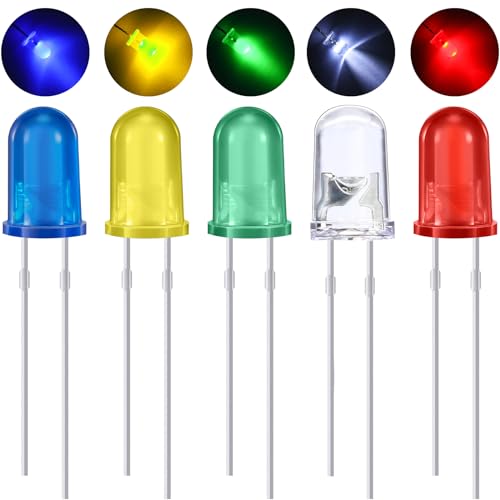
EBOOT’s 100-piece kit emphasizes color variety with 10 colors, including several warm and cool tones. The lamp heads are water-drop shaped, offering clear aesthetics for display projects or decorative indicators in science fair setups. Forward voltages vary by color, with 1.8-2.0V for red, yellow, and similar colors, and 3.0-3.4V for blue and white variants. The broad color range supports experiments in color mixing, circuit demonstrations, and engaging visual indicators in student experiments.
BOJACK 500 Pcs LED Kit

BOJACK offers a large 500-piece assortment with five standard colors and a 5mm diameter. This kit is well-suited for teachers and hobbyists who need a reliable bulk supply for experiments, displays, or long-term projects. Typical forward voltages are 2.0-2.2V for red and yellow LEDs and 3.0-3.2V for blue, green, and white LEDs. A high-count kit supports repeated practice sessions, multiple groups, and extensive lighting demonstrations without frequent restocking.
Buying Guide: Key Considerations for Mini LED Kits
- Color range and color behavior: A broad palette helps in color-mixing experiments, signaling, and visual demonstrations. Check the number of distinct colors included and whether the colors align with your curriculum needs.
- Voltage and current: Most standard 5mm LEDs run at about 2.0-3.2V with a maximum current around 20 mA. Confirm that the kit’s colors have compatible forward voltages for the projects you plan to build and whether you’ll need resistors for safe operation.
- Quantity and value: For classroom use, larger kits reduce the need for constant restocking. Consider whether you need bulk packs for multiple students or repeated experiments, or smaller packs for introductory lessons.
- Physical form and aesthetics: Water-drop head shapes and clear housings enhance visibility in demonstrations and exhibit panels. The LED lens shape can affect brightness perception in bright or dark environments.
- Documentation and learning support: Some kits come with usage notes, color voltage guidelines, and application ideas, which can help instructors plan activities and ensure safe, effective experiments.
- Compatibility with projects: If you’re integrating LEDs with microcontrollers, ensure the kit includes a mix of forward voltages that align with your board’s current-limiting strategy. Breadboard-friendly form factors simplify classroom setups.
- Durability and handling: ABS or similar housings protect LED modules in classroom wear and tear. For portable demos, consider pre-wired options to save wiring time before student activities.
- Budget and storage: Bulk kits can be cost-effective, but ensure you have organized storage to avoid color mix-ups and accidental misplacement during lessons.
The selections above provide options for different teaching scenarios—from compact, easy-to-use kits for quick demonstrations to large inventories suitable for lab-based projects and science fairs. When choosing, match the color variety, voltage compatibility, and quantity with your course goals and class size to optimize learning outcomes.