If you often juggle several gaming consoles, media players, and streaming devices, a compact mini HDMI amplifier switcher can simplify your setup. This article reviews five top-rated 5-in/1-out or multi-input HDMI switchers that deliver high refresh rates, HDR support, and reliable switching with or without remote control. Each product below is evaluated for compatibility with modern consoles like PS5, Xbox, and Switch, as well as PCs and streaming devices. Use this guide to compare features, upgrade your home theater, and maintain smooth gaming and viewing experiences.
| Product | Brand | Key Benefit |
|---|---|---|
| UGREEN HDMI Switch 5 In 1 Out | UGREEN | 4K@60Hz, remote control, HDR, multiple inputs |
| OREI 8K eARC HDMI 2.1 Switch 4×1 | OREI | 8K/4K support, audio extractor, EDID options |
| RGBlink Mini V3 Video Switcher | RGBlink | 4K, TAO Cloud features, dual HDMI outputs |
| UGREEN 8K@60Hz HDMI Switch 5 In | UGREEN | 8K@60Hz, VRR, HDCP 2.3, 40 Gbps |
| Neoteck HDMI 2.0 Repeater | Neoteck | Long-distance signal extension, 4K@60Hz |
Below you’ll find five selected products tailored to a “mini HDMI amplifier switcher” use case. Each section includes a concise overview, core features, and practical considerations to help you decide which model fits your setup.
UGREEN HDMI Switch 5 In 1 Out – 4K@60Hz with Remote

The UGREEN 5×1 HDMI switcher aggregates five devices into a single HDMI display input. It supports 4K@60Hz, 3D, HDR, and HDCP2.2/1.4. It is compatible with PS5, Xbox, Switch, Roku, Fire TV, and laptops. The device employs HDMI 2.0/1.4 and VRR for smoother gaming experiences. A USB power connection helps stabilize video transmission to prevent frame drops. Note: Input/output cable lengths should be kept within recommended limits to achieve 4K@60Hz performance.
Key considerations:
– Pros: Remote control for easy switching; wide device compatibility; HDR and VRR support.
– Cons: Longer cable runs may require powered operation; automatic input switching is not mentioned as a feature.
OREI 8K eARC HDMI 2.1 Switch 4×1

This 4×1 HDMI switcher from OREI adds an audio extractor via Optical (SPDIF) and L/R RCA outputs, with eARC/ARC compatibility for TVs. It supports up to 8K @ 60 Hz or 4K @ 120 Hz, including HDR formats. It features dual voltage input with US and international adapters. It’s suitable for PS5, Xbox, streaming devices, Blu-ray players, and PCs. Important note: Audio routing to external soundbars may require selecting the correct port and ensuring TV compatibility with eARC/ARC for return audio.
Key considerations:
– Pros: True 8K/4K performance; built-in audio extraction options; broad device compatibility.
– Cons: Some setups may require manual EDID adjustments; not all users need 8K hardware yet.
RGBlink Mini V3 Video Switcher
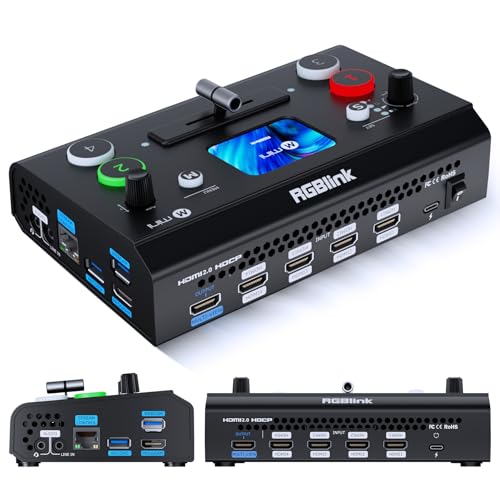
The RGBlink Mini V3 is a compact 4× HDMI input switcher with two HDMI outputs and a 2.1-inch touch screen. It supports 4K switching and provides professional features like T-bar control and multi-cam live streaming. It is designed for live productions, multi-camera setups, and streaming workflows. Activation and TAO Cloud access unlock upgrading features, including PTZ control and overlay options, making it a flexible option for content creators who need more than simple switching.
Key considerations:
– Pros: Dual HDMI outputs; touch screen for quick control; cloud-enabled feature set with upgrade options.
– Cons: Requires activation for premium features; higher upfront complexity than basic switches.
UGREEN 8K@60Hz HDMI Switch 5 In 1 Out

This UGREEN model combines five inputs into a single display with 8K@60Hz support and 40 Gbps bandwidth. It is backward compatible with 4K@60Hz and 1080p at higher refresh rates. It supports HDMI 2.1 features like VRR and full HDR formats, including HDCP 2.3. A remote control makes routine switching simple, suitable for PS5, Xbox, Nintendo Switch, Roku, and streaming devices. Cable length recommendations help ensure 8K performance.
Key considerations:
– Pros: High bandwidth for 8K; VRR and HDMI 2.1 features; remote control.
– Cons: Maximum 8K performance depends on cable lengths; some users may not need 8K capability yet.
Neoteck HDMI 2.0 Repeater

The Neoteck HDMI 2.0 Repeater extends HDMI signals up to 60 meters, enabling stable long-distance transmission. It supports HDR and 4K @60Hz with 6.0 Gbps bandwidth, provided high-quality HDMI 2.0 24 AWG cables are used. The device is compact and metal-cased, making it suitable for PC, Blu-ray players, satellite boxes, and gaming consoles across wider rooms or setups that require longer cable runs. Positioning recommendations emphasize placing the repeater closer to the source for longer distances.
Key considerations:
– Pros: Great for long cable runs; supports HDR and 4K @60Hz; robust build.
– Cons: Requires high-quality cables to maximize performance; not a full switcher—it’s a repeater/amplifier.
Buying Guide: Key Purchase Considerations And Comparisons
What to evaluate when choosing a mini HDMI amplifier switcher:
– Input count and throughput: Confirm how many devices you need to connect (5×1 is common) and ensure the switch supports the required bandwidth (HDMI 2.0/2.1, 18-48 Gbps) for the highest resolution and refresh rate you use.
– Resolution and refresh rate: If you game or watch high-frame-rate content, look for 4K@60Hz, 8K@60Hz, or 4K@120Hz options, along with HDR formats and VRR support for smoother visuals.
– Audio routing: Decide whether you need an audio extractor (optical, HDMI ARC/eARC) or simple HDMI pass-through. Some models offer independent audio outputs for soundbars or stereo receivers.
– Distance and cabling: For 8K or high refresh rates, keep input/output cable lengths within recommended limits. Repeater devices are helpful for long runs but require compatible cables.
– Power and stability: USB-powered switches can provide reliable performance, but some setups may require dedicated power adapters to maintain signal integrity.
– Ease of use: Remote controls and on-device buttons simplify switching, especially in living rooms or setups with hidden equipment.
– Compatibility: Ensure your primary devices (PS5, Xbox, Switch, PC, Roku) are listed as compatible. Some devices may need specific EDID or CEC settings to function optimally.
– Features versus budget: Premium models may offer cloud activation, multi-camera output, or professional controls. Weigh whether those features align with your needs to avoid overpaying.
– Future-proofing: If you anticipate upgrades to 8K devices, consider HDMI 2.1-capable switches with VRR and eARC/ARC support to minimize future changes.
Comparison snapshot:
– Beginner-friendly multi-input switches with remote control provide straightforward switching and broad device support.
– 8K/HDMI 2.1 switches are ideal for future-proofing but come at a higher price and require compatible cables and displays.
– Audio extractor options are beneficial for home theaters with external sound systems.
– Repeater-based devices excel in long cable scenarios but are not substitutes for full switchers when you need multiple sources routed to a single display.
This selection emphasizes compatibility with mainstream gaming consoles, streaming media devices, and home theater setups, offering a range of price points and feature bundles while avoiding automatic switching where not supported. The included options cover most use cases: simple multi-input switching, high-bandwidth 8K readiness, cloud-enabled streaming production, audio extraction, and long-reach signal amplification. When configuring, document which ports feed which displays and keep spare cables of the recommended types to preserve performance.