Stream smarter with a selection of top media players and streamers that fit different setups—from compact USB-driven players to powerful Android TV devices. This guide highlights five models that balance performance, versatility, and ease of use, helping you decide which one best fits your home theater or digital signage needs. Each product section includes key features and real-world capabilities to support objective comparisons.
Summary of Selected Products
| Product | Brand | Highlights |
|---|---|---|
| RockTek GX1 UHD Streamer | RT ROCKTEK | Realtek RTD1325, Google TV OS, AIQ/QMS, Google Cast, Voice Remote |
| NVIDIA Shield Android TV Pro | NVIDIA | Android TV, Tegra X1+, 4K HDR, Dolby Vision/Atmos, Plex, USB expansion |
| Micca 4K Ultra-HD Media Player | Micca | USB/MicroSD playback, 4K@60Hz, supports FAT/exFAT/NTFS |
| fnetic 4K Digital Media Player | fnetic | H.265/HEVC, 4K output, dual USB ports, USB/SD card support |
| COSOWELL 4K Media Player | COSOWELL | 4K playback, USB/SD input, looping, AV/HDMI output |
RockTek GX1 UHD Streamer

The RockTek GX1 UHD Streamer is a Google TV 4K streaming box built around Realtek’s RTD1325 processor. It aims to deliver fast, stable performance with Google-certified compatibility. Features include AIPQ intelligent picture adjustment, AISR super-resolution, and QMS quick media switching for smoother transitions and improved color fidelity. The device runs Google TV OS, supports voice commands via Hey Google, and integrates with Google Cast and smart home ecosystems for a connected entertainment experience.
Key considerations include Google TV’s personalized recommendations and the potential for live TV options in supported regions. The remote control supports voice input, and the platform’s ecosystem can streamline app access, casting, and smart-home routines. As with any streaming box, the strength of your experience depends on your network and the available apps in your region.
NVIDIA Shield Android TV Pro

The NVIDIA Shield TV Pro is a high-performance Android TV streaming device designed for enthusiasts who want robust streaming, gaming, and media server capabilities. Powered by the NVIDIA Tegra X1+ chip, it offers AI upscaling to 4K, built-in Plex Media Server, and 3 GB RAM with 16 GB storage. Connectivity includes Bluetooth 5.0, Gigabit Ethernet, and dual-band Wi-Fi. It supports Dolby Vision and Dolby Atmos for immersive picture and sound, and the redesigned remote adds motion-activated, backlit controls plus Bluetooth and IR TV control integration.
This model targets power users seeking expandability via USB 3.0 ports, plus broad app support and a responsive user interface. For streaming purists, it provides a top-tier blend of media versatility and home theater performance, with an emphasis on premium image processing and audio experiences.
Micca 4K Ultra-HD Digital Media Player

The Micca 4K Ultra-HD Digital Media Player focuses on USB and MicroSD-based playback, making it ideal for sharing content from local storage. It supports 4K Ultra HD video up to 4096×2304@30fps, along with a broad range of file formats. The player includes dual USB ports for plugging in drives and is compatible with FAT/FAT32, exFAT, and NTFS formats. Its compact design pairs well with any TV, projector, or display, and it can be controlled with wireless air mice for easier usage in non-line-of-sight setups.
This option emphasizes offline media playback and local content management, delivering reliable performance for travelers or households with large media libraries stored on USB drives or microSD cards.
AGPTEK HDMI Media Player

The AGPTEK HDMI Media Player is a compact, portable option for travel or space-constrained setups. It supports full 1080p playback and offers HDMI output along with AV composite. This unit is designed for quick plug-and-play use, making it a practical travel companion or secondary player for a bedroom or kitchen TV. While it emphasizes portability, it also supports a range of video formats, making it a versatile choice for simple media playback without a full streaming environment.
fnetic 4K Digital Media Player
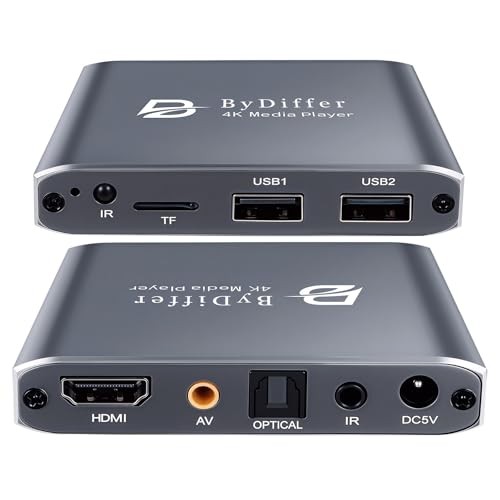
The fnetic 4K Digital Media Player centers on 4K output with H.265/HEVC decoding, designed for digital signage, home theaters, and office environments. It provides USB and SD card support through dual USB ports, allowing expansion with external drives and memory cards. The device emphasizes looping, auto playback, and resume features, which are valuable for signage and kiosk-style deployments, as well as home entertainment when content is stored locally.
COSOWELL 4K Media Player

The COSOWELL 4K Media Player focuses on instant media playback for USB and SD input, with 4K HDMI output and AV compatibility. It supports up to 4K@30fps, and includes options for looping and auto playback for signage or continuous playback scenarios. Storage options include USB drives and SD cards with compatibility for FAT/FAT32, exFAT, and NTFS, and a basic IR remote for easy control in various environments.
Buying Guide: Key Purchase Considerations
- Content source and ecosystem: If you rely on streaming apps and smart home integration, devices with Google TV or Android TV (like Google-certified boxes or NVIDIA Shield) offer a broader app catalog and better voice control. For local playback from USB/SD, consider Micca, fnetic, or COSOWELL models with strong file-format support.
- Video and audio capabilities: Look for 4K support, HDR formats (Dolby Vision, HDR10), and audio formats (Dolby Atmos). Devices with advanced upscaling and AI-assisted enhancement may improve older content, but verify whether these features align with your display and speaker setup.
- Storage and expandability: If you plan to store media locally, choose models with USB 3.0 ports or built-in storage, and support for large drives (8TB or more) via USB or networked storage. Plex or other media servers are a plus for centralized libraries.
- Connectivity and network: A stable Wi‑Fi 6 or Ethernet connection helps streaming 4K content. Some devices offer dual-band Wi‑Fi, Bluetooth, and local network features; ensure compatibility with your home network and smart devices.
- Use case considerations: For digital signage or public displays, features like auto playback, resume, and looping are essential. For home theater, prioritize seamless app access, responsive performance, and high-quality audio/video output.
- Remote and control options: Evaluate whether a voice-enabled remote, air mouse compatibility, and compatibility with smart speakers improve daily use and accessibility.
- Ease of setup and ongoing support: Some devices emphasize plug-and-play with limited customization, while others offer deeper settings. Check regional app availability, firmware updates, and customer support quality.
- Privacy and security: Consider devices with updated security patches and clear privacy controls, especially for smart home integration and voice assistants.
In choosing a device, align the model’s strengths with your content sources (streaming services vs. local media), display capabilities (4K HDR vs. 1080p), and your network environment. The list above offers scalable options—from compact USB-driven players to high-performance streaming boxes—so you can balance price, performance, and features to fit your setup.