Low voltage DC motor speed controllers enable precise control for hobby projects, robotics, and automation using voltage ranges typically from about 1.8V to 12V. Below you’ll find a curated selection of reliable PWM controllers designed for DC motors, fans, and small devices. This article highlights key features, suitability, and practical considerations to help you choose the right model for your setup. The following table summarizes the featured products for quick comparison.
| Product | Brand | Voltage Range | Max Current | Notes |
|---|---|---|---|---|
| BOJACK Low Voltage DC Motor Speed Controller | BOJACK | 1.8V–12V | 2A | Simple PWM, 30W max |
| Gebildet 2Pcs PWM Low Voltage Controller 1803BK | Gebildet | 1.8V–12V | 2A | NE555 design, fuse protection |
| UMLIFE 10Pcs PWM Low Voltage Controller | UMLIFE | 2.2V–15V | 2A | Multiple units, PWM with switch |
| LifCratms 3Pack PWM Motor Speed Controller | LifCratms | 1.8V–12V | 2A | Self-recovery fuse, LED |
| RioRand Small PWM DC Motor Controller | RioRand | 6V–28V | 3A | Forward/reverse switch |
All models emphasize low-voltage operation, PWM-based speed control, and built-in protection features. When selecting a controller, consider the motor’s stall current, your supply’s ability to provide peak current, and whether you need forward/reverse control, indicator LEDs, or a compact form factor for tight enclosures.
BOJACK Low Voltage PWM Motor Speed Controller 2A

The BOJACK controller provides a straightforward PWM-based speed adjustment with a 0%-100% duty cycle range. It supports a maximum output power of 30W and can deliver up to 2A of continuous current, making it suitable for small hobby motors and fans in 1.8V–12V systems. Its compact design helps fit within limited spaces, and the 2A rating is best matched to motors with modest current demands.
Gebildet 2Pcs PWM Low Voltage Controller 1803BK

Gebildet’s dual-pack 1803BK controllers use a NE555-based design with a speed-control potentiometer and a practical on/off switch. A 2A resettable fuse protects the circuit, and a power-on indicator helps monitor operation. This model covers a broad 1.8V–12V input range, with the same 2A maximum output current and 30W maximum output power, making it a versatile choice for multi-mensor setups or simultaneous experiments.
Gebildet 6Pcs PWM Low Voltage Controller Kit

This six-pack of Gebildet PWM controllers shares a common NE555-driven design with a speed-control knob, a switch function, and a 2A self-recovery fuse. It provides the same voltage range, current capacity, and power ceiling (1.8V–12V, up to 2A, up to 30W) as the single-unit variants, offering cost-effective scalability for projects requiring multiple independently controllable motors or devices.
UMLIFE 10Pcs PWM Low Voltage Controllers

UMLIFE’s package of ten PWM controllers emphasizes bulk availability for projects that scale. The controllers operate from DC 2.2V–15V inputs and deliver 1.8V–15V outputs with a maximum of 2A continuous current and up to 30W output. Each unit includes a potentiometer with a switch function, enabling quick manual speed adjustments in tight spaces or educational kits.
LifCratms 3 Pack PMW Motor Speed Controller
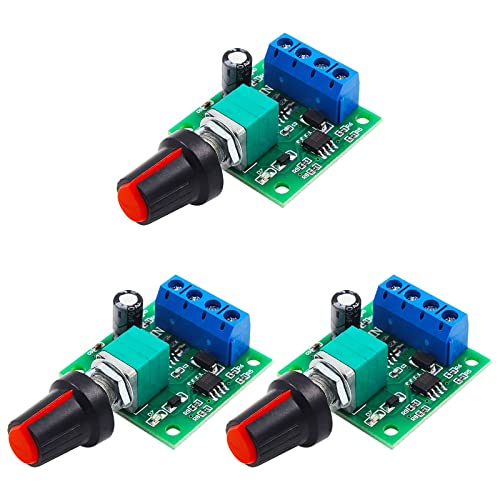
The LifCratms three-pack provides a compact, reliable PWM solution with a 2A self-recovery fuse and a power indicator. Its duty cycle ranges from 0% to 100%, supporting a DC input of 1.8V–12V. This kit is well-suited for small robotics, LED fans, or educational experiments requiring multiple control points without overheating concerns.
RioRand Small PWM DC Motor Controller

RioRand’s controller is designed for 6V–28V inputs with up to 3A continuous current and 80W max output power. It provides forward and reverse switch control, along with a PWM-based speed adjustment. This model is particularly suitable for slightly higher voltage applications or motors that demand more torque at modest speeds, while remaining within a compact footprint.
Buying Guide
When selecting a low voltage DC motor speed controller, consider the following factors to ensure optimal performance and safety:
- Voltage range: Match the controller’s input range to your power source and motor. Some units tolerate 1.8V–12V, others extend to 15V or higher. Ensure your motor’s operating voltage sits within the controller’s range.
- Current capability: Check the motor’s stall and running current. Choose a controller with a continuous current rating above the motor’s peak current to prevent overheating or tripping fuses.
- Protection features: Self-recovery fuses, overcurrent protection, and power-on indicators add reliability, especially in learning environments and experimental setups.
- Duty cycle and control method: PWM-based adjustment offers smooth speed control. Some models include a knob or potentiometer with a switch, which is helpful for manual tuning during testing.
- Size and mounting: For compact enclosures or embedded projects, verify dimensions and mounting options. Several models are designed to fit into small space without sacrificing performance.
- Multiple units: If your project requires independent control of multiple motors, consider bulk options or multi-pack kits to reduce cost per unit and simplify wiring.
- Safety and wiring: Use proper gauge wire for the expected current, and ensure secure connections. Avoid direct connection to AC mains; these controllers are meant for DC power supplies only.
In practice, users should begin by verifying the motor’s stall current and then selecting a controller with a comfortable margin above that value. For simple hobby projects, a single 2A controller with PWM suffices; for multi-motor setups, a 2A or higher unit per motor, or a bulk kit, is advisable. When in doubt, start with a tested model that includes robust protection features and a clear indicator LED to confirm operation.