Choosing a low-loss RF splitter helps preserve signal quality when distributing a single input across multiple devices. This guide highlights five reliable options, covering a range of frequencies, isolation levels, and use cases—from home TV setups to amateur radio and lab measurements. Each product listing includes key specs and practical considerations to help you compare performance and durability.
| Product | Brand | Frequency Range | Isolation / Attenuation | Typical Use |
|---|---|---|---|---|
| RF Power Splitter | Hyuduo | DC–5 GHz | 6 dB output attenuation; 50 Ω | CAB TV, internet, MoCA, antennas |
| CF-4160J Comet Duplexer | Comet | HF/VHF/UHF bands | High isolation between bands | Amateur radio setups, multi-band operations |
| Active RF Splitter | Cryfokt | 100 kHz–150 MHz | Output isolation >60 dB; insertion loss minimal | Multiple devices with isolation needs |
| 2-Way Coaxial Splitter | Hyuduo | 100–2700 MHz | Low loss; 50 Ω system | Industrial equipment, RF distribution |
| 2-Way SMA Splitter (UU TOJOIN) | UU TOJOIN | 0.005–1 GHz | Low loss; SMA connectors | Antenna systems, microwave measurements |
RF Power Splitter By Hyuduo

The RF Power Splitter by Hyuduo is a compact 2-way splitter designed to divide a single-channel input into two outputs with a 50-ohm impedance. It supports a wide frequency range from DC to 5 GHz and is suitable for CATV, satellite receivers, internet modems, MoCA networks, and antenna systems. Its design emphasizes low insertion loss and good amplitude balance, helping maintain signal integrity after distribution.
Key features include high precision in splitting, robust construction for steady operation, and a compact housing that fits easily in simple installations. It handles up to 0.5W (27 dBm) and uses a male SMA connector to ensure a tight, low-leakage connection. This makes it a practical choice for both hobbyist and light industrial use.
CF-4160J Comet Duplexer

The CF-4160J Comet Duplexer provides efficient separation of HF, VHF, and UHF signals, enabling multiple devices to share a single coax line while preserving low-loss performance and reliable communication. It emphasizes high isolation between frequency bands, reducing intermodulation and interference across the supported bands. The unit is suitable for amateur operators who require consistent, interference-free operation.
Designed for wide-band compatibility, this duplexer supports a variety of transceivers and antenna systems. Its precision RF components contribute to stable signal clarity, making it a versatile option for both mobile and base installations where multiple bands are in use.
Active RF Splitter By Cryfokt

The Active RF Splitter from Cryfokt uses an active distribution approach to deliver RF signals with improved isolation across multiple channels. It operates across a wide RF spectrum and emphasizes low insertion loss with high output-to-output isolation. The product is designed to minimize common-mode noise and ground-loop interference, which can be important in complex setups with multiple connected devices.
Key attributes include an isolation-enhanced input stage and a modular distribution concept that supports several connected devices without degrading signal strength. This makes it suitable for lab environments or installations needing dependable multi-channel RF distribution with minimal loss.
2-Way Coaxial Splitter By Hyuduo
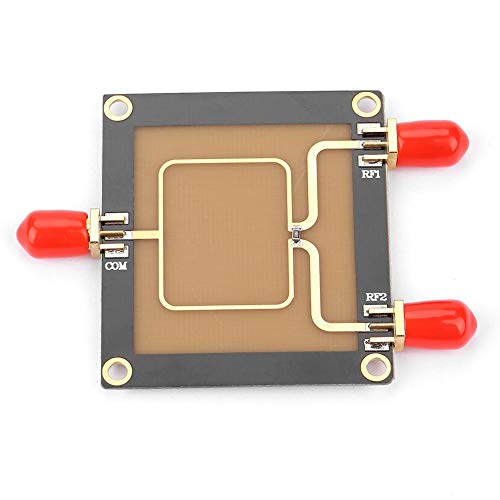
This Hyuduo 2-Way Coaxial Splitter covers 100–2700 MHz, offering low-loss performance and a 50 Ω system impedance. It is designed for industrial equipment and RF distribution tasks where stable signal splitting is critical. The device emphasizes good isolation between the two output ports to prevent inter-channel interference and preserve signal quality for each branch.
The splitter is built with attention to robust material quality, enabling reliable operation in diverse environments. It suits applications ranging from CCTV and broadband distribution to signal testing in professional settings, where dependable two-way splitting is required without notable degradation.
2-Pack N Male To N Female RF Adapters (XRDS)

The XRDS adapters convert N male connectors to two N female connectors, enabling convenient RF signal distribution in antenna systems. Nickel-plated brass construction ensures durability and corrosion resistance, supporting reliable signal transmission in various environments. While not a pure splitter, these adapters facilitate practical 3-way distribution in conjunction with other splitting components.
Ideal for antenna systems, boosters, and Wi-Fi distribution scenarios, these adapters provide a straightforward way to expand RF distribution options without introducing substantial loss or complexity. They are commonly used in conjunction with larger RF splitters or in proof-of-concept setups where quick reconfiguration is needed.
TOJOIN Passive Power Splitter (UU TOJOIN)

The TOJOIN passive power splitter divides a larger signal into two outputs with a typical plug loss of 3.4 dB and a maximum of 3.7 dB. It uses 2-way SMA female connectors and supports 0.005–1 GHz RF/microwave measurements accessories. While not a TV-specific splitter, this device is suitable for RF measurement and antenna testing work where minimal loss is important and quick setup is needed.
Buying Guide
- Frequency range: Match the splitter to your system’s frequency bands. Wider ranges support more devices but may come with trade-offs in isolation or size.
- Insertion loss and isolation: Low insertion loss helps preserve signal strength; high isolation reduces crosstalk between outputs. Consider your tolerance for attenuation per branch.
- Impedance: Most RF systems use 50 Ω. Ensure the splitter’s impedance aligns with your equipment to avoid reflections and inefficiency.
- Connectors and form factor: SMA and N-type connectors suit different setups. Choose a model with the right connectors for your cables and hardware, and consider mounting space.
- Power handling: Some units specify maximum input power. Ensure the splitter supports your signal levels without overheating or performance loss.
- Environment and durability: For outdoor or industrial use, rugged housings and weather resistance matter. Look for durable construction and secure connectors.
- Usage scenario: For multi-band amateur or lab use, consider duplexers or active isolators if you need high isolation and multi-channel stability.
- Compatibility: If combining adapters and splitters, verify that connectors and impedance align to prevent mismatches and loss.