When choosing a 24V LiFePO4 battery, reliability, lifespan, and safety are top priorities for RVs, trolling motors, boats, and solar setups. This guide highlights five highly rated options that balance energy density, cycle life, and protection features. Each product is suitable for expanding power availability in off-grid living, recreational vehicles, and marine applications.
Below is a quick comparison table of the selected models to help you compare at a glance. All entries are 24V LiFePO4 with built-in BMS for safety and performance.
| Product | Brand | Capacity | Key Feature |
|---|---|---|---|
| Litime 24V 100Ah LiFePO4 Battery | Litime | 100Ah / 2.56kWh | Expandable to 48V 400Ah with 4P2S configuration; long life |
| XZNY Compact 24V 100Ah LiFePO4 Battery | XZNY | 100Ah / 2.4kWh | Low-temperature protection; compact design |
| Cymoye 24V 100Ah LiFePO4 Battery | Cymoye | 100Ah / 2.56kWh | Small size; high energy density; expandable to 20.48kWh |
| Talentcell 24V 6Ah LiFePO4 Battery Pack | Talentcell | 6Ah / 153.6Wh | Compact 24V pack with included charger |
| DUMFUME 24V 100Ah LiFePO4 Battery (2-Pack) | Dumfume | 100Ah per pack / 2.56kWh each | Two-pack option with 100A BMS; high cycle life |
Litime 24V 100Ah LiFePO4 Battery
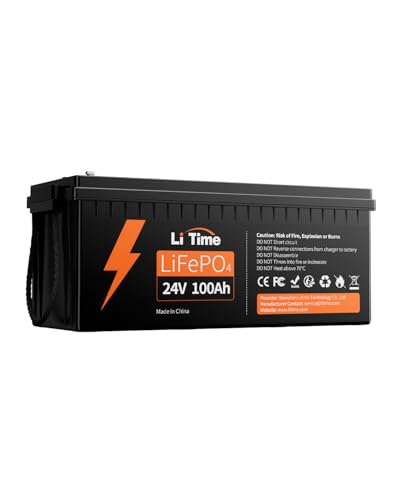
The Litime 24V 100Ah LiFePO4 battery delivers 2.56kWh of energy and supports 4P2S expansion for larger systems up to 48V and 400Ah (20.48kWh). Designed for trolling motors, marine setups, RVs, and off-grid solar, the unit uses EV-grade cells to extend life beyond 4000 cycles at 100% depth of discharge. A built-in 100A BMS provides protection against overcharge, over-discharge, overheating, and short circuits, ensuring safe operation across varied temperatures and conditions. This model emphasizes long-term cost savings through high cycle life and retained charge.
XZNY Compact 24V 100Ah LiFePO4 Battery

The XZNY 24V 100Ah LiFePO4 battery emphasizes low-temperature protection with a built-in 100A BMS that protects against charging and discharging extremes. Its compact design reduces size by roughly one-third compared with standard 24V batteries, while maintaining full 100Ah capacity. The product also offers warranty support beyond three years, providing ongoing post-purchase assistance. This makes it a strong option for cold-weather boating or camping setups where space is at a premium and safety is paramount.
Cymoye 24V 100Ah LiFePO4 Battery

The Cymoye 24V 100Ah LiFePO4 battery offers a compact form factor (approximately 13.38 x 7.48 x 9.84 inches) with a weight around 42 pounds, making it the smallest option among its peers. It employs an automotive-grade LiFePO4 core and a 100A BMS to protect against overcharge, over-discharge, over-current, short circuits, and high temperatures. The battery supports expansion to a maximum energy of 20.48kWh with up to 4P2S configuration. A practical choice for portable power and small to mid-size off-grid systems, especially where space and weight are critical.
Talentcell 24V 6Ah LiFePO4 Battery Pack LF8011

The Talentcell LF8011 pack provides a 24V LiFePO4 solution with 6Ah capacity (153.6Wh) and a built-in charger. It is designed for trolling motors, RVs, and camping applications, offering a compact form factor and a 29.2V–18V nominal output. The product emphasizes practicality and ease of use, with a straightforward charging pathway and compatibility with standard 24V systems. The included charger supports quick charging within a reasonable timeframe for smaller power needs.
DUMFUME 24V 100Ah LiFePO4 Battery (2-Pack)

The Dumfume two-pack provides two 24V 100Ah LiFePO4 batteries with a total energy of 5.12kWh. Each battery features a 100A BMS for protection against overcharge, over-discharge, over-current, short circuits, and high/low temperatures. The two-pack configuration is suitable for larger off-grid systems, RVs with higher power demands, and backup power applications. The batteries are designed for stable performance across a wide temperature range and are optimized for long-term use in demanding environments.
Buying Guide: Key Considerations For 24V LiFePO4 Batteries
Choosing the right 24V LiFePO4 battery involves evaluating system needs, space, and safety considerations. Here are essential factors to weigh when selecting a model for RVs, marine use, or off-grid installations.
- Capacity and energy density: Higher Ah ratings provide longer runtime, but also consider space and weight. If you plan to scale up, look for expandable configurations such as 4P2S options that can reach 48V and larger capacities.
- Cycle life and depth of discharge: LiFePO4 chemistries typically offer thousands of cycles at high DOD. A longer cycle life translates to lower replacement frequency and lower long-term cost.
- BMS protections: A robust Battery Management System should guard against overcharge, over-discharge, over-current, short circuits, and temperature extremes. Some BMS units include low-temperature cutoffs for charging and high-temperature protection to safeguard performance.
- Temperature performance: Cold-weather scenarios demand BMS and chemistry that tolerate low temperatures. Look for products with built-in low-temperature protection and high-temperature limits to avoid degradation.
- Size, weight, and space: Compact designs save space in RVs or boats, but confirm mounting compatibility and cable routing. Weighing options against available space helps ensure installation feasibility.
- Expandability and system integration: If you plan a larger solar or storage system, prefer batteries that allow parallel or series expansion with clear guidance on correct wiring to avoid balancing issues.
- Warranty and service: A reliable support policy and warranty duration can be valuable for addressing manufacturing defects and post-purchase questions.
- Charger compatibility: Ensure the included charger or your existing charging equipment is compatible with LiFePO4 chemistry and the target voltage (24V or higher for expandable systems).
When evaluating options, consider the total energy needs of your devices, including peak power draw and daily usage. For marine and RV applications, a balance between energy storage and lightweight design often yields the best practical results. For off-grid solar, prioritize expandability and cycle life to maximize long-term resilience. Safety features, warranty coverage, and support quality should guide your final choice as much as immediate price or capacity.